Subscribe now for full access and no adverts

The Honours of Scotland recently underwent the most significant conservation in their centuries-long history, helping preserve them for generations to come. The Crown, Sceptre, and Sword of State represent the oldest crown jewels in Britain and are among the oldest in Europe: they were first used together at the coronation of Mary, Queen of Scots, in 1543, although the Crown had already been worn by her predecessor, James V.
To conserve these delicate artefacts, experts from Historic Environment Scotland (HES) had to clean each item carefully under a microscope – removing years of tarnish, dust, and grease – in order to monitor any potential changes in their condition. This allowed the team to appreciate some of the finer details of the Honours for the first time, including the figures of saints engraved on the blade of the Sword, as well as the beautiful floral motifs that had been incorporated both into its scabbard and into the Sceptre.
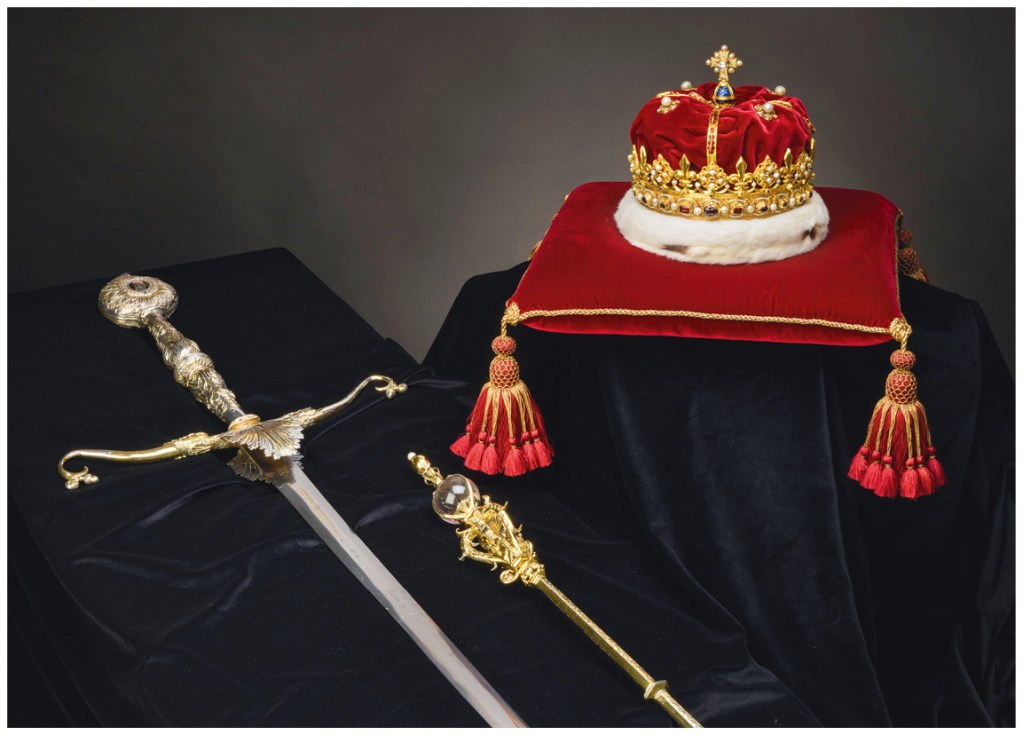
HES used the opportunity to conduct a range of scientific analyses, including X-radiography and portable X-ray fluorescence, and used an optical microscope, in order to learn more about how the Honours were made and repaired over their lifetimes. This revealed that several gems in the Crown had been affixed with different kinds of pins over time. It is hoped that X-radiography will be able to identify what each of these pins are made of, which could help identify when individual repairs took place.
Now that conservation is complete, the Honours are back on display at Edinburgh Castle; see http://www.edinburghcastle.scot/see-and-do/highlights/honours-of-scotland for details.
Text: K Krakowka / Images: Historic Environment Scotland