The warlord, the prince, and the village people: Examining three early Anglo-Saxon burial sites from Buckinghamshire

A new exhibition at Discover Bucks Museum in Aylesbury draws together antiquarian excavations and very recent finds to illuminate life and death at different levels of early medieval society. Carly Hilts visited the displays and spoke to their curator Brett Thorn.
Start
This article is from Current Archaeology issue 435


Subscribe now for full access and no adverts

You can’t take it with you’ is a phrase that early Anglo-Saxons would have surely regarded with some bemusement. Their graves were often equipped with practical and personal items to accompany the deceased into their next life. At their simplest, these carefully curated collections might comprise a single pot, a knife, a brooch or two, a handful of beads – but, at the other end of the scale, ‘princely’ displays like those from Sutton Hoo, Taplow, and Prittlewell (see CA 190 and 352) represent potent statements of identity, influence, and access to exotic materials from a time of great population movement and cultural change. Grave goods also give us vital clues about the people who lived in the centuries immediately after the collapse of Roman administration in Britain. Finely worked artefacts defy ‘Dark Age’ stereotypes of this period, speaking of skill, sophistication, and far-reaching trade links that had not been severed by the end of imperial rule. Without written sources to preserve the voices of those who inhabited this transitional time, the objects that they were buried with hint at the experiences and interests of long-vanished communities: how they lived, how they expressed their identities, what they believed, and what was important to them.
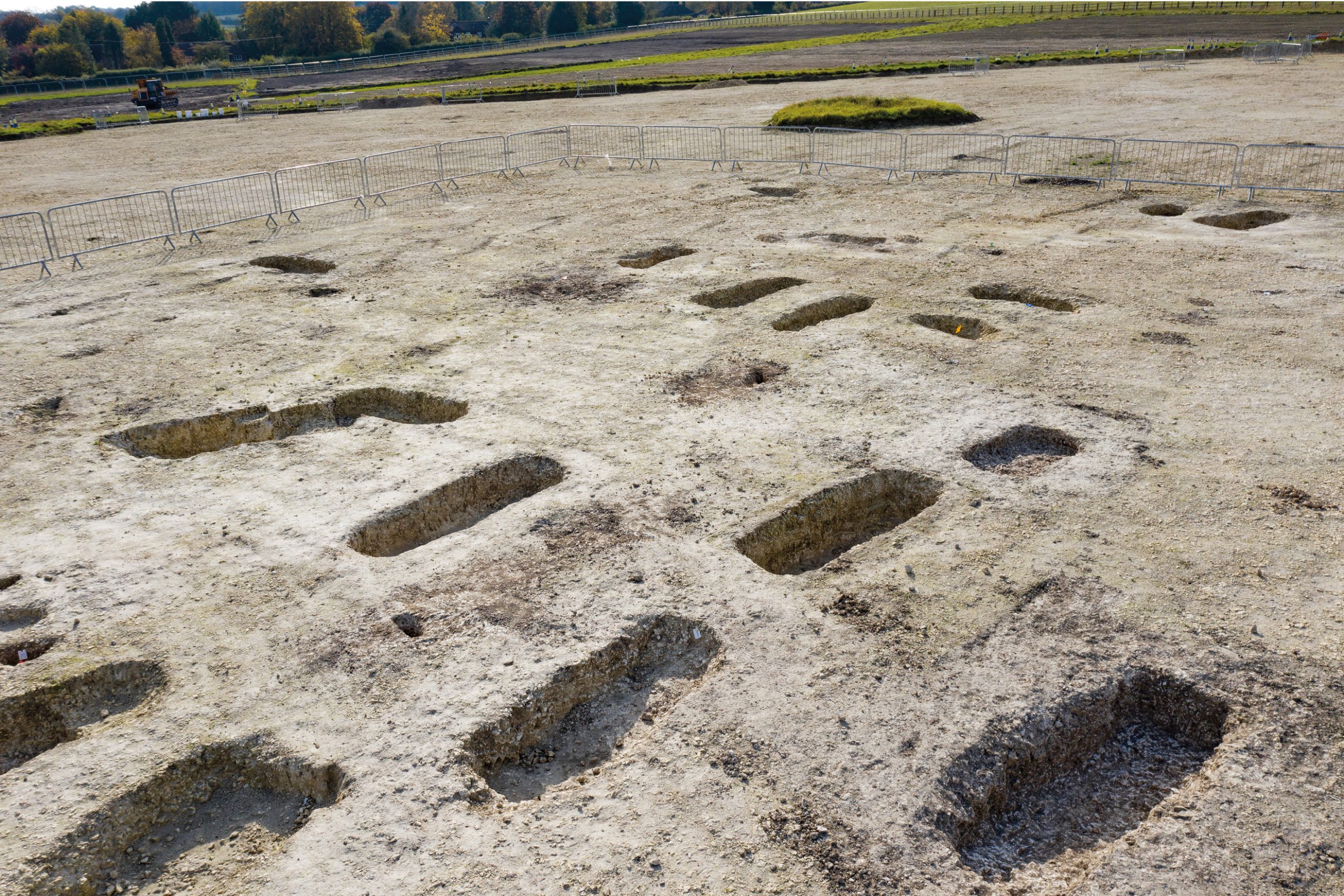
Wendover’s Anglo-Saxon cemetery. Photo: HS2

Some of these illuminating insights form the focus of a new exhibition running at Discover Bucks Museum in Aylesbury. The SAXONS draws together evidence from three Buckinghamshire burial sites, all dating to the 6th and early 7th centuries, to explore what antiquarian finds and recent discoveries can tell us about different groups within early medieval society.

The Marlow ‘warlord’

The first individual encountered by visitors to the exhibition had been laid to rest in a solitary grave on a hilltop overlooking the River Thames near Marlow. His burial was first discovered by Sue Washington, a member of the Maidenhead Search Society metal-detecting club, in 2018 (CA 369). Crucially, after uncovering two bronze bowls and realising the significance of her find, Sue immediately stopped digging and contacted the Portable Antiquities Scheme. This decision preserved a wealth of contextual information within the grave, which could then be investigated through a targeted excavation by the Local Finds Liaison Officer Arwen Wood, followed by a fuller phase of fieldwork (including geophysical surveys of the surrounding area) in 2020, led by Dr Gabor Thomas of the University of Reading. In the years that followed, a successful crowdfunding campaign supported expert conservation of the grave goods by Drakon Heritage, and scientific analysis of the objects and the remains of the man that they had accompanied by the University of Reading. The results of this research are presented in The SAXONS, alongside the artefacts themselves, which have been donated to Discover Bucks by the landowner.
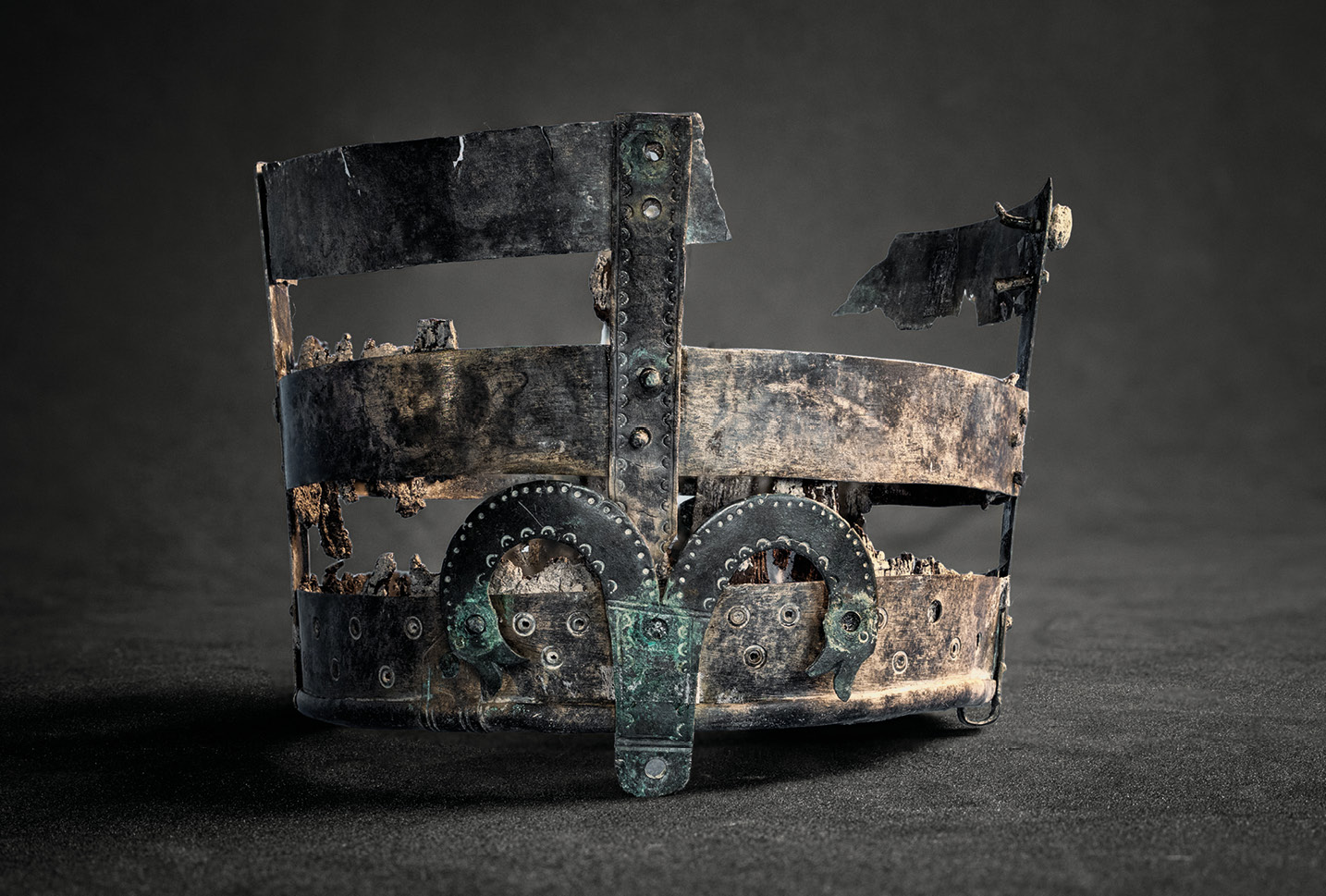
This ornate object, photographed inverted, is a situla, or small drinking bucket, associated with feasting. It was found at Wendover. Unusually, some of its wood survives. Photo: Discover Bucks Museum

The isolated grave’s occupant was a man of around 40 years old; he was robustly built and tall even by modern standards at 6ft 4in (1.93m). This imposing figure had been provided with useful tools including a small iron knife and a firesteel (used with flints to make sparks), as well as copper-alloy tweezers and iron shears associated with personal grooming. There were also signs of his social status in the form of the bronze bowls that had first betrayed his presence – a smaller vessel, perhaps used for washing, and a larger, cauldron-like container, both of which were possibly made in what today is France or Germany – along with an elegant glass cone beaker.
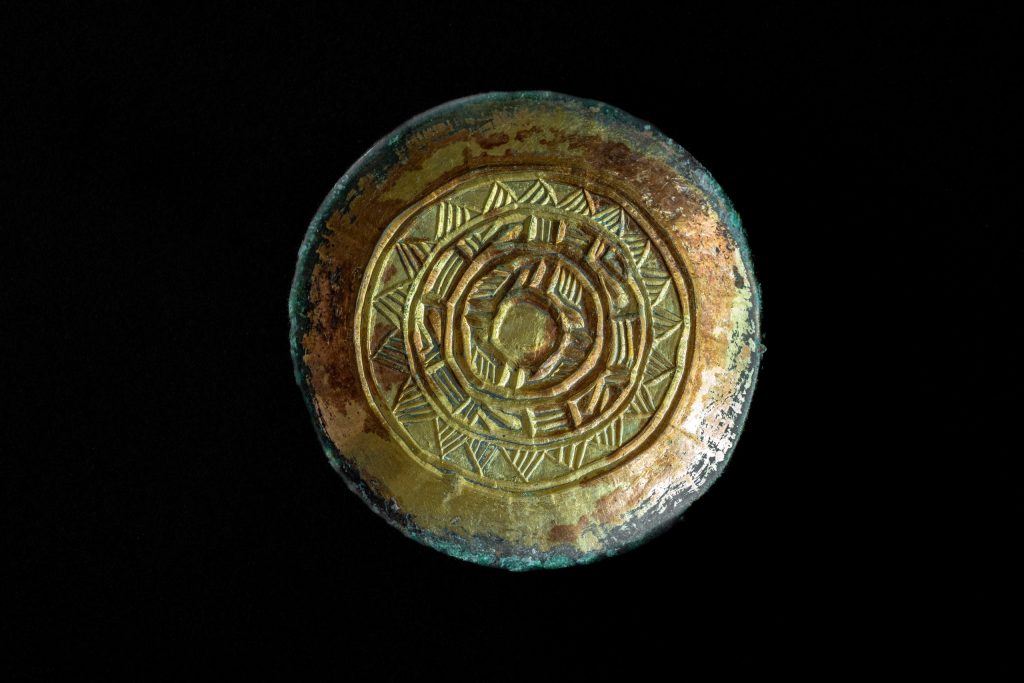
A gilded bronze saucer brooch from Wendover. Photo: Discover Bucks Museum

Perhaps the most telling clue, however, was the weaponry that had accompanied the Marlow man to the grave. Spears are not uncommon finds in male burials of this period, and the Marlow burial produced two: one with a small head that suggests it was designed for throwing, and a larger one that had a butt spike so that it could be set firmly in the ground to face a charging foe. Much more unusual, however, was the exceptionally well-preserved sword. Swords were expensive, requiring much more work to create than spearheads, and the presence of such a weapon in the Marlow man’s grave suggests that he was an important individual. X-ray imaging of its 85cm-long (33.5in) blade has revealed its complex pattern-welded construction, while researchers have identified traces of horn surviving on the sword’s grip, as well as evidence of a leather-and-wood scabbard.
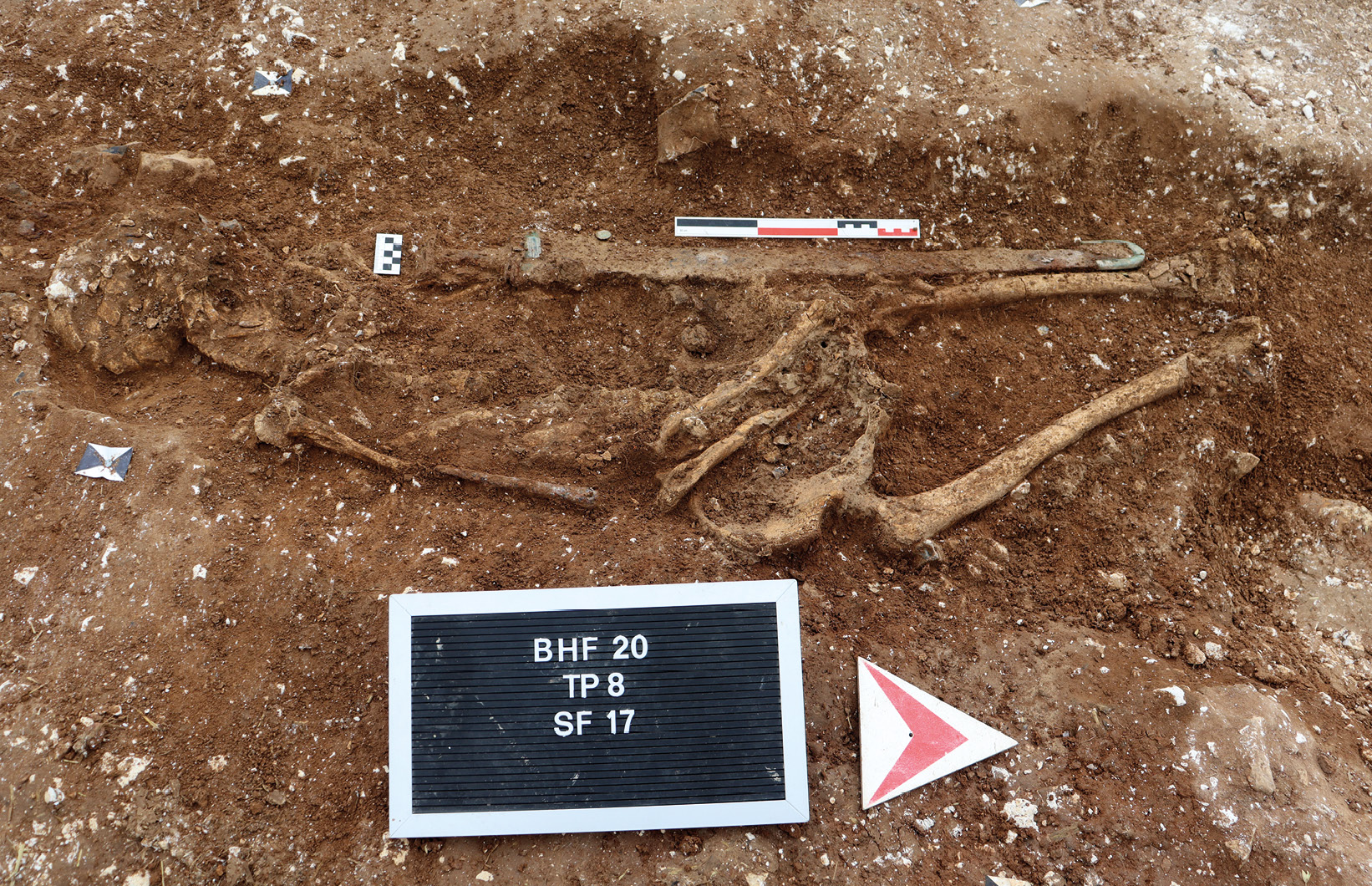
 The grave of the Marlow ‘warlord’. Photo: University of Reading

In the exhibition, the sword is shown alongside a replica created by specialist bladesmith Rod Hughes, and the artistry of its appearance highlights what an impressive sight, and clear signal of its owner’s authority, such objects would have been. There are further clues to be gleaned from its design: the displays feature research by Matt Bunker, an expert in Anglo-Saxon swords and a member of the Wulfheodenas living history group, who highlights that the weapon’s iron guard-plates and U-shaped scabbard chape are unusual features for British finds. Instead, Matt suggests that the sword could have been made in Denmark – and, intriguingly, aDNA analysis of the Marlow man himself has revealed that he was a first- or second-generation immigrant from Scandinavia or northern Europe.

This combination of weaponry and equipment associated with eating and drinking testifies to the man’s place within society. He lived in a culture that celebrated both martial success and social generosity in their leaders, who were expected not only to keep their people safe, but to stage feasts to reward and reinforce the loyalty of their retinue. For this reason, the Marlow individual has been interpreted as a local leader or warlord. His presence in the lower Thames Valley – long seen as something of a marginal backwater during this period, located on the fringes of lands that would later develop into the kingdoms of Wessex, Kent, and Mercia – raises thought-provoking suggestions that this area might once have been important in its own right, before its people were squeezed out, or absorbed, by their more powerful neighbours. Perhaps this tension might explain why the ‘warlord’ was buried not in a cemetery, but on high ground overlooking the river, standing guard over what may have been a key territorial border and continuing to protect his people even in death.

The Marlow grave goods included two bronze bowls and two spearheads. Photo: University of Reading

The Taplow ‘prince’

While the Marlow ‘warlord’ may have been an important figure within his community, the next individual featured in The SAXONS was on another social level entirely. Some 1,400 years ago – again on high ground commanding sweeping views over the Thames Valley – a towering burial mound rose against the sky. It would have been an unmissable landmark, and even today the still-imposing monument gives its name to the village in which it stands: Taplow, from Tæppas hlæw, ‘Tæppa’s barrow’. At its heart, a timber-lined burial chamber was packed with everything that its elite occupant (who is presumed to be male based on his grave goods) could desire in order to enter the afterlife in the style to which he had become accustomed. Weaponry including a sword, spears, and shields nestled alongside equipment for rather more lavish feasts than those that the Marlow ‘warlord’ might have hosted. As well as a set of green-glass claw beakers, the Taplow ‘prince’ had been provided with an iron cauldron, an ornate ‘Coptic’ bowl rising from an elegant pedestal to a scalloped rim, and large drinking horns decorated with silver and gilt mounts. As for after-dinner entertainment, a lyre adorned with gilded birds’ head ornaments and a collection of intricately crafted bone gaming pieces were conveniently on hand.

The exceptionally well-preserved sword found within the Marlow grave. Photo: Discover Bucks Museum 

Discovered in the late 19th century, the Taplow mound remained the richest Anglo-Saxon interment known in England until the excavation of the Sutton Hoo ship burial in 1939. The story of its investigation is rather less auspicious than that of its Suffolk counterpart, however. When James Rutland – Honorary Secretary of the Buckinghamshire Architectural and Archaeological Society – set out to explore the barrow’s contents in 1883, his methods left much to be desired by modern standards. He tunnelled into the mound from several directions, with predictable consequences: the undermined barrow collapsed in on itself, together with the remains of a yew tree that had once grown on its summit – injuring Rutland, delaying the project for several days, and crushing the burial chamber. While the grave’s layout and many of its contents were irreparably damaged, though, illuminating details can still be discerned.

The artefacts were donated to the British Museum soon after their discovery, and some have been loaned to the exhibition. Beside the Coptic bowl, the drinking horn mounts are shown on a replica of the long-decayed vessel that they had once decorated. Analysis of their motifs has revealed two different designs that are stylistically 50-60 years apart. Might their combination on a single object represent an example of early medieval recycling, an owner with rather ‘retro’ tastes, or the incorporation of an heirloom into a new object?

Another ornament with a tale to tell is the great gold-and-garnet buckle that was just one of the elaborate items adorning the body of the ‘prince’ himself. Its ostentatious size and intricate design – with each gem carefully shaped and mounted, cloisonné-style, within a loop of gold wire, set over tiny pieces of silver foil to enhance their sparkle – are impressive in their own right, but the artefact also preserves subtle clues about its owner’s political allegiances. Its style is more typical of Kent than the Thames Valley, perhaps suggesting that it was worn by a sub-king or ally of this powerful territory who was keen to signal his alignment.

The great gold belt buckle from Taplow’s ‘princely’ burial. Photo: © Trustees of the British Museum 

The people of Wendover

The third site highlighted in the exhibition is not the grave of a single high-ranking man, but an extensive community cemetery – one of the largest of its date yet found – with 141 burials containing the remains of men, women, and children. It is also the most recent discovery to feature in The SAXONS, having been uncovered in 2020 during archaeological investigations ahead of HS2 construction works at Wendover. The immediacy of this find is brought home by the fact that some of the artefacts on display have not yet been fully cleaned, as they are yet to undergo post-excavation analysis and may preserve traces of textile or environmental evidence within the soil that still clings to them. They have been loaned by HS2 for the duration of the exhibition, and will then return for research to continue.

A reconstruction of a large drinking horn, with its gilded mounts, which accompanied the Taplow prince. Photo: © Trustees of the British Museum 

The Wendover cemetery – which was excavated by archaeologists from INFRA JV – contained both inhumations and a small number of cremations, and their associated artefacts provide a detailed snapshot of a community of moderate means. Almost three quarters of the graves yielded high-quality grave goods (stylistically dated to the 5th and 6th centuries), many of them speaking of cultural and commercial connections stretching across southern England and continental Europe, though analysis of the skeletons that these objects accompanied adds nuance to the picture. Almost half of the excavated individuals preserved evidence of joint or back problems, testifying to lives of hard, physical work, while a quarter showed signs of malnutrition. This was a well-connected settlement, some of whose inhabitants wielded social influence and purchasing power, but that is not to suggest that their lives were easy.

 Dating to the Roman period but found in an early Anglo-Saxon grave at Wendover, this green-glass bowl may have been a cherished heirloom. Photo: HS2 

Among the Wendover grave goods, brooches were particularly common finds: usually arranged in pairs, they include a diverse range of styles, and many were made of bronze with silver or gold plating, imitating more expensive ornaments. Other personal touches included colourful beads, some of which highlight the reach and relative prosperity of this group: one young woman had over 100 beads strung between her two brooches, made from bronze, amber that was possibly imported from Scandinavia, and glass from continental Europe. Among her other possessions was a silver finger-ring in the form of a coiled snake, and a more unusual object: a tiny bronze cosmetics tube, complete with a miniature spoon for applying its contents. She was not alone in having taken pride in her appearance: other burials produced ear scoops, toothpicks, tweezers, and combs. Meanwhile, a Roman bowl made from pale green glass, recovered from another grave, may have been a treasured antique or heirloom, already centuries old when it entered the ground.

Just as weaponry was a consistent theme at Taplow and Marlow, many of the male burials at Wendover included armaments – though on a more conventional scale, limited to spearheads of various sizes and shield bosses. Only one individual could be clearly said to have met a violent end, however: a young man aged 17-25 who had an iron spearpoint still embedded in his spine. More peaceful activities were also reflected among the artefacts, with an unusually well-preserved wooden situla (a large tankard or drinking bucket for ale or mead) and glass cone beakers (imported from Kent or northern France, they were possibly used to drink wine) speaking of communal gatherings.

 A bronze cosmetics tube and applicator spoon from Wendover. Photo: Discover Bucks Museum

Pottery was present, too, and not only in the form of vessels used for cooking or drinking. Alongside the inhumations, Wendover’s cemetery produced a handful of cremation burials, some of which were contained in strikingly unusual urns. Two are beautifully detailed examples of the Buckelurne style, with three horns protruding from their decorated exteriors, and one of these is so similar to another example from Canterbury that it may have been made by the same potter. There are also two enigmatic ‘window urns’ with pieces of recycled Roman glass set into their bases. This would not have been easy to achieve, suggesting that such designs held a special but long-forgotten significance.

Just as the Wendover cemetery represents multiple levels and groups, The SAXONS aims to provide different levels of information that are accessible to all ages and all degrees of interest and expertise. Wall-mounted boards contain in-depth archaeological information and details of recent research, while film clips offer a more visual representation of the past. Visitors can choose to explore particular themes in more detail, and test their knowledge with quizzes, via interactive touchscreens featuring imagery developed in collaboration with Ubisoft, drawing on their computer game Assassin’s Creed Valhalla.

Above & below: Unusual funerary finds from Wendover: a horned cremation urn (Buckelurne) and a ‘window urn’ set with a large piece of Roman glass. Photos: Discover Bucks Museum/HS2 

Perhaps the most imaginative parts of the displays, however, are the areas where the graves featured in the exhibition are recreated in three dimensions, showing the Marlow ‘warlord’, the Taplow ‘prince’, and a representative man and woman from Wendover laid out as if for burial with replicas of their grave goods. Each of these is accompanied by a digital avatar (portrayed by re-enactors from the Wulfheodenas) who tell stories about the deceased, deducing details of their lives, interests, and personalities from the excavated evidence. Representing a member of the retinue of the ‘warlord’, a high-ranking woman with an unspecified personal relationship with the ‘prince’, and a female village elder, these not only offer a useful opportunity to add more female voices to a story that is otherwise two-thirds dominated by elite men, they also help to humanise themes that could otherwise feel abstractly remote.

While listening to the Marlow retainer speaking about his lord’s ancestry, impressive appearance, and ability to protect his people, or hearing the Taplow woman describe her associate’s diplomatic skill, it struck me that these narratives fit well with the early medieval tradition of praise poetry in northern Europe, or the Old English elegies preserved in the 10th-century Exeter Book. While the technology used to bring these stories to life in the exhibition would have seemed utterly supernatural to Anglo-Saxon observers, I like to think that the featured individuals would be rather pleased to be described in this way.


Brett Thorn is Keeper of Archaeology at Discover Bucks Museum in Aylesbury. After graduating from Exeter in 1995, he initially worked as a field archaeologist and surveyor, but moved into museum archaeology in 2000. Brett is a Romanist at heart, but Discover Bucks’ acquisition of the late Saxon Lenborough Hoard and the Marlow ‘warlord’ burial have led his recent interests in an early medieval direction.

Further information: The SAXONS is at Discover Bucks Museum, Aylesbury, until 1 November 2026. Entry to the exhibition is included in admission to the museum (tickets from £7.20, with concessions and group rates available). For more details, see http://www.discoverbucksmuseum.org/whats-on/the-saxons-an-immersive-exhibition-in-buckinghamshire.

By Country

Popular
UKItalyGreeceEgyptTurkeyFrance

Africa
BotswanaEgyptEthiopiaGhanaKenyaLibyaMadagascarMaliMoroccoNamibiaSomaliaSouth AfricaSudanTanzaniaTunisiaZimbabwe

Asia
IranIraqIsraelJapanJavaJordanKazakhstanKodiak IslandKoreaKyrgyzstan
LaosLebanonMalaysiaMongoliaOmanPakistanQatarRussiaPapua New GuineaSaudi ArabiaSingaporeSouth KoreaSumatraSyriaThailandTurkmenistanUAEUzbekistanVanuatuVietnamYemen

Australasia
AustraliaFijiMicronesiaPolynesiaTasmania

Europe
AlbaniaAndorraAustriaBulgariaCroatiaCyprusCzech RepublicDenmarkEnglandEstoniaFinlandFranceGermanyGibraltarGreeceHollandHungaryIcelandIrelandItalyMaltaNorwayPolandPortugalRomaniaScotlandSerbiaSlovakiaSloveniaSpainSwedenSwitzerlandTurkeySicilyUK

South America
ArgentinaBelizeBrazilChileColombiaEaster IslandMexicoPeru

North America
CanadaCaribbeanCarriacouDominican RepublicGreenlandGuatemalaHondurasUSA

Discover more from The Past

Subscribe now to keep reading and get access to the full archive.

Continue reading