Subscribe now for full access and no adverts
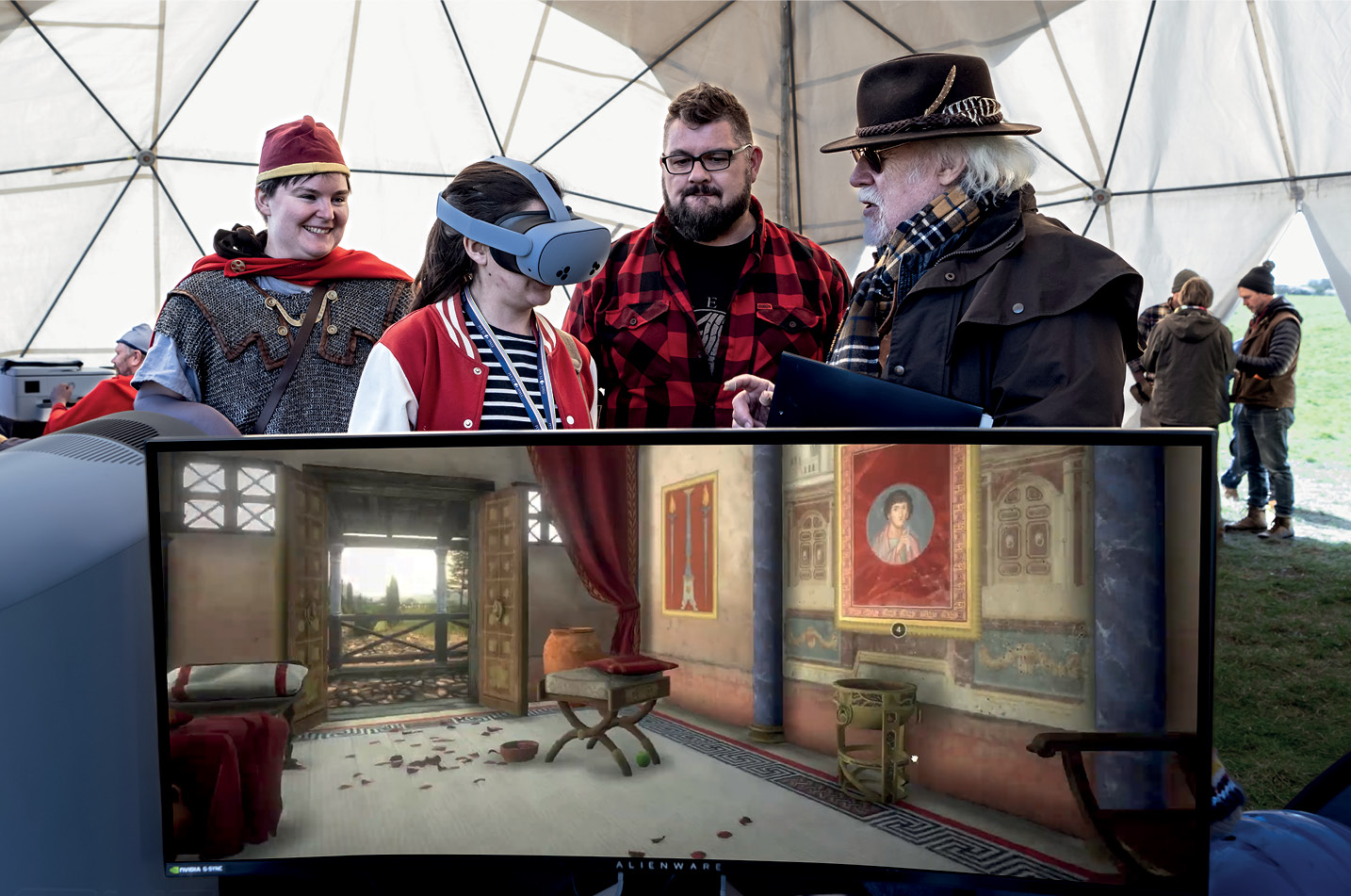
‘Tell me what you can see.’ As I tentatively turned around, VR goggles securely strapped to my face and a controller grasped in each hand, I found that I was no longer standing in a Norfolk field. Before me lay a vibrantly colourful, elegantly furnished room within a Roman villa, beyond which I could see a shrine and a tranquil garden – a vivid virtual reconstruction based on excavated evidence mainly uncovered over the long history of Time Team. The voice directing my gaze belonged to Tim Taylor, the show’s creator and Executive Producer, and I had come to visit the Team during one of their famous three-day excavations. I am sworn to secrecy as to what they found (though watch this space for a fuller update once the episode airs!), but I can disclose that our meeting took place at Brancaster Roman Fort (Branodunum) on the north Norfolk Coast.
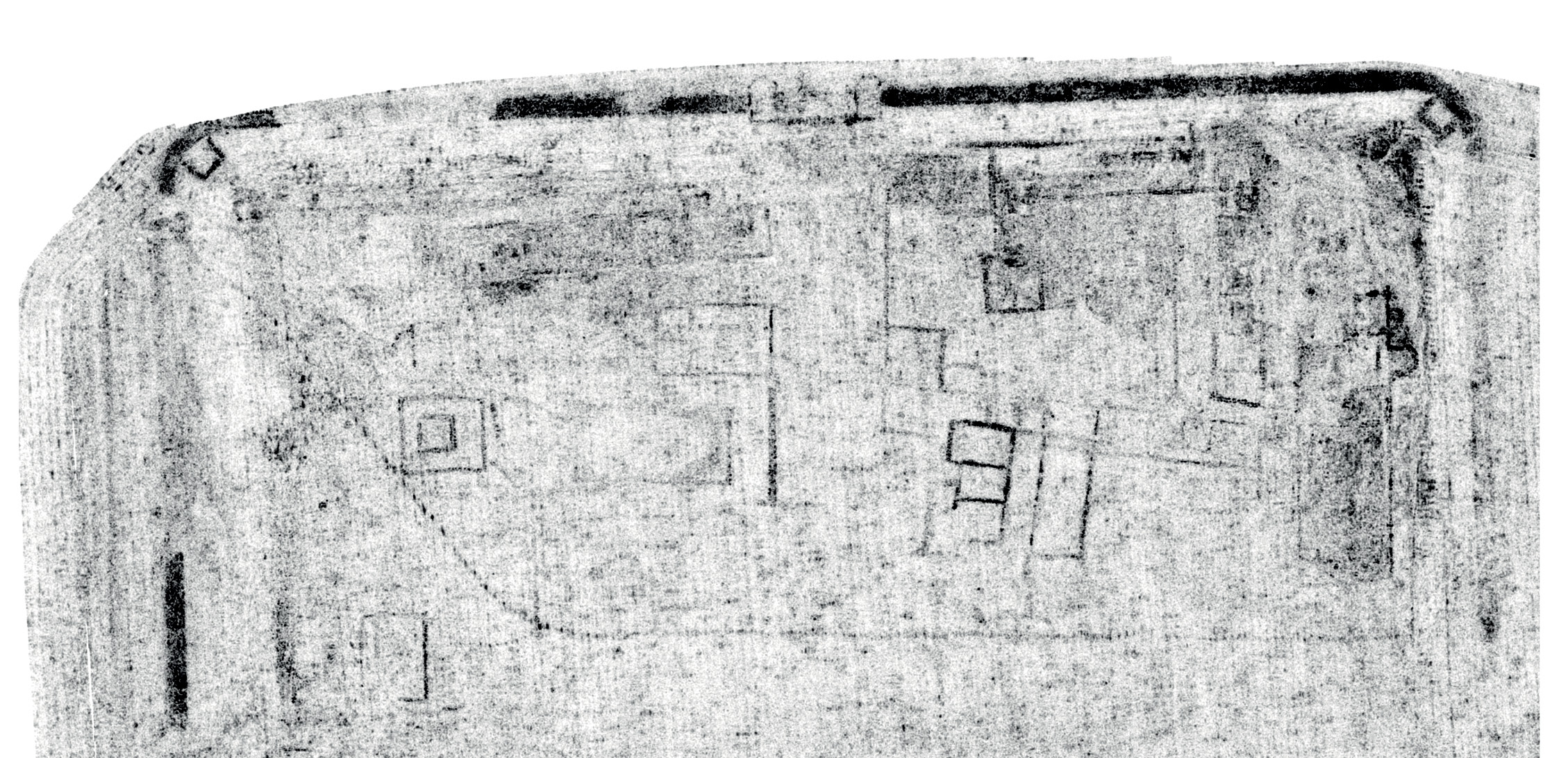
The show had visited this site before, beginning in 2012 when geophysical surveys overseen by Time Team ‘geofizz’ expert John Gater produced exceptionally clear images of the fort’s underlying archaeology, and that of its civilian settlement (see CA 276). They returned last September to carry out another survey using now much-more-advanced technology, and this work (which is available as an episode called ‘Brancaster Geofizz Challenge’ on the Time Team Official YouTube channel, http://www.youtube.com/TimeTeamOfficial) also produced remarkable results. Fast forward to March of this year, and the Team were back on site to explore some of these findings in more detail with a targeted excavation. I will save the rest for a future feature, but it gave me the perfect excuse to speak to Tim and the Team as they celebrated five years since the programme’s return.

Time Team reborn
From its first episode in 1994, Time Team rapidly rose to become an archaeological icon – and the longest-running archaeology/history programme in TV history, investigating hundreds of sites over the course of 20 series. Channel 4 cancelled the programme in 2012, and its final series aired in 2013 (CA 274), but its popularity endured. The fact that viewing figures for the Time Team Classics YouTube channel spiked significantly during the first COVID-19 lockdown highlights how comforting many found its familiar faces and community atmosphere – and in 2021 the show was reborn online, its return crowdfunded by thousands of enthusiastic fans (CA 375). This was achieved via Patreon, a funding platform where supporters pledge monthly donations in exchange for early access to or extra content, and other benefits. Time Team’s Patreon membership currently has three differently priced tiers, offering various rewards, including access to exclusive videos, ad-free podcast content, and 3D digital models of finds; Q&As with the team and ‘behind the scenes’ insights; the chance to join the team on a live dig; online archaeological masterclasses; and the ability to vote in polls of future excavation sites (see ‘Further information’ below). The success of this approach, and the steadfast support of Time Team’s fans, is demonstrated by the fact that, five years later, the programme is still thriving.
‘When the show was axed, it put me in the position of finding a new way to do Time Team,’ Tim said. ‘Instead of going to London to ask for money from a broadcaster, we turned to our fans – and this opened up a relationship with them that is closer than ever before. We have online sessions where we talk with people at all levels of Patreon and ask what they would like us to focus on. It’s much more flexible than when we were on TV, and you feel like you’re part of a club.’
It is a club whose numbers are steadily growing: today Time Team has more than 11,600 supporters on Patreon, and each of its two YouTube channels have over 300,000 subscribers, with viewers tuning in from some 132 countries. Since its relaunch, the Team have excavated at world-famous sites like Sutton Hoo, but they also still carry out the community-focused back-garden digs for which they are best known, and were much loved by the much-missed Mick Aston, whom Tim credits as archaeological inspiration for Time Team. Many of the programme’s original members, including Carenza Lewis, Helen Geake, Stewart Ainsworth, and John Gater, are still involved, and Wessex Archaeology continues to play an integral role in the excavations. The relaunched Time Team also works closely with the National Trust, as well as with Operation Nightingale, the MOD initiative using fieldwork to boost the wellbeing of wounded service personnel and military veterans.

‘When we ask fans which episodes they prefer, they always say the same thing – it’s when we go to a small village or town and tell the community’s story and answer their questions,’ Tim said. ‘They don’t want us to be searching for the Holy Grail or some extraordinary artefact – it’s about the journey, the adventure, and the relationships within the Team. We all know what we get from excavating: the pleasure, the focus, and the wellbeing of scraping away at mud and soil, finding artefacts, and answering questions – and our work with Operation Nightingale highlights the importance of archaeology for people, too.’
Today Time Team has more than 11,600 supporters on Patreon, and each of its two YouTube channels have over 300,000 subscribers… in some 132 countries.
Virtual archaeology
While internet innovations offered a way for Time Team to return outside television, its members are beginning to explore ways, too, in which digital technology can help to bring the past to life in a more immersive way, including through augmented and virtual reality. ‘A question I always ask myself is: how near can we get people to the experience of excavation, and to what the past was actually like? I am interested in how technology can help bring home the immediacy of archaeology,’ Tim said.
These technologies are rapidly evolving, and while the Team are still working towards being able to put people in a virtual trench, or letting them wander through a fully reconstructed building, during my visit Tim was keen to show me how they have been using QR codes to conjure digital renderings of artefacts and archaeological remains on the screen of a smartphone. While out on site, I was able to view part of the fort’s defences recreated in augmented reality by scanning a QR code and holding up my phone to see their masonry standing intact once more. Tim hopes that in subsequent excavations they will be able to place QR codes around the sites and villages that Time Team visits, granting access to reconstructions of features and finds, alongside photographs and other information from the investigations.

Other QR codes summoned 3D models of artefacts, among them the Bromeswell Bucket from Sutton Hoo: an early 6th-century copper-alloy vessel that was originally found in 1986, with further pieces recovered during Time Team’s more recent excavation on the site (CA 414 and 425). After scanning the code, the ornate object appeared on my phone screen and I was able to ‘place’ it on the real-life table in front of me and examine its imagery. If you have a smartphone and would like to try this for yourself, use its camera to scan the QR code shown above.
Tim and the team are also experimenting with virtual and augmented reality, initially using headsets and smart glasses like the ones I was invited to try. ‘In a sense, we’re time-travelling, getting people back into the past,’ he said. ‘Time Team has long been famous for its reconstructions – I loved Victor Ambrus’s drawings, and in our current shows we use digital images – but this technology creates reconstructions that you can move through. Virtual reality is that step closer to being able to walk through history, taking fans on a journey through the past while showing them the evidence. Everything they see is based on our own finds or those from other excavations – we don’t include it if there isn’t evidence for it.’
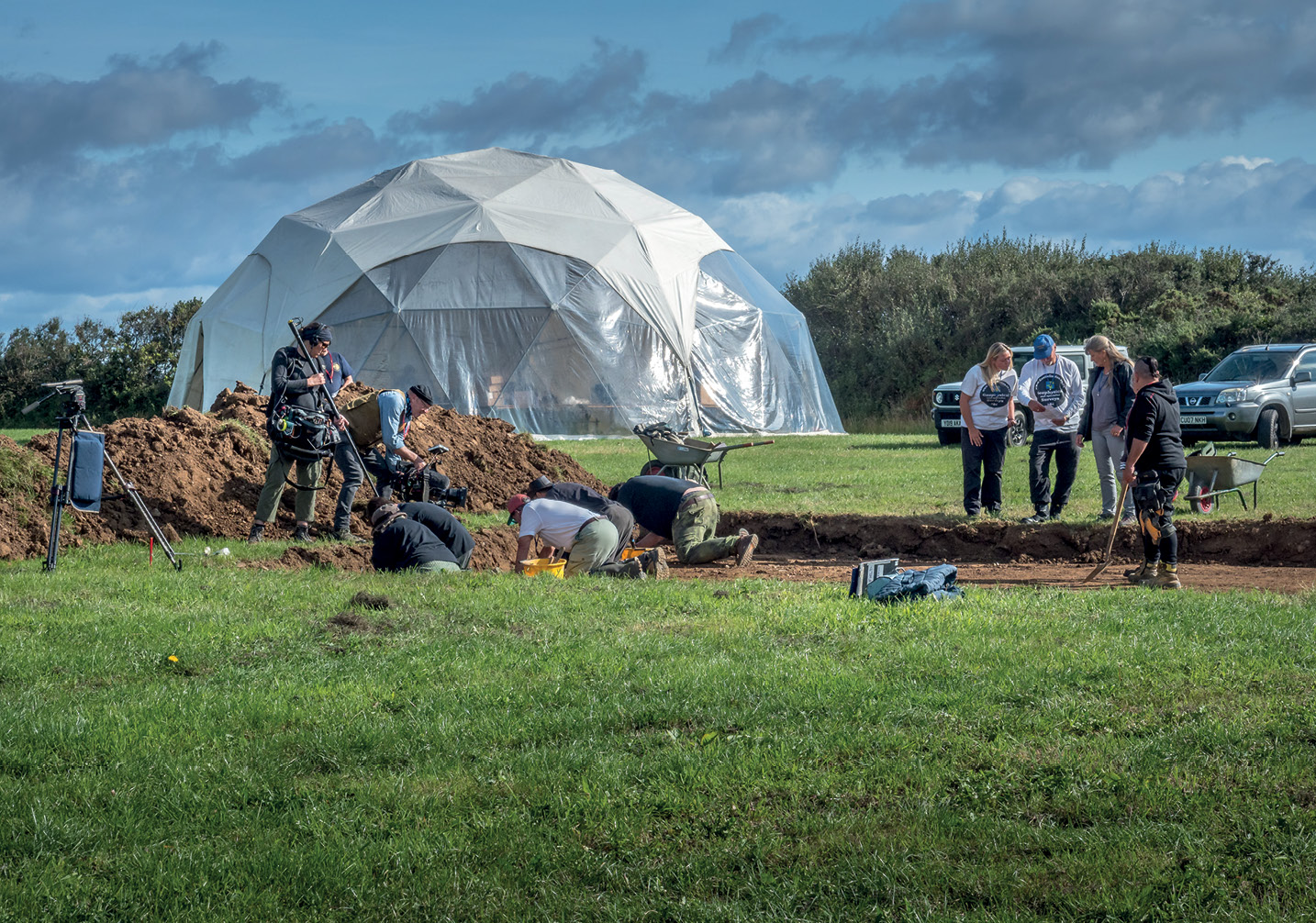
Tim’s most ambitious aim, though, is to harness digital technology to create an online ‘Dig Village’ that communities could use to share knowledge about their local history. While playing with AR and VR kit, I was standing inside the big white dome that Time Team temporarily raises on every excavation site. During filming, this is used as a quiet, sheltered space to process data, work on digital reconstructions, and carry out interviews (a video call with Time Team’s original presenter, Tony Robinson, took place during my visit). In the virtual world, however, Tim envisages creating a national network of digital domes housing information about everything found on a specific site. They would serve as virtual, interactive, remotely accessible museums/archives, growing with every new discovery, where you can examine maps, historical documents, and 3D models of artefacts; walk around recreated trenches; and watch videos of archaeologists talking about their experiences of an excavation or their interpretations of its finds.
‘Imagine a dome for every site we’ve dug – the village would help to uncover its own archaeology, and we would then create the software to make them a dome where they could put their archive,’ Tim said. ‘We could build a social network of domes where different groups could share information and ideas and compare finds. I’m interested to see how much this would resonate with the wider archaeological community.’
Complementing these imaginative plans, Time Team’s work has recently been recognised in rather more traditional ways, with the show winning the prestigious Riccardo Francovich international award for its achievements in outreach, while Tim himself received an MBE for services to Archaeology and Heritage in the King’s Birthday Honours in 2025. Perhaps the most enduring testament to the programme’s ongoing success, however, is the love shown by its fans.
Tim Taylor created Time Team’s prototype predecessor Time Signs in 1991, followed by Time Team itself, whose first episode aired in 1994. He was a Visting Professor (for the Public Understanding of Archaeology) at the University of Bristol, received an honorary doctorate in Arts from the University of Plymouth in 2024, and has written numerous books on archaeology.

Further information: For more information about joining Time Team’s Patreon, see http://www.patreon.com/cw/TimeTeamOfficial or scan the QR code below:

You can watch episodes of the relaunched show at http://www.youtube.com/TimeTeamOfficial, while earlier series can be found at http://www.youtube.com/TimeTeamClassics.