Subscribe now for full access and no adverts
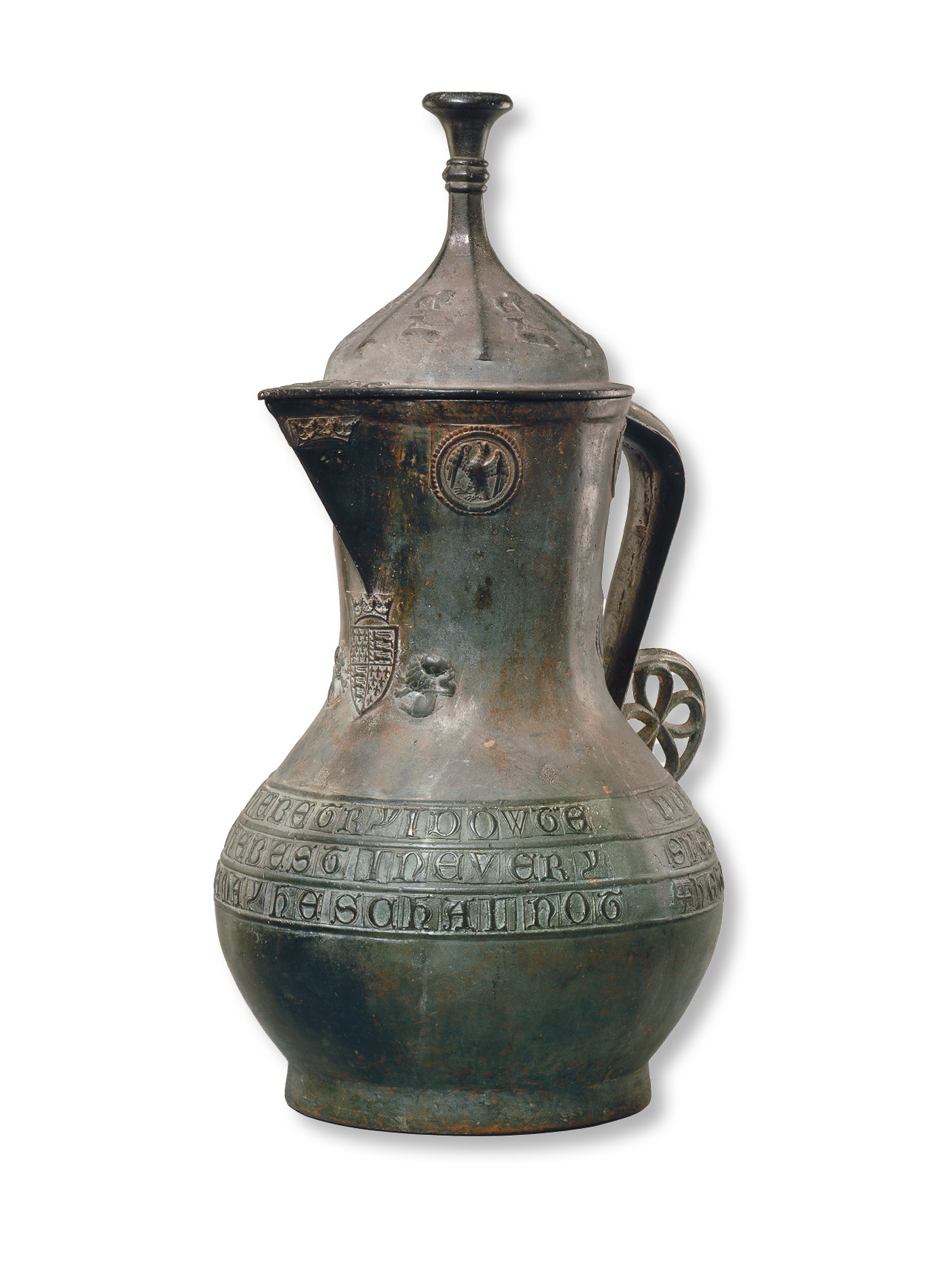
The ewer is the largest surviving bronze vessel made in medieval England.
What is it?
This medieval vessel, known as the Asante Ewer, is a large bronze jug with a pear-shaped body, long neck, and triangular spout; it has a thick ridged handle ending in an openwork disc, and a heptagonal fluted lid. The ewer stands at 62cm tall and weighs nearly 19kg empty. It is decorated with an inscription in English advising the reader to display good judgement and financial prudence, as well as an array of embossed images depicting animal figures and heraldry, including a crowned version of the English royal coat of arms beneath the spout. The object has been dated by its decorations to between 1340 and 1405, and its production process suggests that it was made in an English bell foundry.
Where was it found, and when?
Despite its English origins, the earliest documented evidence of the ewer is a photograph taken in 1884 at the palace of Asantehene Prempeh I, the king of the Asante people in Kumasi, present-day Ghana. This image, taken by photographer Frederick Grant, shows the jug alongside another medieval European vessel in the centre of a courtyard of the royal palace complex. However, little is known about how or when the vessel ended up in West Africa. In January 1896, the ewer was among the items taken from the palace by British soldiers during looting in the aftermath of the Fourth Anglo-Asante War. The vessel was sold at public auction, and was later acquired by the British Museum.
Why does it matter?
The Asante Ewer is noteworthy as the largest known surviving bronze vessel made in medieval England. Its size and decoration indicate that it was a high-status object; it has even been suggested that the ewer was made for the household of Richard II, although there is no absolute evidence for this. The function of the jug is uncertain, it may have been an ostentatious piece of tableware to be used at feasts, or it could have functioned as a standard of measurement, perhaps used in the wine trade.
What makes the ewer particularly fascinating, though, is its West African provenance. Questions remain about its journey – did the ewer move via trade routes across the Sahara or by trade along the Atlantic coast? – and the gap between its arrival in Africa and its earliest documentation in 1884. However, the location of the jug in the 19th-century photograph illustrates both its cultural value and, perhaps, its spiritual significance – cared for in a royal courtyard on a mound of earth at the base of two trees, one of which had a white cloth tied around its trunk, often indicating a shrine. Sadly, whatever local history and beliefs were once associated with the ewer were not recorded when the object was removed from this context, but its cultural significance for the Asante people is evident.
FIND OUT MORE: The story of the vessel has been explored in the new publication Object in Focus: the Asante Ewer (British Museum Press, £6). An accompanying free exhibition, The Many Lives of the Asante Ewer, will open at the British Museum on 5 March 2026.
Text: Amy Brunskill / Photo: © 2025 Trustees of the British Museum, courtesy Department of Photography and Imaging