Subscribe now for full access and no adverts
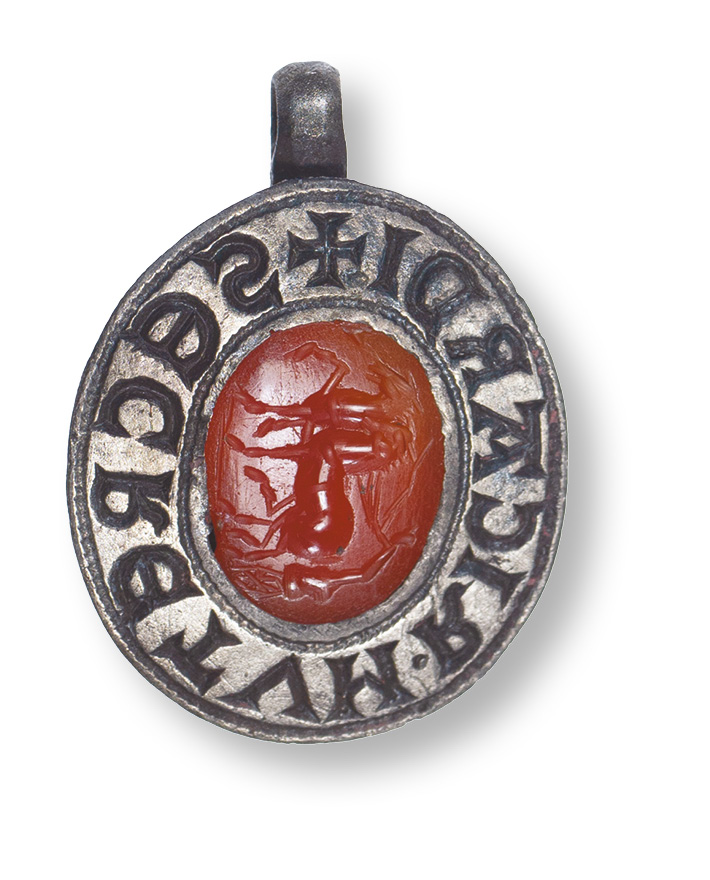
This unusual silver seal matrix dates to the medieval period, but has reused a Roman intaglio as part of its design. It was discovered by a metal-detectorist in September 2024 at Gosfield, north of Braintree in Essex.
Oval in plan, the artefact has a dish-shaped profile and a suspension loop on the top. Its central carnelian intaglio is carved with an image of a biga, or two-horse chariot, and the figure of the charioteer, holding reins and a whip, has been crammed in behind the animals on a very small cart. Along the bezel of the seal is an engraved mirrored inscription that reads ‘+SECRETVM.RICARDI’, which translates as ‘Richard’s secret’.
Based on a similar find from Promina in Croatia, this intaglio is believed to date to the Augustan period in the early 1st century AD. The seal matrix itself, however, probably dates to the 13th or 14th century, as it appears to have been a sign of social status to have gem-set matrices during this period. This fashion saw the importing of many Augustan intaglios from Rome to be incorporated into new objects, although others may have been found by chance while working the land in Britain.
A number of other seal matrices with Roman intaglios have previously been recorded by the Portable Antiquities Scheme, including another depicting a biga, which was found near Lewes in East Sussex in 2012 (search for SUSS-628524 on the Portable Antiquities Scheme database). Two others (DOR-24BAB6 and DOR-952C7E) are carved with a lion and an emperor respectively, and also bear inscriptions referencing a secret belonging to their owner. More recently, a burnt seal matrix with an intaglio depicting the god Mars was found near King’s Lynn in Norfolk in 2020 (NMS-49F121; see CA 377).
The Gosfield seal matrix was recently declared Treasure, and Braintree Museum hopes to acquire it. For more information about the object, search for ESS-8024E7 on the PAS database or see https://finds.org.uk/database/artefacts/record/id/1182239.
The Portable Antiquities Scheme is an initiative to encourage the recording of archaeological objects found by members of the public in England and Wales. For more information on the Scheme, and to browse its database of almost 1.8 million finds, visit https://finds.org.uk. Information on this find was provided by Lori Rogerson – Finds Liaison Officer for Essex.

Text: Kathryn Krakowka / Image: Colchester and Ipswich Museum Service