Subscribe now for full access and no adverts
Many films which depict combat in a realistic way – with intense battle sequences and soldiers incurring horrific wounds – are inevitably described as being ‘anti-war’. This has been said of Steven Spielberg’s Saving Private Ryan, with its memorable opening sequence involving men struggling ashore on Omaha Beach during D-Day. More recently, Ridley Scott’s 2023 film about Napoleon or Edward Berger’s 2022 adaptation of All Quiet on the Western Front have similarly been described as ‘anti-war’ in their message.
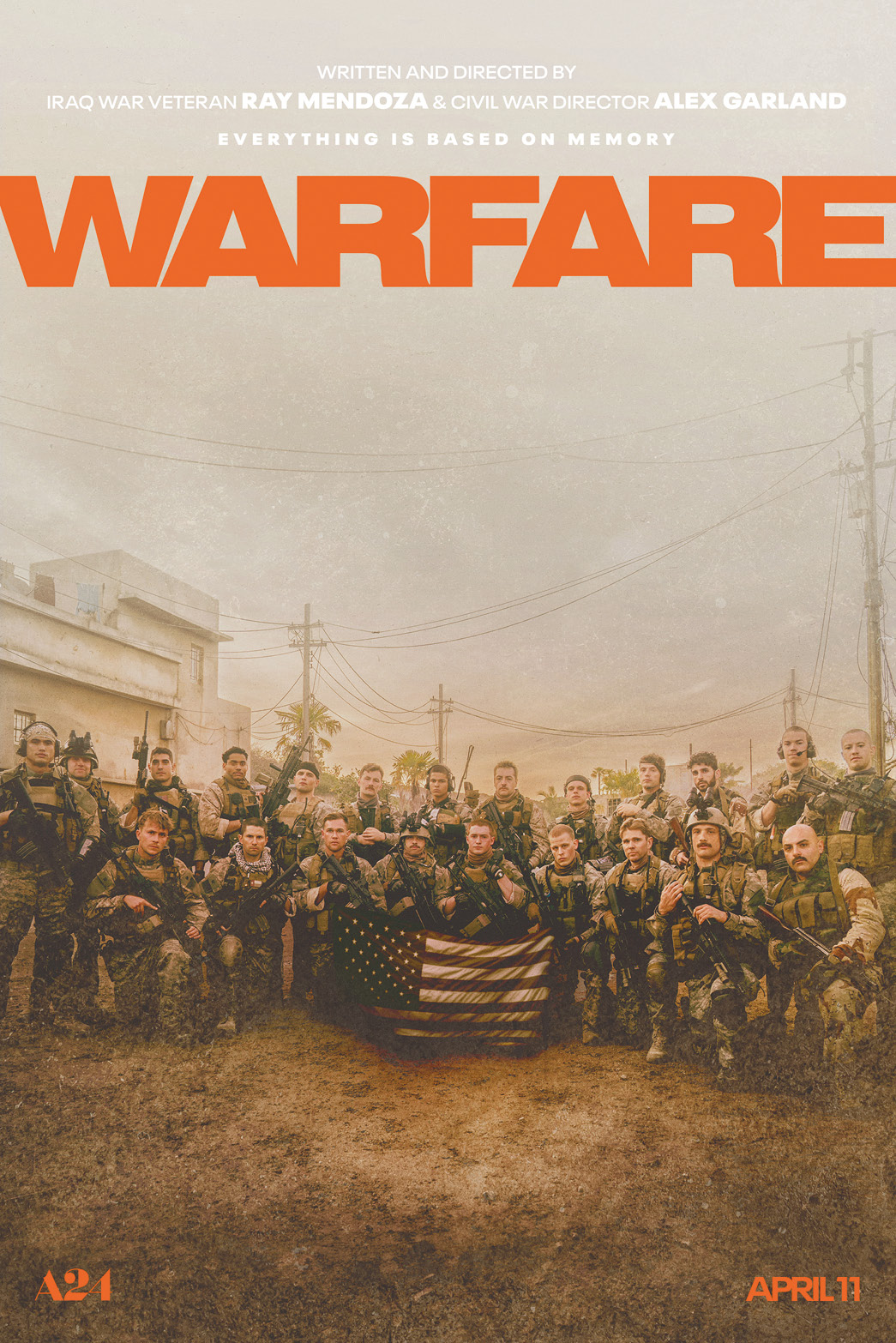
Warfare, the new film written and directed by Alex Garland and Ray Mendoza, may well be lumped into the same category. And on one level, Warfare is firmly anti-war in its tone. It tells the story of a platoon of US Navy SEALs, the elite special forces team, who are surrounded in a house in Ramadi, Iraq, in 2006, during the American-led occupation of the country.
With its frank and visceral depiction of young men under fire, the film totally immerses the viewer in the story of these soldiers. Although brutal and shocking in places, and painful to watch at times, it is not in fact an anti-war film. This is because we are told nothing about why these Americans are in Ramadi in the first place, or whom they are fighting. Nor are we given any background information about the Insurgency that followed the US-led invasion of Iraq in March 2003. This striking lack of context is both Warfare’s greatest strength and a significant weakness.
One of the central figures behind the film is Alex Garland, the British writer and director who began his career producing novels before moving on to screenplays. His debut was the 2002 post-apocalyptic horror film 28 Days Later, which was directed by Danny Boyle. Garland went on to work with Boyle again for the screenplay of 2007’s Sunshine, along with several other successful movies including 2010’s Never Let Me Go. He began directing with the science-fiction thriller Ex Machina in 2014, for which his script was nominated for an Academy Award. He then wrote and directed Annihilation in 2018, Men in 2022, and Civil War in 2024.
In the latter film, Garland painted a picture of the United States torn apart by a modern and very violent conflict between an authoritarian president and secessionist states led by California and Texas. Against the fraught nature of modern American politics, the film was a major critical and commercial success.
Working on Civil War as military adviser was Ray Mendoza, a veteran of the US Navy SEALs, with whom he had served for 16 years. After his retirement, Mendoza became a stunt coordinator for several Hollywood projects, including Civil War. He and Garland got on especially well on the set of that film, and when Mendoza told the director the story of the Ramadi incident in 2006, in which he had been involved, the pair decided to collaborate and put a script together based on Mendoza’s memory of the incident.
With a film in mind, they then interviewed as many of the soldiers who had taken part in the incident as they could find, using memories to flesh out each sequence. Mendoza and Garland have said they wanted to avoid editorialising and instead go for what they have called a ‘forensic approach’, pursuing accuracy as much as possible. ‘This was an unusual process and not like any other writing job I’ve been involved with before,’ Garland has said.
The producers A24 – an independent production and distribution company based in New York, which had financed Garland’s last two movies – agreed to back this new project. The script was turned into a full screenplay and casting began. Garland and Mendoza are both credited as joint writer-directors, in the same way that Michael Powell and Emeric Pressburger received joint credits on their epic oeuvre of films in the 1930s and 1940s, although in that era it was usually clear who had been the principal writer and who the major director. Filming took place last year at Bovingdon studios, a former World War II airfield in Hertfordshire just outside London. Given that Civil War was only released last summer, the turnaround for Warfare has been remarkably quick.
Boot camp
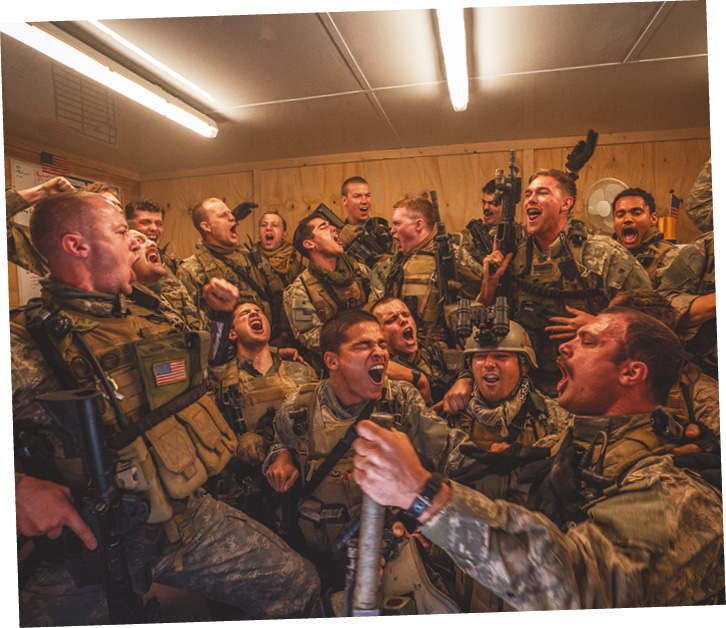
The film opens with a semi-pornographic fitness video typical of the Noughties, showing scantily clad women moving around to a heavy music beat. The viewer could be forgiven for thinking that the projectionist had cued the wrong movie. However, it turns out that the video is being watched by a platoon of male soldiers, who cheer and hoot as the girls gyrate.

The story itself begins when a squad of American soldiers cautiously advances through the Iraqi town of Ramadi one night, which we are told is 19 November 2006. The men are one part of a Navy SEALs operation supported by two Iraqi scouts. Their objective is to defend and provide back-up for a Marine operation that is due to take place the following day. The officer selects a house that puts them in the right position for their mission. They break in and gather the terrified civilian families, including two children, into a bedroom. The families are told that if they keep quiet no harm will come to them.
By the morning, the soldiers have established a forward observation post in the house in Ramadi. As civilians pass up and down the street, everything appears normal. Slowly we are introduced to the members of the unit. It is led by an officer known simply as Erik, played by English actor Will Poulter. His radio communications deputy is the Ray Mendoza character, played very powerfully by the Native American Canadian actor D’Pharoah Woon-A-Tai. Other figures whom we get to know are lead sniper Elliott Miller, played by Cosmo Jarvis, and Sam, a Leading Petty Officer, played by Joseph Quinn.

It is worth noting that, ahead of filming, the entire cast spent three weeks together on an intensive Navy SEALs training programme. This began with all the actors shaving their heads in the style of US Special Forces. Along with giving the actors familiarity with aspects of weapons usage, radio communications, and casualty evacuations, the programme also helped build a bond, a form of brotherhood, between the actors.
Mendoza led the boot camp, in which the actors were confronted with a variety of complex situations, as in the real training regime. ‘We were putting them through these intense and difficult situations,’ Mendoza later said of the experience, ‘so they were overcoming adversity while their brotherhood became strengthened organically.’
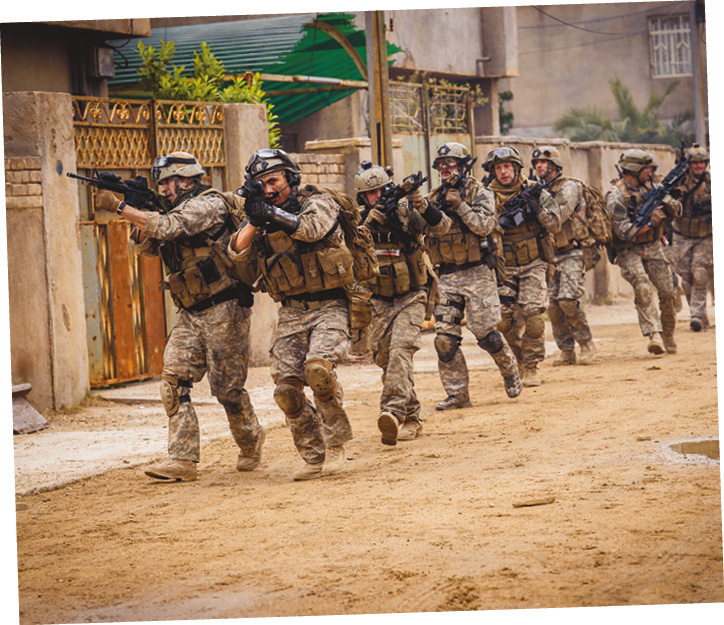
The actors grew used to carrying the sort of kit that was normally carried by Navy SEALs, which could weigh up to 70 pounds. And they learned to communicate with each other in the short, staccato words and phrases used by the military to convey key information in a brief, unambiguous way. This preparatory boot camp without doubt helps to create a superb level of authenticity in the action that followed. The actors look and behave realistically, and the viewer is rapidly absorbed in the action of the story.
The Battle of Ramadi, 2006
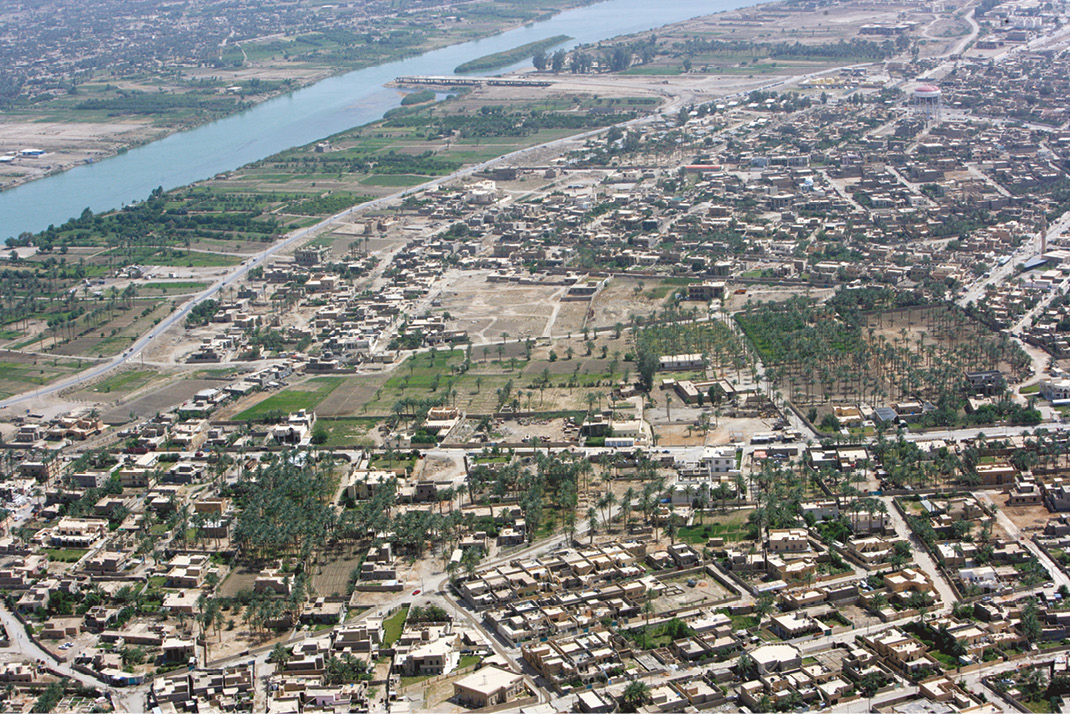
Ramadi, a city of half a million people about 70 miles west of Baghdad, became the centre of what was known as the Insurgency against the US occupation of western Iraq. From March 2006, there were periods of heavy fighting in the city, which had become a base for al-Qaeda. In October that year, the militant organisation declared the Islamic State of Iraq, with Ramadi as its capital.
Fighting between various Sunni forces opposed to the predominantly Shi‘ite Iraqi government in Baghdad added a further sectarian element to the conflict, which frequently verged on civil war. US forces adopted a policy of actively patrolling parts of the city to establish their authority and to cut off supplies to the insurgents. But as they withdrew, al-Qaeda would usually move in and reoccupy the areas. Dozens of American soldiers were killed in combat operations in Ramadi during 2006, and hundreds more were wounded. This is the grim context to the story told in Warfare.
Kill all Americans
In the occupied house, Elliott, based at a first-floor lookout post, uses the telescopic sights of his sniper rifle to survey the surrounding houses. Slowly his suspicions are aroused as several young males gather behind a stall selling food. He watches them as they go in and out of an interior room, and is unsure of what is happening until he sees a car arrive and weapons unloaded. The muezzin supposedly proclaims Friday prayers, but it seems that the words have been changed to ‘kill all Americans’ instead. As the tension builds, the heat rises, literally, and the men begin to sweat profusely under the strain.
Eventually the tranquility of the observation post is shattered, and the Americans come under heavy fire. Elliott is hit and is carried down to the lower level. It is clear that he needs medical help. The officer tells Mendoza to call in a medevac team. After various delays, they are informed that the evacuation team is ten minutes away.

In real time, as bullets ricochet around the house, the SEALs nervously count down to the arrival of the Bradley armoured vehicle that will evacuate Elliott. They guide the rescue party into the street and then to the house they are occupying. Meanwhile, Erik announces that the rest of the unit will remain in the house to carry out their mission. He provides firm, strong leadership, although it is clear that many of the men would rather be getting into the armoured vehicle to be taken away.
As soldiers leave the house to cover the evacuation, Elliott is carried out to the waiting vehicle. Then an Improvised Explosive Device (IED) goes off, causing carnage and leaving everything covered in dust. For a few moments, the action takes place as in slow motion amid the debris. It is clear that one of the soldiers, an Iraqi scout, is dead. But Elliott is very badly wounded in both legs and another soldier is hit. They are carried back into the house.
The US soldiers are now effectively surrounded and under siege. As the explosions and gunfire around them grow in scale, they once again call for a medevac. But this time they are told the request has to go up to brigade headquarters for approval, as there are possibly other IEDs in the area and an evacuation mission has become a lot more dangerous.
By now the situation is desperate. Elliott is screaming in agony. His legs are terribly wounded, with bone and muscle horribly exposed. He is given morphine to ease the pain, but there is not enough of it to be effective. Elliott is the unit medic, so Mendoza hands over his radio set and acts to help him. The tight discipline of the unit seems to be breaking down under the horror of the incident.
The only hope for the besieged squad is rescue by another SEALs unit that is also taking part in the operation. But no good appears to have come of the mission. The real losers are the civilians of Ramadi caught in the crossfire of a war over which they have no control.
Realism
There is plenty to admire about Warfare. The sense of military cohesion under fire is superbly created, and all the sequences have been well rehearsed and choreographed. This was necessary given that most of the movie takes place in such a small area. Garland lets scenes run in real time, often with two separate camera crews following the action in an almost documentary style. This adds to the realism of the film.
There is also little in the way of Hollywood theatrics. Although the film remains inside the house for most of the time, we spot a lot of the enemy, the al-Qaeda operatives, running around the streets and on adjoining rooftops. But they are not typically shot down in the Americans’ gunfire. It would have been so easy to show al-Qaeda being torn to pieces by the Americans, with stuntmen leaping in the air and falling off roofs. But this does not happen, and the movie is better for it.

Mendoza can also be credited for drawing real veterans into the action, such as his ex-colleague Elliott Miller, who attended parts of the shoot in his wheelchair. When the credits run, each actor is shown alongside a photo of the soldier he plays. Some veterans have preferred to remain anonymous and their faces are blurred. But most are proud to be shown as survivors of an intense and dangerous firefight.
Warfare is about the experience of being in frontline combat. It is not about why the war was being fought – nor is it trying to make a statement about whether it should have been. There’s nothing wrong with that and, on its own terms, will undoubtedly prove to be one of the most powerful war films of the year.
Warfare (2025)
Written and directed by Ray Mendoza and Alex Garland.
Starring D’Pharoah Woon-A-Tai, Cosmo Jarvis, Will Poulter, and Joseph Quinn.
A DNA Films production produced and distributed by A24.
In cinemas and IMAX in Britain and the United States.