Subscribe now for full access and no adverts

Palestine 36 is an Anglo-Palestinian feature film funded by the BFI and BBC Film along with French, Danish, and Norwegian money and a host of Middle Eastern backers. It tells a story set within a little-known period of British colonial history (one that follows on from Nicholas Saunders’ feature here). From 1936 to 1939, Palestinian Arabs rose in violent protest against British rule in Palestine, and the rising was determinedly put down by British troops. The film takes the viewer inside the Palestinian national movement, and has many elements that echo with events today. But what was Britain doing in Palestine at the time? How did British rule in the region come about?
At the end of 1917, with stalemate on the Western Front, Lloyd George’s government was desperate for success somewhere. General Allenby, commanding the Egyptian Expeditionary Force, achieved the victories that were so sought after. His army defeated the Turks at the Third Battle of Gaza in November 1917, occupied Jaffa later that month, and captured Jerusalem in December, the first Christian conqueror of the Holy City since the 11th century. It was a stunning triumph over the failing Ottoman armies. Allenby and his entourage, which included Lawrence of Arabia, marched into the conquered city on foot, to show their humility. In the following year, Allenby’s forces advanced up the Jordan valley, defeated the Turks at the Battle of Megiddo, and in October reached Damascus.

At the war’s end, the British Army set up a military administration in the area called Palestine. It was soon resolved that the area would be governed by Britain under a ‘Mandate’ from the newly formed League of Nations. This was a new concept in international law by which the victorious wartime powers would govern a territory on a temporary basis until the community living there was able to govern itself. The promise made in the 1917 Balfour Declaration to build a Jewish ‘national home’ in Palestine was incorporated in the terms of the Mandate. The first High Commissioner for Palestine, Sir Herbert Samuel, a prominent English Jew, arrived in 1920. Winston Churchill as Colonial Secretary spent March 1921 in the region negotiating the final terms. The area to the east of Palestine, on the other side of the Jordan river, known as Transjordan, was also given to Britain as a Mandate shared with Emir Abdullah, the Hashemite brother of Feisal, who had led the Arab Revolt against the Turks. A dynasty was established that rules to this day. Feisal himself was offered Iraq as a further sop to the promises made in the McMahon letters (see box below). In line with the Sykes-Picot Agreement, the French were given Mandates in Lebanon and Syria.

In Palestine, the resident Palestinian Arabs amounted to about 88% of the population. The remaining 12% consisted mostly of traditional Jewish religious groups and a number of relatively new Zionist settlers. During the 1920s and 1930s, the number of settlers fleeing persecution in Europe rapidly increased, to the despair of the Palestinian population who were opposed to the Mandate, which seemed to encourage Jewish immigration into what they regarded as their own land. There were frequent outbursts of violence against Jewish settlers, followed by Zionist reprisals. The most severe of these came in Hebron and Jerusalem in 1929, when Arabs and Jews who had lived happily alongside one another for generations turned on each other; 250 people died. The centre ground was collapsing rapidly. Extremists on both sides were taking over.
Revolt spreads
This is roughly where Palestine 36 picks up. The film is written and directed by Annemarie Jacir, a celebrated Palestinian film-maker who lives in the West Bank and who has been called ‘the first Palestinian female director’. Her previous films include Salt of the Sea (2008), When I Saw You (2012), and Wajib (2017); they have all been nominated for Oscars. Preproduction began in January 2023, selecting locations around Jerusalem and the West Bank, but had to shut down after the 7 October Hamas terrorist attacks. While the war in Gaza raged, filming began in Jordan, but was completed back in the West Bank in November 2024 despite political tensions.
The film centres on the story of one Palestinian village, Al Basma, a few miles outside Jerusalem. One of the central characters, Yusuf (Karim Daoud Anaya in his screen debut), commutes between this village and a job with a wealthy Palestinian couple in Jerusalem, Amir Atef and his journalist wife Khuloud. He sees two very different worlds. In 1936, Palestinian protests against Jewish immigration culminated in an uprising against British rule. It began with a general strike across Mandated Palestine, soon turning into a full-scale Arab Revolt that carried on for three painful years.

Palestine 36 creatively combines its own specially shot sequences with archive film that has been beautifully colourised to match the original footage. These archive shots set the broader context: Jerusalem street scenes in the 1930s that show a mixture of the traditional and the modern; the narrow alleyways of Old Jerusalem teeming with people; the Jaffa orange industry; Jewish immigrants disembarking from liners at Haifa; street-wide demonstrations as the revolt spreads. All these scenes would have needed a mega-budget to recreate, but the colourised archive footage very effectively sets the central narrative inside the context of major political events.
In a series of incidents, the film captures the growing sense of injustice among Palestinian villagers as Zionist settlers build settlements surrounded by barbed wire and guarded by tall watchtowers. Rabab (movingly played by Yafi Bakri in her screen debut) and her 12-year-old daughter Afra (Wardi Eilabouni) look across the valley as their village lands are acquired by Zionist settlers.
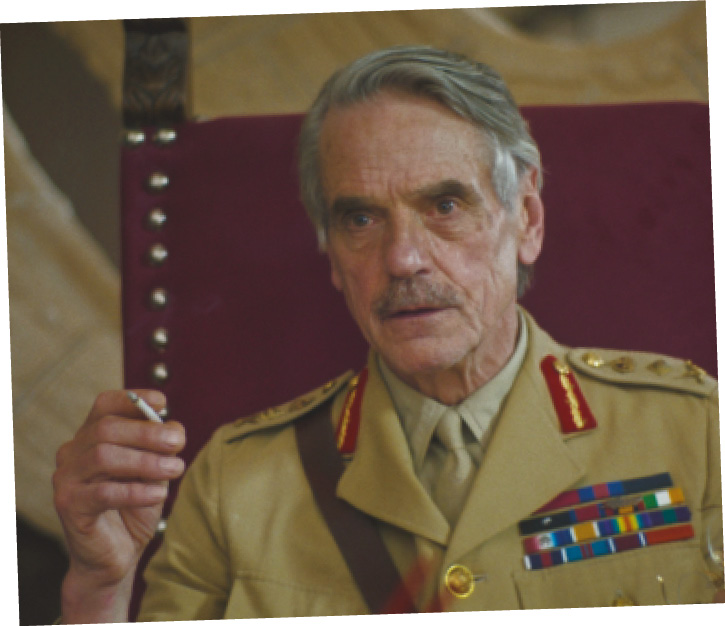
Meanwhile, the British High Commissioner Sir Arthur Wauchope (beautifully played by Jeremy Irons) opens a new Palestine Radio Service. His view and that of the British authorities at this point is that while committed to encouraging Jewish immigration, he wants to see Jews and Arabs living peacefully together. As the film progresses that dream will rapidly fade. Wauchope’s secretary Thomas Hopkins (Billy Howle) is sympathetic to the Palestinians and tells the villagers they must register their land under a new Land Registry. The elders of Al Basma refuse. They say that the evidence of thousands of years of farming and cultivation is enough to establish their rights. They have no concept of what the future will bring.
The Arab Revolt spreads, and rebel fighters gather in the hills, fed and supported by local villagers. The British garrison is heavily reinforced to 20,000 strong. The British armed forces are represented in the film by the unconventional Captain Orde Wingate (ruthlessly played by Robert Aramayo, a recent double BAFTA winner for the film I Swear). Wingate went on to lead the Chindits, who operated heroically behind Japanese lines in Burma. He became one of Churchill’s favourite military commanders. But his service in Palestine was more controversial. He was a committed Christian Zionist, who wholeheartedly believed that the Bible promised the Jewish people a rightful return to their Promised Land. He and a troop of frankly thuggish British soldiers pay several visits to Al Basma village, convinced it is a rebel stronghold.

Irreconcilable divisions
Events move rapidly in the film, as they did in reality. The Palestinian leadership is shown to be radically divided. First, there is the gulf between village farmers, the fellahin, who see daily encroachments on their land, and the urban Arab businessmen, who see the arrival of the Zionists as a splendid opportunity to make money. There are divisions between Christian and Muslim Palestinians. And there is corruption. Amir Atef, leader of something called the Muslim Committee, is later found to be taking bribes from Zionists. The middle-class Palestinian women of Jerusalem march to Wauchope’s office and tell him ‘Palestine is not for sale’. But Wauchope explains that rebel attacks have doubled and he must use his authority to maintain law and order. In reality, Wauchope ordered a vicious crackdown on Palestinian resistance fighters and the blowing up of homes where sympathisers were thought to live.
A Royal Commission led by Lord William Peel is sent from London to assess the situation. Again, archive film of the Commission is mixed with the central narrative. Peel concludes that the Mandate is now unworkable and should be partitioned. Effectively, this was the first attempt at a two-state solution to the problem of dual claims to the land. But, while the Zionists enthusiastically accept the creation of a Jewish state, the Palestinians totally reject the idea that their land should be divided and part of it given away. The revolt goes up a gear. There are explosions in Jerusalem. Villagers are rounded up and taken away to detention centres. Once more, colourised archive film of real events surrounds the central story.

The radicalisation of Yusuf is a central part of the film’s narrative. In the opening scenes, he is trying hard to reconcile village and urban life, and does not express any political attitudes. By the end of the film, he has become a dedicated rebel fighter, living in the hills, and willing to sacrifice his own life for the Palestinian cause.
The climax of the film comes when, after an attack on a British patrol, Wingate leads a troop of soldiers to nearby Al Basma village. He demands to know where the villagers have hidden weapons. He shoots a terrified villager in the back of the head. The men and women are rounded up. The priest, in order to save his son, takes Wingate to a weapons cache in the crypt of the church. What follows is based on the events of 6 September 1938 that became known as the Al Bassa massacre. Following a policy of ‘collective punishment’ to those suspected of harbouring rebels, first applied in Ireland in the 1920s, houses are violently searched and food and personal possessions are destroyed. Some homes are blown up even if residents are still inside. The male suspects are put in a bus, which is directed to drive away over a mine, and everyone is killed. It is a shocking scene that does not pull its punches. The village is left burning that night when the army withdraws.
Palestine 36 is a powerful film that presents a frequently overlooked chapter in British colonial history. It is rare to see British soldiers – rather than German or Japanese – shown as cruel, gun-toting thugs and murderers. The film does not attempt to tell the Zionist story, although it makes clear that many Jewish immigrants are coming to Palestine to escape persecution in Germany, Poland, and Czechoslovakia. The story has many parallels with today’s events. In the West Bank, Zionist settlers are bullying and attacking Palestinian villagers who cling on to the land their families have farmed for generations. In the 1930s, the Palestinians understood the plight of the Jews of Europe – but in the film they ask, why should we pay the price for European crimes? Why don’t you allow Jews to emigrate to your countries? Annemarie Jacir, the film’s director, has written ‘Palestine 36 is a period film, but I never conceived it as something of the past. It has always been current, relevant, and alive.’
In reality, as in the film, the British Army succeeded, slowly, in crushing the Arab rebels: 7,500 Palestinians were detained; 112 were executed; 5,000 were killed in action. Many leaders went into exile. By 1939, the Palestinian leadership had been effectively decimated by the British. This would fatally weaken the Palestinian national movement for the next crucial decade in its history.
However, when war came in 1939, British policy changed dramatically. Needing to placate the Arab states, Britain announced severe restrictions on Jewish immigration. When war ended, it was Zionist extremists who this time launched their fight against the British. The Irgun and the Stern Gang carried out terror acts against the British authorities. The end of Britain’s sad rule in the Holy Land came with a complete withdrawal in May 1948. The state of Israel was declared and armies from several Arab nations invaded. The rest, as they say, is history. Palestine 36 powerfully and emotionally captures a single chapter in this long history. One of which Britain cannot be proud.
BRITAIN’S BROKEN PROMISES
During the First World War, the British made three sets of conflicting promises affecting Palestine. At the end of 1915, British diplomat Mark Sykes and French diplomat François Georges-Picot negotiated a secret deal to divide the Middle East into post-war spheres of influence after the likely collapse of Ottoman rule in the region. Britain would control the area that became Palestine, Jordan, and Iraq. France would have Lebanon, Syria, and Kurdistan. The deal was ratified by both governments in secret in May 1916.
At around the same time, Sir Henry McMahon – British High Commissioner in Egypt – wrote a series of letters to Sharif Hussein bin Ali, the Emir of Mecca. In order to encourage the Arabs of Arabia to support the British war effort against the Ottomans, the letters offered to create an independent Arab state after the war if the Arabs rose in revolt against the Turks. The borders of this new state were purposefully left vague, but the Arabs interpreted the promise as covering much of the land captured from the Ottoman Turks. Emir Feisal, supported by Colonel T E Lawrence, led the Arab Revolt (see also the feature here) on the right flank of the British Army.
In November 1917, in advance of the British conquest of Palestine, Foreign Secretary Arthur Balfour issued his famous Declaration. It promised support for the creation of a Jewish ‘national home’ in Palestine, as long as ‘nothing shall be done which may prejudice the civil and religious rights of existing non-Jewish communities in Palestine’. The Zionists, who had lobbied hard for such a promise, were delighted. The Arab majority in Palestine were outraged that their lands were apparently being given away without them even being consulted.
These three promises were clearly contradictory, and the history of the next 30 years shows how Britain tried and failed to reconcile them.
Palestine 36
Directed and written by Annemarie Jacir.
Produced by Ossama Bawardi.
Starring Karim Daoud Anaya, Yafi Bakri, Wardi Eilabouni, Robert Aramayo, and Jeremy Irons.
A BFI, BBC Film, Doha Institute, and Katara Studios production by Philistine Films, 2025.