Subscribe now for full access and no adverts
There are many ways a film can depict conflict. ‘War on Film’ has explored several of them over the years. There are the stories of the supposed superheroes, as in The Ministry of Ungentlemanly Warfare or Masters of the Air; the parables of Apocalypse Now or A Matter of Life and Death; the satire of Catch-22, Dr Strangelove, or Oh! What a Lovely War. There are stories of science and war as in Oppenheimer or School for Secrets; stories from the perspective of the frontline soldier as in Saving Private Ryan or Enemy at the Gates; stories painting the grand canvas of war as in Napoleon, The Longest Day, or A Bridge Too Far.
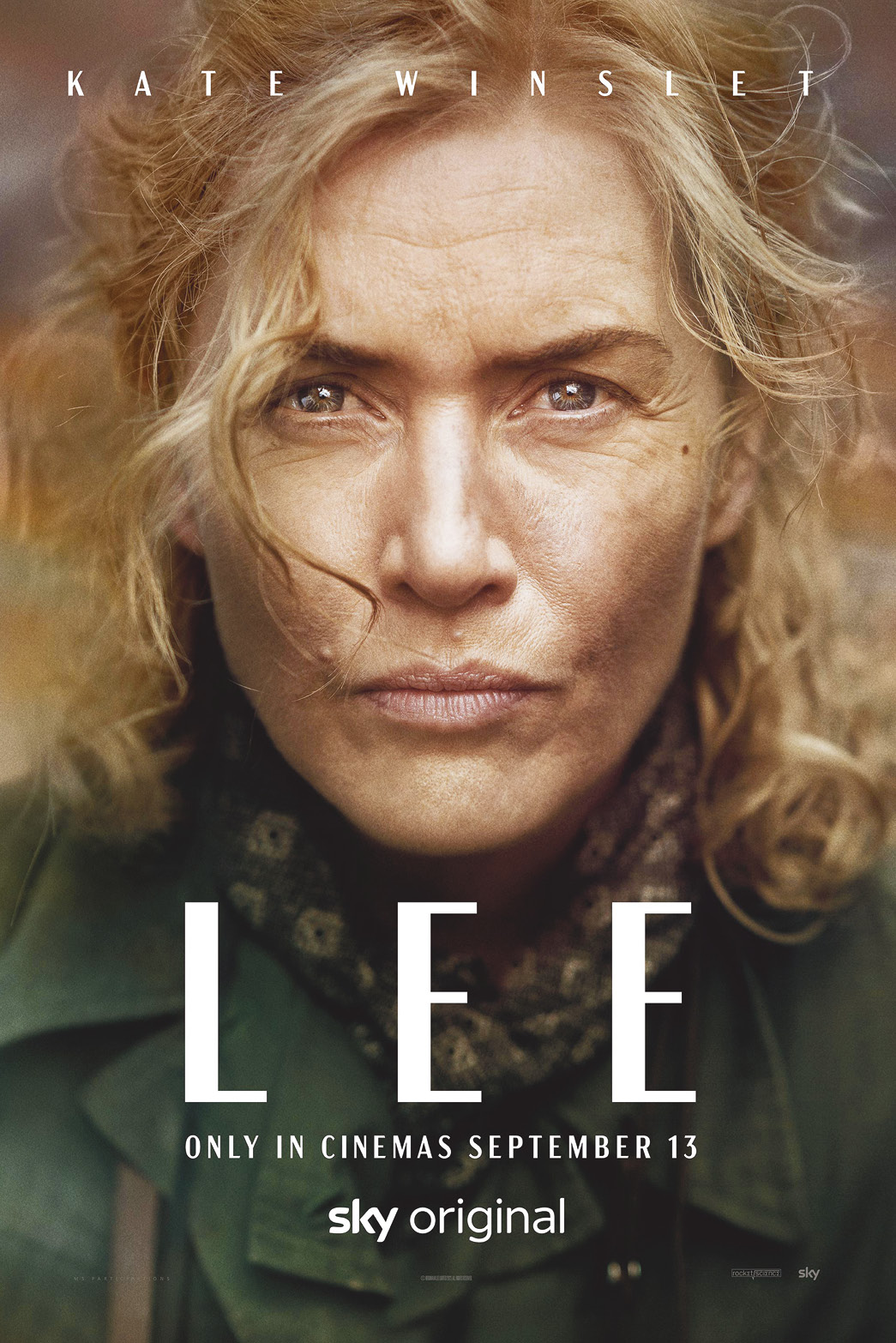
While Lee is not the first time war has been seen through the lens of a photographer or cameraman, it is perhaps unique in seeing war through the lens of a female photographer. And it is that women’s perspective that gives Lee its very special viewpoint.
While the film is an opportunity to bring the story of a great war photographer to a mass audience, in movie terms it is very much a vehicle for Kate Winslet. There is no doubting Winslet’s qualities as an actor. She has appeared in literally dozens of movies over the course of her career, having shot to fame in 1997’s Titanic. Although she has won an Academy Award and five BAFTAs, Winslet has often chosen to appear in low-budget independent movies rather than Hollywood blockbusters, and has championed a range of causes from autism to body-shaming. In recent years, she has served as producer or executive producer on several projects.
Lee was more than just another picture for Winslet. She picked up on the Lee Miller story in 2015 and for years struggled, as producer of the project, to raise funds. She asked Ellen Kuras, who had originally interested her in Miller, to direct. Kuras is an experienced documentary filmmaker and director of concert films and commercials, but had never before directed a feature. Winslet’s faith in Kuras’ abilities proves to be well founded in Lee.
Winslet has said she was badly patronised by several male movie executives, and it took years to get the funding and casting in place. The film is based on the 1985 biography The Lives of Lee Miller by her son Anthony Penrose. The script went through several rewrites before Winslet was happy with it.
Filming did not begin until September 2022, and took place in Croatia, Hungary, and the UK. Winslet slipped on the first day of filming and had to go to hospital, which delayed production by two weeks. But she insisted she would carry on, despite severe back pain. The result is a tremendous piece of work that will put Lee Miller centre stage as a war photographer.
‘Just pictures’
Miller first became well known as a model in late 1920s New York, working with Condé Nast, the publisher of Vogue magazine. In 1929, she moved to Paris where she became an apprentice to the surrealist Man Ray and moved in an artistic circle that included Pablo Picasso and Jean Cocteau. She returned to New York in the mid-1930s, and became a famous portrait and fashion photographer, enjoying her own exhibitions and success in many American magazines. In the late 1930s, she was back in Europe again, moving in artistic circles, and it is at this point that the movie picks up her narrative. We find her in the south of France, where a group of artist friends are discussing Hitler, and the threat posed by Nazi Germany.
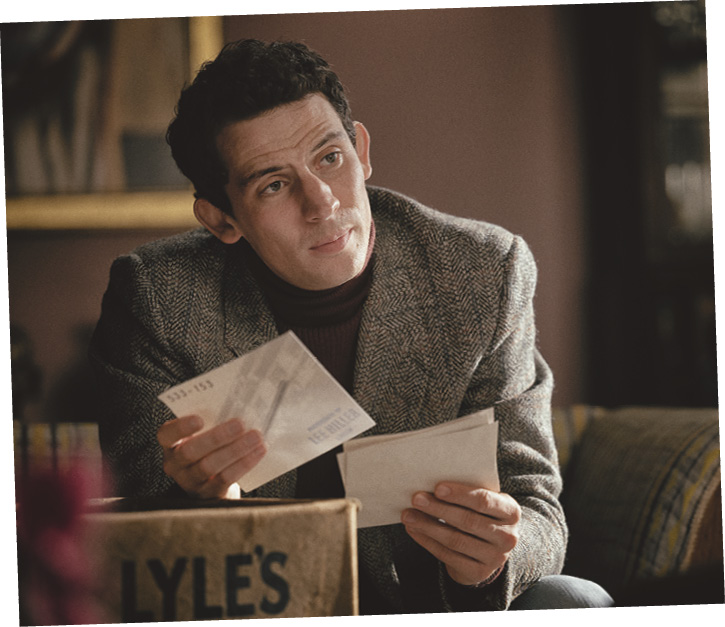
The format of Lee is that of an interview with its subject, aged 70, held in her home at Farleys House in East Sussex, England, in 1977. We do not know at first who the interviewer (The Crown’s Josh O’Connor) really is. He asks questions. She is reluctant to talk. ‘You’re making a big deal out of nothing, they’re just pictures,’ she tells her interviewer. But he persists. ‘They’re all stories.’ Eventually Miller starts to talk, to tell these stories.
The interview is then interspersed with long flashbacks in which Miller narrates her life. She tells her interviewer that, before the war, she was only good at three things: ‘drinking, having sex, and taking pictures. I did them all as much as I could.’ In the south of France, she meets Roland Penrose, the English surrealist and art curator (played by a suave Alexander Skarsgård). They begin an affair, and she moves to live with him in Hampstead, London.
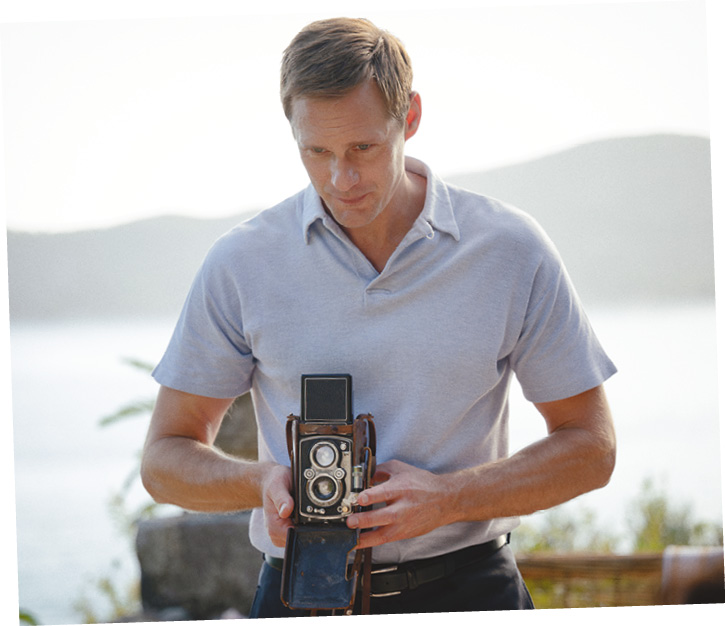
When war comes, Penrose is commissioned by the War Office to come up with various camouflage designs. He eventually begins to lecture on how to camouflage military equipment so it will not be identifiable in aerial photos. Miller decides she must do something for the war-effort too, and goes to the Vogue offices in London. She meets the editor Audrey Withers (Andrea Riseborough), who takes her on.
Throughout the movie, Miller comes up against patronising or bullying men. At the Vogue office, she encounters Cecil Beaton (Samuel Barnett) who sees her as a rival and clearly does not want her on the payroll. But Withers tells her that Vogue’s mission is to ‘encourage the women of Britain to do their duty’. Miller begins photographing the aftermath of the Blitz and the people who make up the emergency services that help Londoners survive the mass destruction of aerial bombardment.
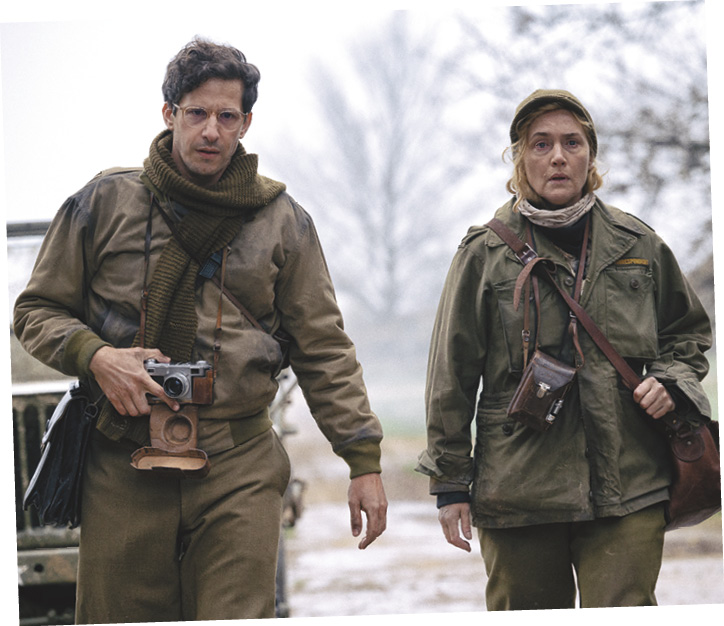
It is when she is photographing the men and women of an anti-aircraft battery that Miller meets David Scherman (Andy Samberg). He is a Jewish New Yorker and war photographer for Life magazine. They form a team and start to work together. She becomes frustrated when, as a male photographer, he is allowed access to places and people that, as a woman, she is not. ‘The only reason you can go [to the Front],’ she tells Scherman, ‘is because you have a set of balls.’ She realises the British military establishment will never allow her to work near the frontline, so she becomes accredited as an official American war photographer.
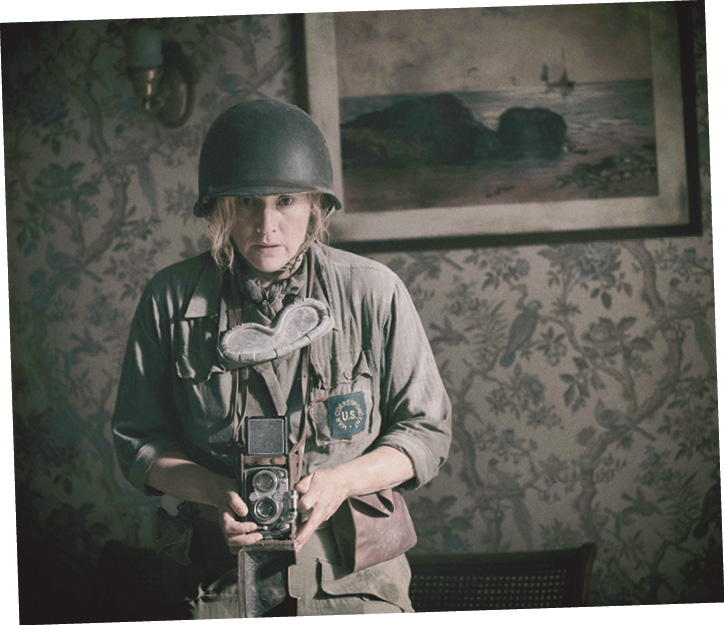
The film jumps forward to Normandy, 1944, after D-Day. Still Miller comes up against men who will not allow her to do and go as she wants. At one point she dresses as a man to attend a male-only press briefing. But she is promptly told: ‘We don’t send women into combat’. This was standard policy in all armies in World War II, and it should not have come as a surprise to Miller – but still she baulks at the restrictions she faces. She is, however, very moved when she takes some pictures of horribly wounded soldiers in a field hospital.
Eventually, the colonel in charge of the press corps tells Miller that she can go to Saint-Malo, the scene of heavy fighting. She finds herself in the midst of real combat and the first use by the Allies of napalm. The Germans eventually surrender, and again the movie gives a female perspective on the aftermath. A young Frenchwoman admits to Lee that she had fallen in love with a German soldier who told her that he loved her. ‘They all say that,’ Lee tells the girl. In the frenzy of liberation, a French crowd furiously shaves the heads of this girl and others seen as collaborators. In Miller’s eyes, the girl has done nothing more than fall in love. But she knows the shame will live with her for the rest of her life. Miller can do nothing but watch and photograph what she sees. ‘I want it to be true, but I want it to be good,’ she tells Scherman.
Miller is in Paris soon after its liberation in late August 1944. Here in a dark alley one evening, she finds an American soldier raping a Frenchwoman. She intervenes and tells the soldier to get lost, threatening him with a knife. He looks at her as if to say, ‘But this is fair game, what’s it got to do with you?’ She gives the girl her knife and tells her to use it ‘next time’.
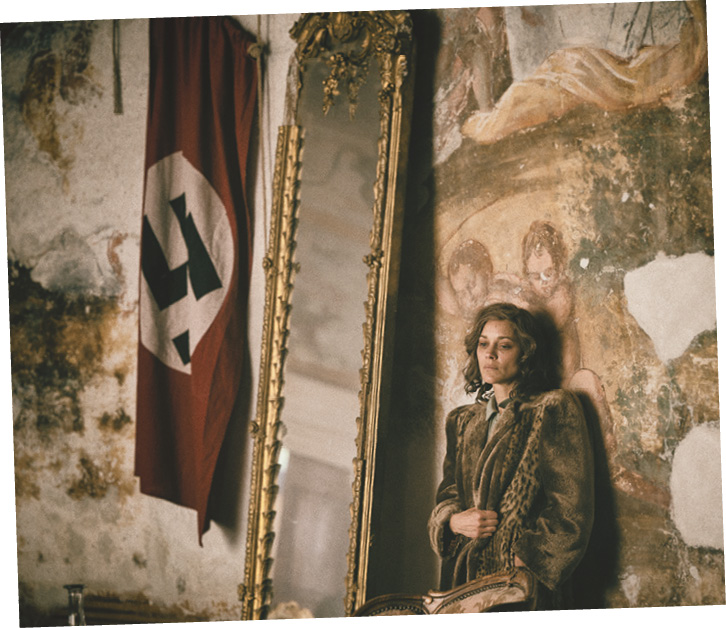
She then comes across her old friend Solange d’Ayen (Marion Cotillard), the editor of Vogue France, whom she had known before the war. D’Ayen has been deeply traumatised by the occupation. Her son has been shot. Her husband and father have been sent away by the Germans. D’Ayen does not know what has happened to them. The story of people mysteriously disappearing in the fog of war becomes a central theme of the film. Back at the hotel, Miller tells Scherman, ‘Bad things happen to us girls.’
Miller comes across other old friends from before the war, who tell her about the thousands of people who have been sent away: ‘Not just Jews, but artists, homosexuals, gypsies…’. The list goes on. ‘They put them on to trains, and they don’t come back.’ Miller is profoundly moved by this, and it drives her onwards.
Penrose appears in Paris and tries to persuade her to go home, where it will ‘all be normal again’. ‘Normal – no way,’ Miller responds angrily. She speaks with Audrey Withers in London, who thinks the liberation of Paris must just be one big party. ‘It’s not over,’ Miller tells her, and that, with thousands of people missing, things can never be the same again.
Atrocities
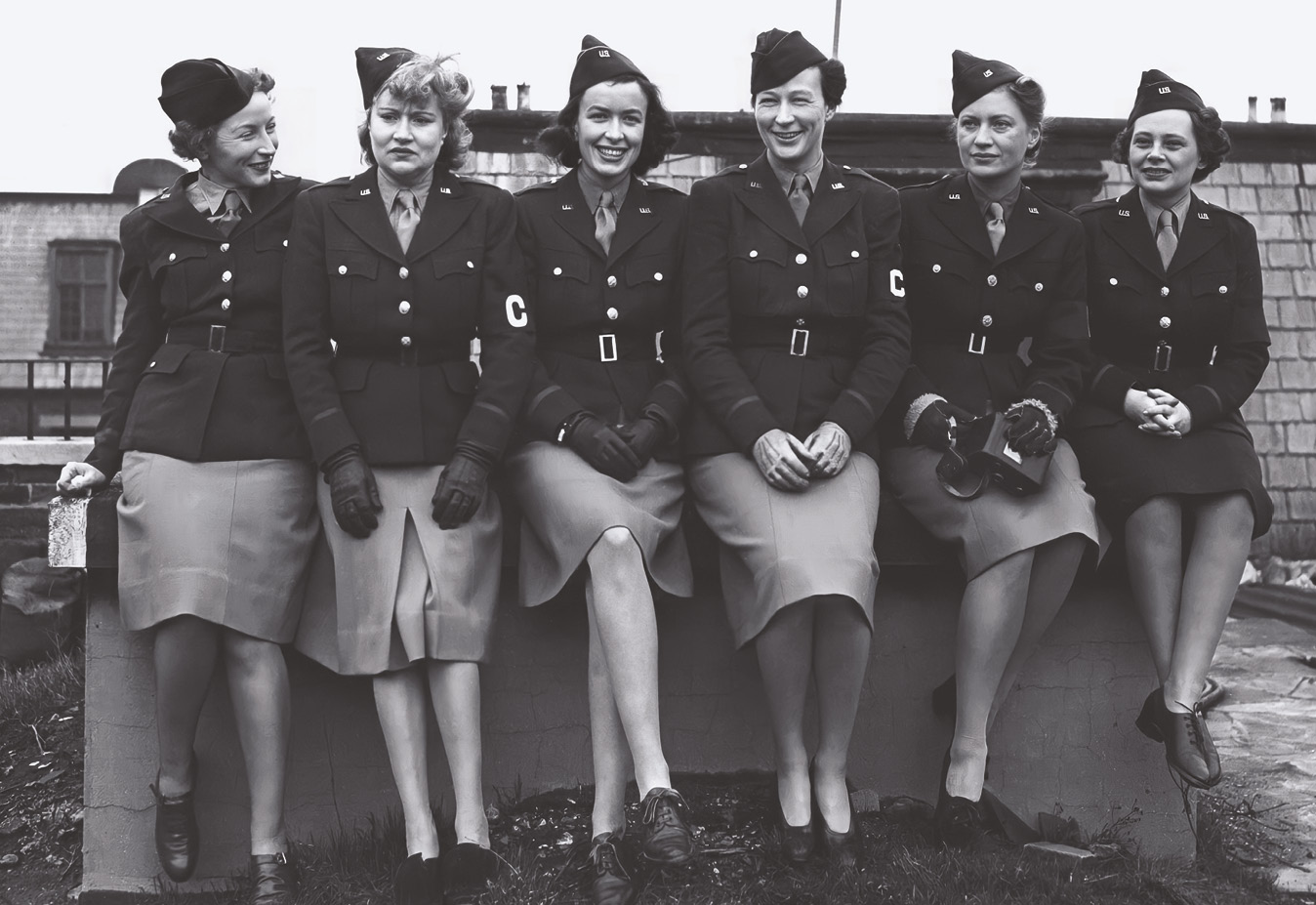
In the last, dark chapter of the film, Miller and Scherman drive together into Germany to discover the death pangs of the Third Reich. She becomes more and more like a man, drinking heavily, sharing the driving of the jeep, covering hundreds of miles, not being able to wash for days. In their war correspondent uniforms, it is difficult to tell them apart. What they see will bring the horrors of the collapse of Nazi Germany to a new audience, who will no doubt go to see Lee, but would probably not be persuaded to watch most war movies.
First, they come across the aftermath of the suicide pacts where Nazi officials and their families have taken cyanide capsules to avoid capture by the Allies.
Then they arrive at railway yards. A dreadful smell overcomes them, the smell of decaying corpses. As the doors of each cattle wagon are opened, bodies tumble out. American soldiers check each wagon for signs of life – there are none. Now Miller begins to understand why all those people, including her friends, had been sent away and never came back.
In an even more harrowing scene, Scherman and Miller visit a recently liberated concentration camp. In reality, Miller visited both Buchenwald and Dachau, but in the movie the camp is not given a name. Skeletal figures stagger around. The pair are shocked by what they find in some of the huts. All the viewer sees are the black-and-white photos she takes, a clever and appropriate way of revealing the extent of the atrocities. ‘All of these people,’ says Scherman in horror, ‘they’re my people.’
At one point, a cart delivers several loaves of bread. Miller follows a woman who takes bread back to her hut. When she enters, all the women are terrified by the arrival of a person in uniform. She tries to reassure them. Again her compassion for the suffering of the female victims of war overcomes her. But she can only do what she can do. She photographs the haunted and terrified face of a young girl. We can barely imagine what terrible things she had been through. ‘Once you’ve seen it, you can never unsee it,’ she tells her interviewer in 1977.
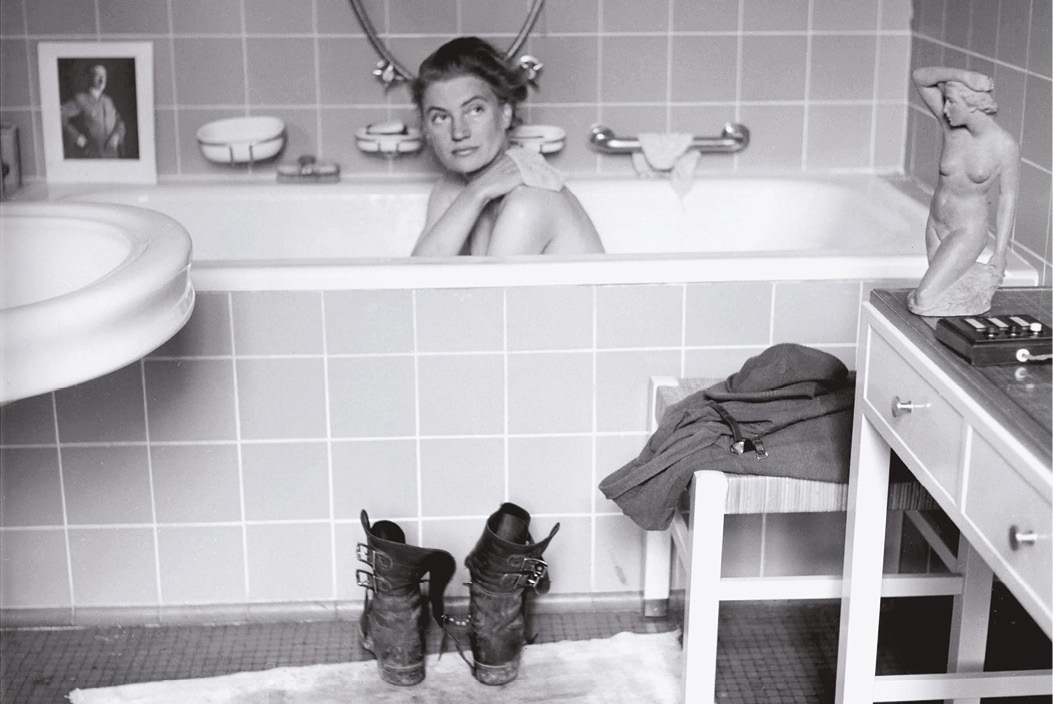
The final war scenes of the film re-enact the most famous photograph of Lee Miller during the war. In Hitler’s old apartment, she takes a bath and Scherman photographs her washing in the Führer’s personal tub.
The film concludes in post-war London. Miller shows clear signs of post-traumatic stress. Upset when the victory issue of Vogue does not feature any of her images, she explodes. She has captured the female experience of war, but now the world does not want to know. Violence against women ‘happens all the time,’ she says, ‘and they just get away with it.’ Following this, the film has a few more twists in its tail.
Lee is a well-written, powerfully structured movie that will get a new audience thinking about the role of women in war. It is brilliantly shot by cinematographer Paweł Edelman, with lots of contrasting light and darkness, the shadows obscuring some of the atrocities Miller sees.
But what will bring many to the film is the superb performance of Kate Winslet. Much has been written about the actor allowing herself to be filmed looking dishevelled and without make-up. Frankly, this is an irrelevance. She plays the part of an extraordinary person honestly and truthfully, both as a traumatised war reporter and as a heavy-drinking 70-year-old reflecting back on her life. Winslet has brought this project together, and she deserves much praise for creating and starring in a memorable and remarkable war movie.
The famous bathtub photo
Driving across Germany in the wake of the US Army during the final weeks of WWII, the photographer Lee Miller and her Life magazine colleague David Scherman get to Munich and find the apartment in Prinzregentenplatz that had belonged to Adolf Hitler. The apartment has been taken over by a group of American officers from the 179th Regiment, who are using it to drink, relax, and have a good time. Miller and Scherman find Hitler’s bathroom. Miller goes in first and discovers, to her amazement, that there is still hot running water. Having not bathed for weeks, she runs the taps. Then she calls in Scherman to photograph her.
Carefully placing a photo of Hitler on the side of the bath, Scherman captures one of the most famous pictures of the war: Lee Miller, an American war correspondent, bathing in the Führer’s personal tub. It so happened that this took place on 30 April 1945, the same day Hitler and his wife Eva Braun committed suicide in Berlin.
The image perfectly sums up Lee Miller, the woman who had once dazzled America and France as a fashion model. Now, as a war correspondent, having witnessed terrible atrocities, she luxuriates in Hitler’s bath, metaphorically and literally washing away the dust of conflict. Humanity has triumphed over appalling violence.
Lee (2024)
Directed by Ellen Kuras. Produced by Kate Winslet, among others.
Based on the book by Anthony Penrose.
Starring Kate Winslet, Andy Samberg, Alexander Skarsgård, and Andrea Riseborough.
A Brouhaha Films production, available on Sky Cinema.