Subscribe now for full access and no adverts
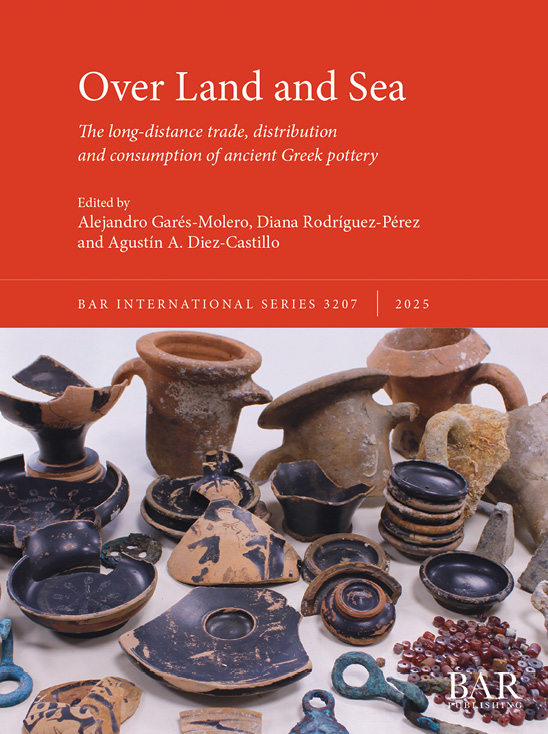
REVIEW BY ROBIN OSBORNE
Trade in Greek pottery long attracted little interest. Finley’s massively influential The Ancient Economy (1973) discouraged both the idea that archaeological data might have anything to add to study of the ancient economy and the idea that pottery was economically significant. However, the scale of pottery production is clearly such that the low value of individual items does not stand in the way of pottery as a whole being economically important, and pottery is arguably the single item most informative about the exchange of goods in antiquity. This is because the functions and the geographical origins of many pots can be identified with a high level of reliability. Precisely because pottery is unlikely to have been moved on its own, the patterns of distribution and consumption to be observed with pottery offer a model of patterns of distribution and consumption more generally.
This rather miscellaneous, and unfortunately under-edited, volume (several papers have never been corrected by a native English speaker; there is no index) consists primarily of 12 case studies of the distribution and consumption of Greek, and especially Athenian, pottery of the Archaic and Classical period in the western Mediterranean, and particularly Iberia (there is one paper focusing on Thrace, two on distribution west and east of particular workshops or iconographies). There is no conclusion, but the volume is headed by two further papers looking at the overall picture.
What do we learn? First, the specificity of the pottery trade. The most striking finding comes from an analysis of finds from Ullastret, in Spain – a fortified settlement in the hinterland of Empúries (ancient Emporion, meaning ‘market’) – which has identified a group of Athenian black-figure drinking vessels, found only in Ibiza/south-east Iberia and here around the Gulf of Roses and the Gulf of Lion, which display two most remarkable features. They date to a generation after other workshops have stopped producing drinking vessels in black-figure – apparently Iberian demand is keeping a whole otherwise obsolete production going in Athens. The second feature is that, although both in Iberia, the two areas in which Ullastret-group pots are found are normally thought of as served by quite different trade routes – the Gulf of Lion and the Gulf of Roses by a route along the coasts of eastern Italy and southern France; south-east Iberia by a route crossing via Sicily, Sardinia, and the Balearic islands.
This connects with the second lesson. This is that ‘Greek’ and ‘Phoenician’ trade networks turn out to be much less distinct than has often been imagined. Recent excavations at Carthage have revealed large quantities of Attic pottery, in forms parallel to those found across the western Mediterranean. What is more, the 4th-century BC El Sec wreck excavated off Mallorca and published only this year has turned out to combine Phoenician galleyware with a cargo of Attic pottery drawn from a single workshop.
The third lesson is that that such focused marketing co-exists with ‘down the line’ trade. The most vivid example of this concerns Athenian pottery in the middle Guadiana valley in southern Iberia, where it is possible to show that, although this inland area receives hundreds of Athenian pots, the route that they followed to get there changed fundamentally over time, with supply initially coming up river, but later coming from eastern Iberia.
Two important features mark this ancient economy. First, the very detailed knowledge displayed, from the Archaic period onwards, both by producers about market preferences, and by consumers about what the market made available. The second is the voracious demand: consumers often used pots very differently from the way Athenians used those same pot shapes, but it was Athenian pottery that they wanted to do the different things with. Wrecks reveal Attic pottery alongside Ionian pottery and Etruscan amphoras, or mixed Attic, Aegean, South Italian, and Etruscan goods. Consumers knew who around the Mediterranean produced the best versions of what they wanted, and merchants were savvy enough to supply their wants.
Over Land and Sea: the long-distance trade, distribution and consumption of ancient Greek pottery
Alejandro Garés-Molero, Diana Rodríguez-Pérez, and Agustín A Diez Castillo (eds)
BAR Publishing, £49
ISBN 978-1407362373