
Subscribe now for full access and no adverts
REVIEW BY ANDRÉ VAN LOON
To start with what this book is not: Martin Sullivan, a lecturer in business and previously an investment banker, does not give us a straightforward biography of Louis-Nicolas Davout, Duke of Auerstädt and Prince of Eckmühl, who lived between 1770 and 1823.
The book does not delve into Davout’s lineage, education at the École Royale Militaire, first experiences in the revolutionary French army, or tensions with Napoleon during the campaign in Egypt. Nor does it look at Davout’s string of victories as Marshal commanding the Grande Armée’s Third Corps or his exile from power after Napoleon’s fall.
Instead, Napoleon’s Undefeated Marshal is an analytical snapshot of a moment in time: the start of the War of the Fifth Coalition in 1809. Sullivan is fascinated by how Davout’s leadership helped to reverse the risk of defeat by Austria’s Archduke Charles, and his triumph at the Battle of Eckmühl on 22 April that year. It was Davout, Sullivan contends, who gave Napoleon the upper hand by outsmarting the Austrians, setting the scene for the emperor’s subsequent victory in the Battle of Wagram in July, which ended the war.
Sullivan, often taking a day-by-day approach, means to explain Davout’s recipe for leadership, and what modern readers can learn from him. How did Davout manage to turn his initial position of weakness (outnumbered and outmanoeuvred) into victory? How did he flourish when others floundered?
The author begins with an analysis of Davout’s strict discipline and training, and focuses on his concern for his corps’ welfare and encouragement of initiative. In line with Napoleon’s adaptive vision, commanders and divisions were part of the whole, but able to act independently. This relatively loose structure performed superbly during the Battle of Eckmühl, allowing Davout to occupy crucial hilltops, while still attacking the enemy’s left flank, which fell apart. The Austrians just could not understand how the French were able to be so fast and mobile across different parts of the battleground.
The book considers how Davout understood the political dimensions and the key players, not least what Napoleon sought to achieve, against the Fifth Coalition’s hopes of re-establishing Austrian supremacy in its region.
Successful on its own terms, the book is also highly accessible. Sullivan means to be understood, and his passion for and intimate knowledge of the period are clear. But there are a few minor quibbles and one limitation to mention. First, Sullivan cannot resist writing as much (and often more) about Napoleon than about Davout. This is understandable, but more precision about the book’s subject would have been welcome.
Also, the book is very liberal with its quotations, which often run to several pages. While highly illustrative, their length means that Sullivan can be restrained in delivering his own judgements. More forthright argument could have helped the book attain more of its undoubted strengths.
The larger point is that Sullivan can sometimes underplay a crucial aspect to Davout’s leadership. The Grande Armée was expressly designed to be like a living, proactive, and adaptive organism. It was highly mobile and interconnected, able to break off into parts and then regroup, with infantry, cavalry, and artillery working in a mutually reactive unity.
While Davout undoubtedly led with clarity and an iron will, he was widely supported by a range of commanders, all of whom had a chance to thrive in the dynamic context of Napoleonic warfare. This larger web of command and action, going beyond the marshal and his generals to consider colonels and other officers, would make for a fascinating study of interconnected leadership – perhaps something Sullivan could consider for a next study.
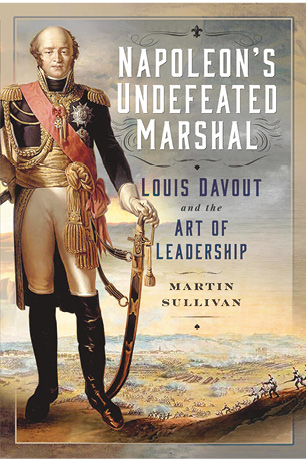
Napoleon’s Undefeated Marshal: Louis Davout and the Art of Leadership
Martin Sullivan
Pen & Sword Military, hbk, 224pp (£25)
ISBN 978-1399053143