Subscribe now for full access and no adverts
The emergence of bipedal walking has long been recognised as a central aspect of hominid evolution, but much less is known about the development of running. Recently, a team of researchers from the UK and the Netherlands set out to remedy this, using computer-based movement simulations to test the potential running capabilities of the early hominin Australopithecus afarensis and compare them to those of modern humans.
Au. afarensis was chosen because it occupies a key position on our family tree, bridging the gap between our more arboreal ancestors and those closer to anatomically modern humans. Previous study of the fossilised skeletons and footprints of australopithecines suggests that they had developed an upright, ‘human-like’ bipedal walking gait by at least 3.7 million years ago. However, they still had long arms and other features associated with tree-dwelling, and lacked several of the evolutionary changes thought to be important in modern human bipedalism.
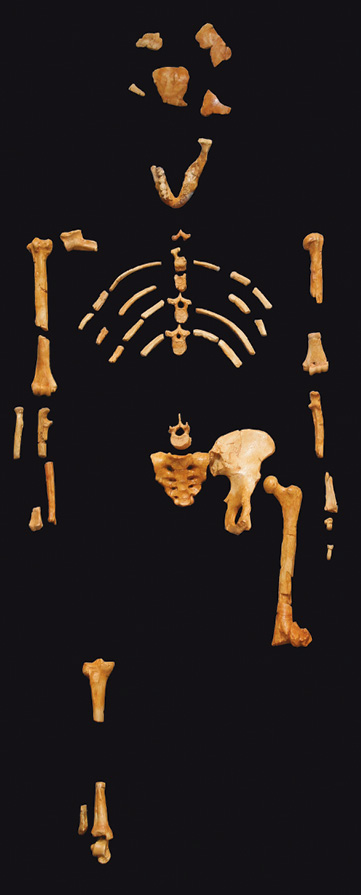
The team based the digital model for Au. afarensis on the specimen known as ‘Lucy’, a small female fossil discovered in Ethiopia in 1974, dated to 3.2 million years ago. Lucy’s skeleton is relatively complete, but her muscles and other soft tissues have been lost to time. Several different simulations were therefore created, with variations in features thought to be significant in modern human running: larger leg muscles were added and removed, and changes were made to the ankle extensor muscle architecture, including the length of the Achilles tendon. The same approach was then applied to a simulation of a modern human. Using these models, the researchers tested two major components of running: top speed and energetic cost.
The experiments confirmed that Lucy was indeed capable of upright bipedal running, whether or not the key hallmarks of modern human running were present. Even in the simulations where muscle mass was lowered to the same relative value as a chimpanzee, and the Achilles tendon length was reduced by over 80%, Lucy was still able to achieve ‘true bipedal running gaits’.
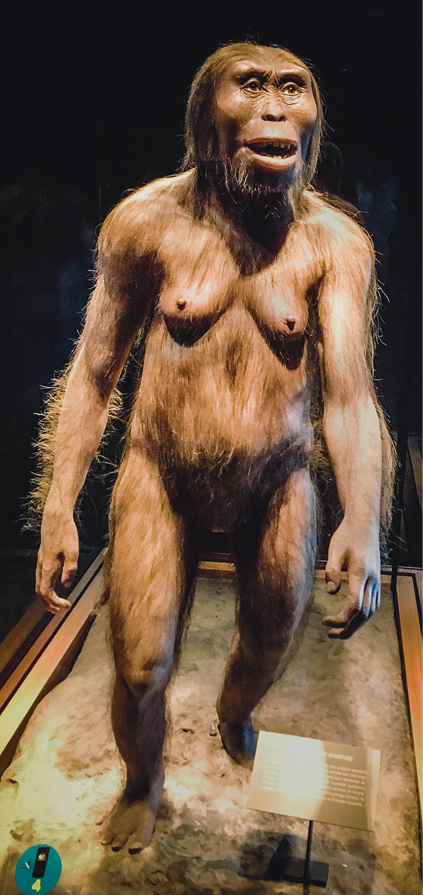
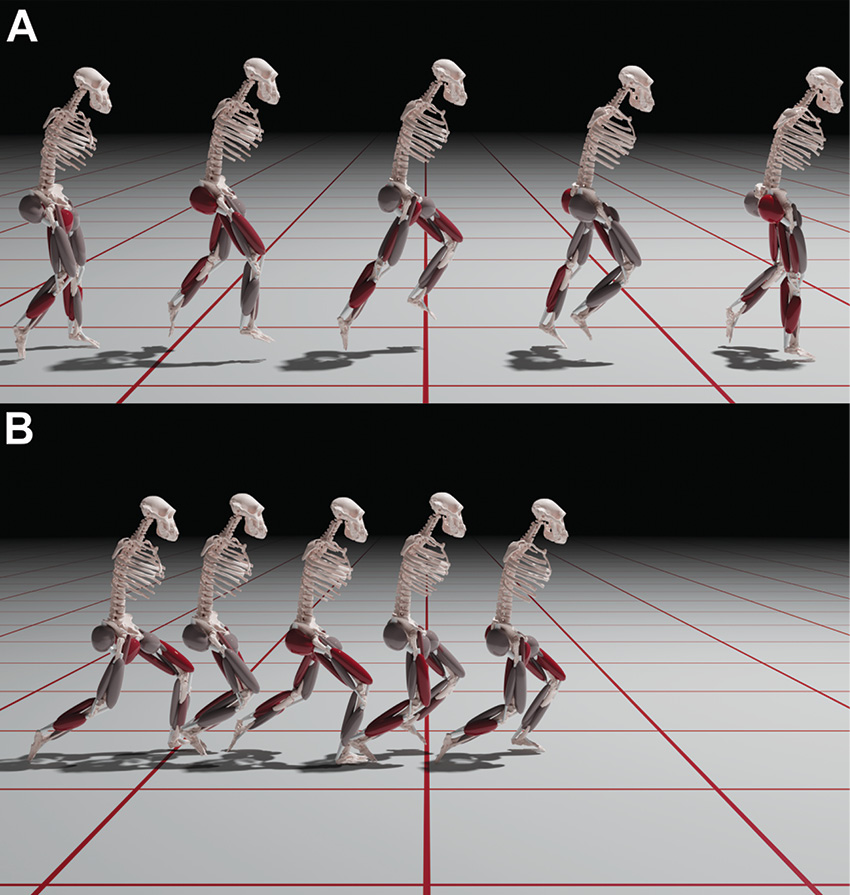
However, they also found that Lucy’s maximum running speeds – both absolute and relative – were significantly lower than those of modern humans. Even her fastest speed, in the simulation with the most human like muscle composition, was just 4.97m/s, compared to the 7.9m/s maximum speed of the modern human model. The fastest speed ever recorded in reality for a modern human, achieved by elite athlete Usain Bolt, is around 12.5m/s. Also limited was Lucy’s range of ‘endurance running’ speeds, or the speeds that could be maintained over longer distances. This suggests that Au. afarensis may not have been practising the sort of long-distance endurance running thought to be important in the hunting activities associated with early humans. The simulations looked at running energetics, too, and determined that Lucy’s metabolic ‘cost of transport’ (the energy used to run) was on par with other mammals and birds of similar body size. Despite the fact that the speeds she was reaching were lower, her cost of transport was between 1.7 and 2.9 times higher than the human model, indicating that later hominins evolved to run more efficiently, as well as faster and longer.
The study examined the impact of individual factors on running ability as well. Skeletal strength was considered but does not appear to have been a limiting factor. Instead, it was changes to muscles and tendons and a shift in overall body proportions that made the most difference in improving running capabilities for modern humans. In particular, the ankle extensor muscle architecture, such as the Achilles tendon, appears to have been extremely significant. The increase in length of the Achilles tendon to its current state played a central role in increasing running speed and efficiency in modern humans, and may have been linked directly to improved endurance running as well. These findings support the idea that such anatomical traits may have evolved specifically to improve running performance, not just as a side effect of better walking capabilities, representing a significant contribution to long-standing debates on this subject.
The research, which was recently published in Current Biology (https://doi.org/10.1016/j.cub.2024.11.025), offers valuable insights into the running capabilities of Australopithecus afarensis, as well as providing a better understanding of the effects of individual anatomical features on running performance in modern humans and the driving forces behind their development.
Text: Amy Brunskill / Images: Wikimedia Commons, 120; Karl T Bates et al., Current Biology 36(1)