Subscribe now for full access and no adverts
Researchers from the University of North Carolina (USA), using remote sensing and other geophysical methods, have identified sections of an extinct branch of the Nile which flowed close to the line of Old and Middle Kingdom pyramids between Giza and Lisht. The large pyramid cluster now lies in a narrow strip of desert, but the monuments were originally constructed close to the long-lost arm of the Nile, which has been named the Ahramat branch. Many of the pyramids were linked by a causeway to a Valley Temple that may have acted as a quay and entrance to the complex. While the stone used to build the pyramids would have been quarried locally, the adjacent waterway could have been used to transport workers and other building materials to the site. The team also suggests that a sluice regulating the flow of water from the Bahr Yusef canal into Lake Qarun may have relied on the Ahramat branch to carry excess water northwards, instead of into the Fayum.
In more pyramid news, an L-shaped anomaly has been identified in an apparently unused area of the elite Western Cemetery next to the Great Pyramid of Khufu at Giza. A joint Japanese-Egyptian team carrying out geophysical surveys in the area discovered what appear to be two man-made connected structures, which the team believes could represent the vertical walls of a tomb shaft leading to a burial chamber.
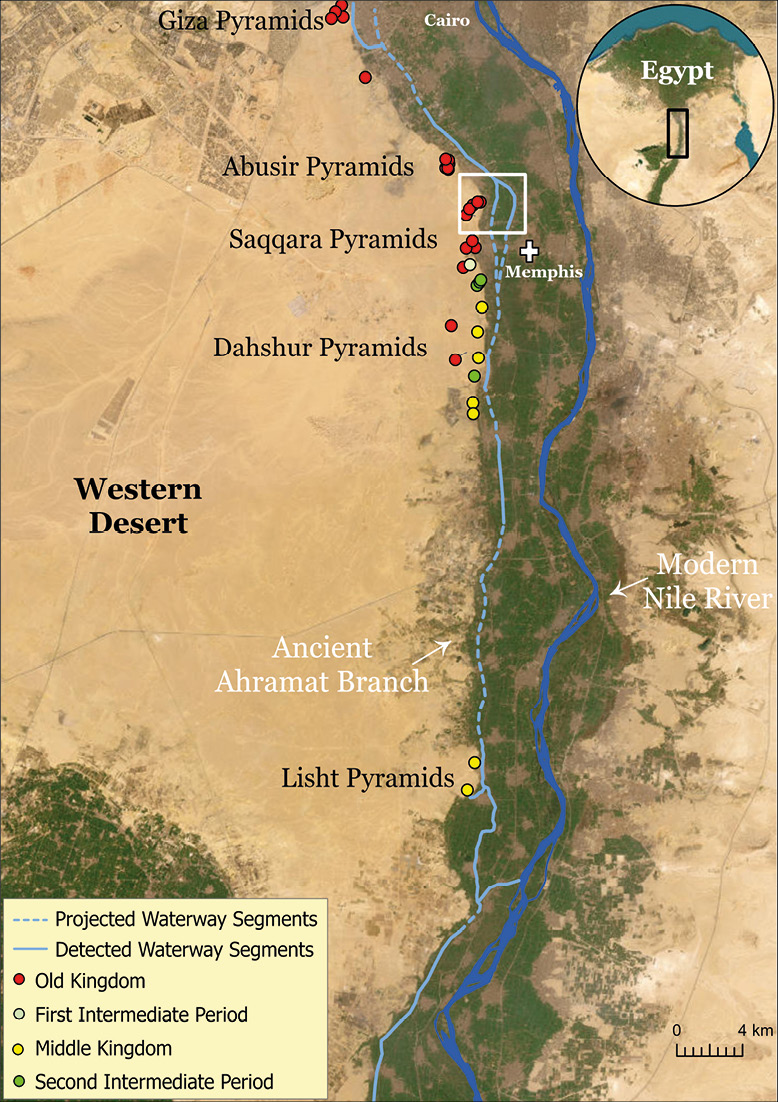
Text: Sarah Griffiths / Image: Ghoneim et al. in Communications Earth & Environment 5 (2024)