Subscribe now for full access and no adverts
In recent years, attempts to identify prehistoric cultural boundaries have increasingly relied on ancient DNA, or palaeogenomics. However, a new study published in Nature Human Behaviour (https://doi.org/10.1038/s41562-023-01803-6) turned its attention to the beads and other decorative objects that people across Europe attached to their clothes and bodies in the Gravettian period c.34,000-24,000 years ago.
The project, led by Jack Baker at the University of Bordeaux, surveyed thousands of personal ornaments from Gravettian Europe. Unlike the Aurignacian period before it, the Gravettian has produced a large number of decorative artefacts of various types, found at both occupation and burial sites. However, very few studies of this material have been carried out at a pan-European scale.
The researchers examined 134 types of personal ornament collected from 112 sites across Europe excavated between the 1800s and the present day. The objects studied were made from a variety of materials, including shells, teeth (both animal and human), bone, and ivory, as well as rarer examples of stone, amber, and jet. These were sorted into a vast georeferenced database that was then analysed, and objects from different sites compared in order to look for patterns and identify clusters of ornaments with shared characteristics.
This analysis identified significant variations in objects from different regions, particularly between east and west. These included the materials chosen: for example, red deer canines were favoured in western areas, while fox was preferred in the east, in spite of the fact that both species were available all over Europe. The data also indicated preferences surrounding colour, with people in what is now Eastern Europe favouring white objects like ivory and teeth, while groups to the south of the Alps preferred stones and shells that were more brightly coloured.
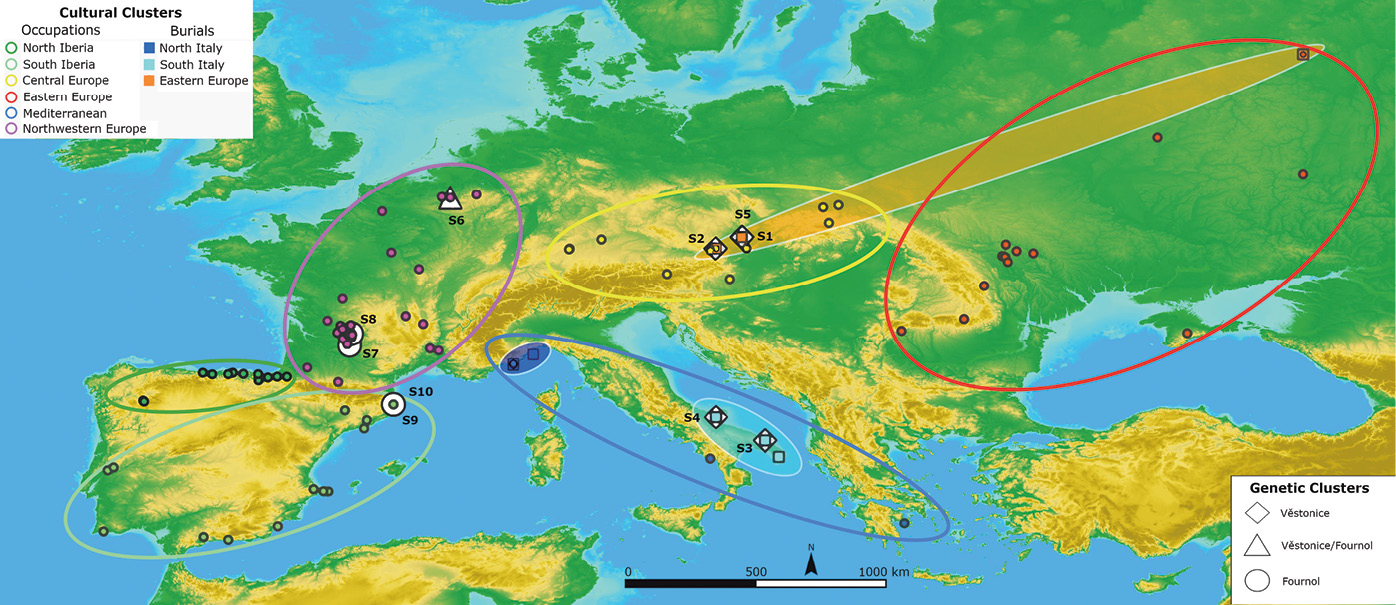
in Gravettian Europe (above), based on the differences between their personal ornamentation (below).
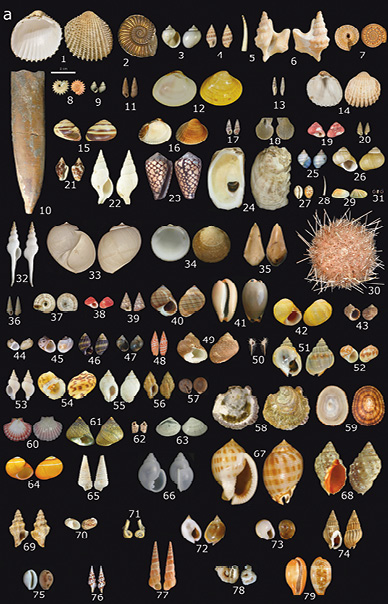
The differences noted were clear enough that the researchers were able to identify nine distinct clusters of sites with unique associations of personal ornamentation across Europe. Six of these groups were identified at occupation sites, while three were based on burial sites. The variations in personal ornamentation were particularly evident at burial sites, perhaps because these were spaces where cultural identities were delineated more clearly than they were in life. The data reveals, too, that some interaction and exchanges did occur between these culturally distinct groups.
One of the main aims of the research was to test whether diversity in material culture correlates directly to geographical distance (a theory known as ‘isolation-by-distance’) or whether other factors played a significant role. The research confirmed that, although physical distance did impact cultural practices, this alone could not account for all of the differences observed. Other factors that also played a role include time, availability of materials, social status of individuals, site function, and cultural exchange with other groups.
The study compared the findings, as well, with existing palaeo-genomic data from the Gravettian. This revealed that many of the clusters identified did line up with cultural boundaries indicated by genetic data. However, the material culture painted a more complex picture. In some cases, people with distinct genetic backgrounds seem to have shared material culture; in others, the personal ornaments indicate that people belonged to different cultural groups despite sharing similar genetic backgrounds. Analysis of the personal ornaments also identified three cultural groups in areas for which there is currently limited genetic data available.
This research demonstrates that Gravettian Europe was a more complex cultural landscape than we previously understood. The database highlights, too, the rich diversity of the period’s material culture and the skills of the hunter-gatherer artisans who made all of these beautiful objects. Perhaps even more important are the connotations the study has for future research. The results demonstrate the potential of personal ornaments as a source of information about cultural boundaries in the Palaeolithic. They also contribute to ongoing debates about the relationship between material culture and palaeogenomic research, showing that the best results come from integrating these approaches. The research serves as a reminder, too, that culture does not always equal genetics, and that cultural identities and social relationships are highly complicated things, in the past just as much as today.
Text: Amy Brunskill / Images: Baker et al., Nature Human Behaviour