Subscribe now for full access and no adverts
Archaeologists have revealed that humans were making fire 350,000 years earlier than previously known.
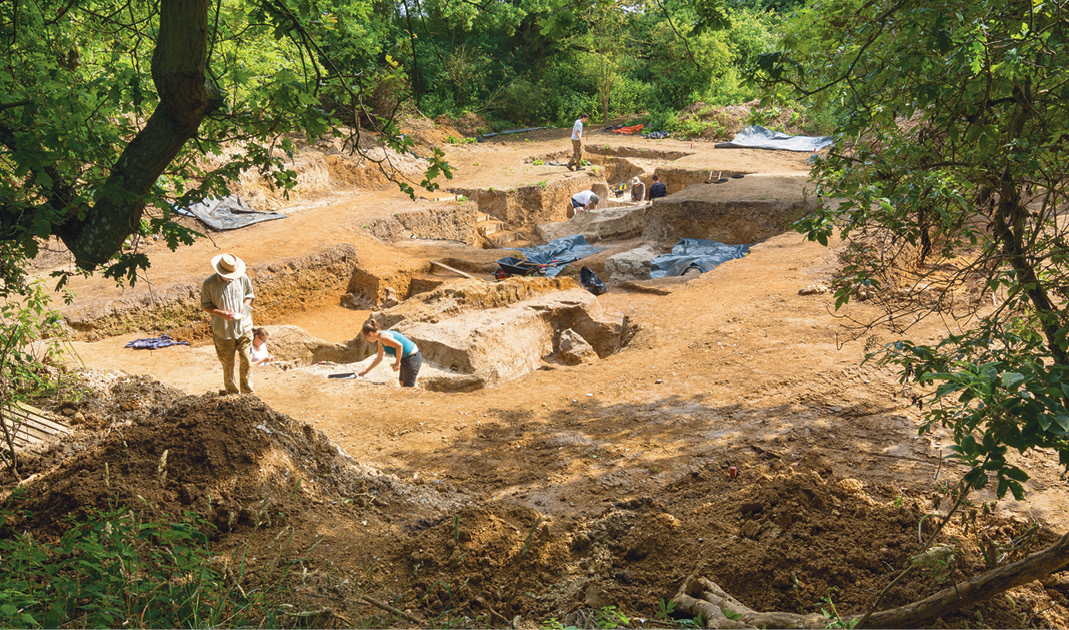
Opportunistic use of wildfire, usually created by lightning strikes, is likely to have developed over a million years ago, but – until now – the earliest direct evidence for human-made fire was limited to a few Neanderthal sites in France dating to 50,000 years ago. However, researchers from the British Museum have uncovered new evidence for the creation and control of fire at a Palaeolithic site in Barnham in the UK, dating to c.400,000 years ago.
The discoveries, recently published in Nature (https://doi.org/10.1038/s41586-025-09855-6), comprise a patch of heated sediment associated with a scatter of stone artefacts, including four heat-shattered handaxes. Careful analysis of the heated sediment demonstrates temperatures exceeding 750°C, and indicates repeated burning activity, suggestive of a campfire or hearth used on multiple occasions. These findings are consistent with anthropogenic fire-creation rather than naturally occurring wildfire. This is further supported by the presence of two small pieces of iron pyrite in the area. This naturally occurring mineral is a popular fire-starter, which can be struck with flint to produce sparks in order to ignite tinder. Pyrite is very rare in the area around Barnham, leading researchers to conclude that these fragments were collected by people – probably early Neanderthals – who were aware of its properties, and where to find it, and brought it to the site as part of a fire-making kit.
The ability to create fire at will would have transformed many aspects of life for ancient hominins, giving them greater flexibility and the ability to survive in harsher environments, widening the range of food that could be consumed and their ease of digestion (which may have been connected to an increase in brain size and enhanced cognition), and advancing other technologies like the production of glues for hafting tools. The hearth would have served as a communal hub, too, where planning and communication took place, further contributing to social evolution. The groundbreaking discoveries at Barnham push this turning point in human history back by hundreds of thousands of years.
For more information about the research, check out issue 431 of our sister-magazine Current Archaeology.
Text: Amy Brunskill / Image: courtesy Pathways to Ancient Britain Project – photo Jordan Mansfield