Subscribe now for full access and no adverts
Stone beads found near Lake Turkana in Kenya are offering a new way to study how early pastoralists in the area interacted with the landscape around them at a time of environmental and cultural change around 5,000 years ago.
The beads in question originate from monumental mortuary sites known as ‘pillar sites’, which feature platforms, stone pillars, cairns, and stone circles. At least seven such sites are known near Lake Turkana, dating between around 5,000 and 4,000 years ago, when animal herding was first being adopted in the region. At three of the six pillar sites excavated to date – Lothagam North (CWA 91) and Manemanya on the western side of Lake Turkana, and Jarigole on the eastern side – thousands of ostrich eggshell and stone beads were found. In a recent study, researchers analysed 806 of the stone beads to work out what types of mineral were used and where they had come from.
They identified 13 distinct types of stone, with clear variations between the sites in the materials chosen. At Lothagam North and Jarigole, similar types of stones were favoured – despite the distance of the sites from each other – many of which were colourful or shiny, and therefore seem to have been chosen at least in part for their visual appeal. In contrast, all of the beads at Manemanya are made from more muted pale pink or white calcite. Significantly, unlike at the other sites, the Manemanya beads – more than 300 stone beads and more than 10,000 ostrich eggshell beads – came from a single burial. Perhaps these beads had a different meaning, or indicated a person of particular importance; perhaps the choice of material was simply a reflection of personal preference.
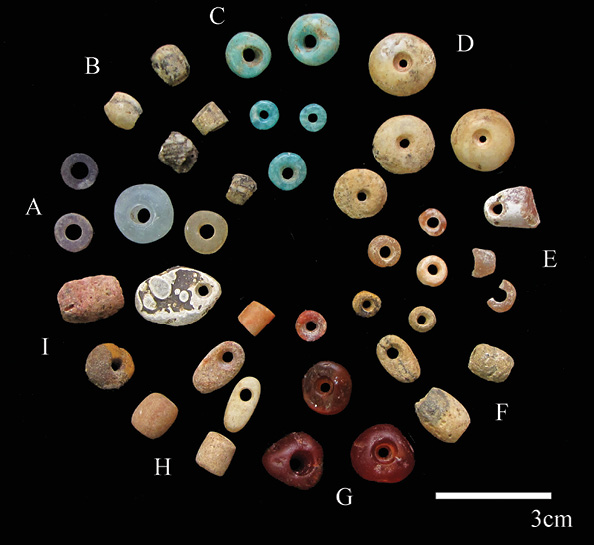
The researchers conducted a review of existing literature, as well as a survey of the area to identify possible sources for the stones. For two minerals, amazonite and fluorite, the nearest known sources are more than 200km away, but the other stones were nearly all locally available. This is interesting, as previous studies have emphasised the importance of long-distance trade and movement among early herders in the region, but the beads represent an element of life where local landscapes were clearly significant, adding a new dimension to our understanding of the dynamics of early pastoralism in eastern Africa. The research has been published in the Journal of Field Archaeology (https://doi.org/10.1080/00934690.2023.2232703).
Text: Amy Brunskill / Image: Carla Klehm