Subscribe now for full access and no adverts
Excavations at the Maya site of Tikal in Guatemala have uncovered a painted altar associated with the city of Teotihuacán, located more than 1,000km away in central Mexico.
Previous archaeological work at Tikal has uncovered evidence of extensive contact between the two cities in the 1st millennium AD, including an inscription documenting the Teotihuacán conquest of Tikal in c.AD 378, as well as a number of features that mirror constructions at the Mexican metropolis (CWA 110). The latest discovery offers further signs of Teotihuacán influence.
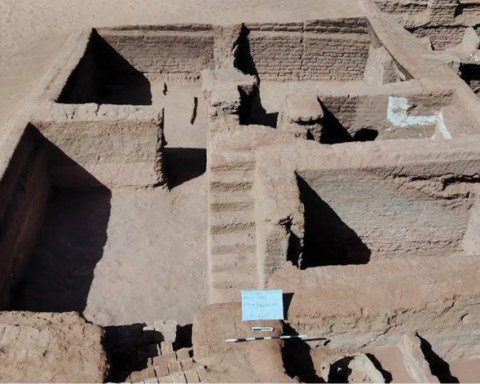
In 2019, excavations began in an area of Tikal known as Group 6D-XV, an elite residential patio compound with a design that strongly resembles known Teotihuacán arrangements. In the centre of this courtyard, archaeologists discovered a small altar, measuring 1.8m by 1.3m, and 1.1m tall. The altar is a talud-tablero construction, a ‘slope-and-panel’ architectural style popular at Teotihuacán. Each of the altar’s four sides feature a recessed panel painted in red, black, yellow, and orange, depicting a figure in an elaborate feathered headdress, wearing distinctive earspools and necklaces, and flanked by other regalia. These images are consistent with depictions of deities at Teotihuacán, and several elements hint at a possible association with the Teotihuacán ‘Storm God’.

The style, content, and production technique of these paintings bear such close similarities to finds from Teotihuacán that it is believed that the altar must have been commissioned by members of the Teotihuacán elite, and made by craftspeople who were extremely familiar with this non-local style – very possibly artists who were trained in Teotihuacán itself. The altar dates to around the 5th century AD, after the Teotihuacán conquest of Tikal, and provides clear proof that this event resulted not just in a transfer of cultural traditions, but in an active Teotihuacán presence in Tikal.
This discovery, which has recently been published in Antiquity (https://doi.org/10.15184/aqy.2025.3), offers valuable insights into the relationship between Tikal and Teotihuacán during this complex period of Tikal’s history. Further questions are raised by the fate of Group 6D-XV, which was abandoned several centuries later, around the time of Teotihuacán’s rapid decline, and remained untouched for the rest of Tikal’s history, despite its prime location near the city’s royal core. Was there, perhaps, something taboo about this place filled with reminders of Teotihuacán’s power?
Text: Amy Brunskill