Subscribe now for full access and no adverts
A changing Rome
Maria Barosso is an unsung heroine in Rome’s archaeological story. An extraordinary new exhibition in the Museo Centrale Montemartini provides a flavour of her work as a functionary in the Direzione Generale Antichità e Belle Arti. Born in 1879 and active until the 1950s, as a young artist she accompanied Giacomo Boni during his colossal excavations to create what today is the Roman Forum. But her greatest contribution was to record, alongside Istituto Luce Films, the humongous works ordered by Benito Mussolini between 1924 and 1943 to invent the Forum, bisected by the Via dell’Impero. Barosso’s watercolours vividly capture the light in the city, the arrant destruction of medieval houses and churches, and the spirited energy of the armies of workmen. She also made exquisite plans of many excavations for the Direzione Generale, as well as ravishing paintings of early medieval frescoes and mosaics that are as startlingly beautiful as her scenes of Mussolini’s overweening imperial ambition. Maria Barosso, artista e archeologa nella Roma in trasformazione runs until 22 February 2026.
Text: Richard Hodges
An Egyptian pleasure boat
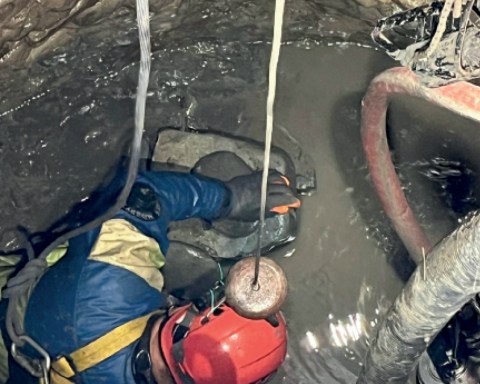
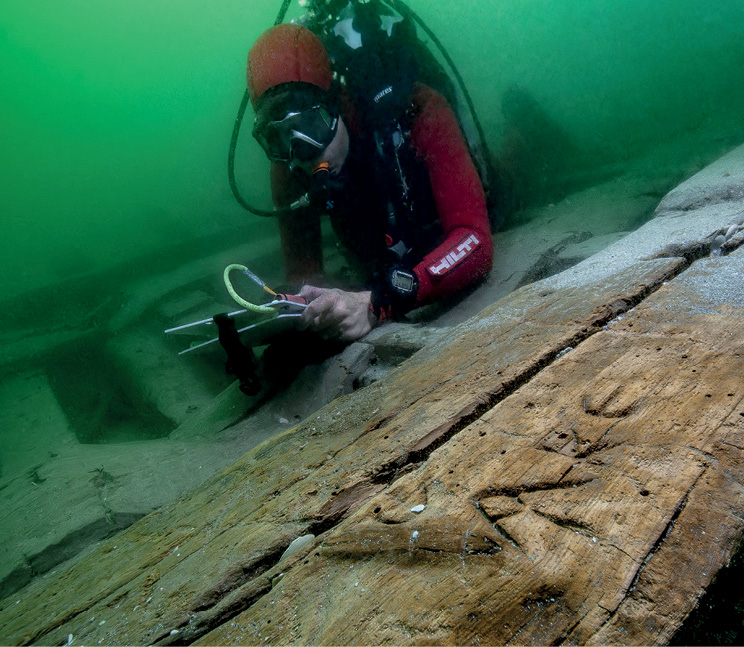
The well-preserved remains of an ancient Egyptian pleasure barge (thalamagos) have been discovered off the coast of Alexandria during underwater excavations by the Institut Européen d’Archéologie Sous-Marine (IEASM) led by Franck Goddio. The vessel was 35m long and c.7m wide), and designed to accommodate a lavishly decorated central pavilion. A piece of Greek graffiti on one of the barge’s timbers dates to the first half of the 1st century AD. Such thalamagoi are depicted in mosaics and mentioned by several ancient authors, but this is first time a physical example has ever been found. Given the location of the discovery, less than 50m from the Temple of Isis on Antirhodos Island, Goddio raises the possibility that the barge could have had a ritual role, and may have sunk during the destruction of the temple c.AD 50.
Ancient olive oil
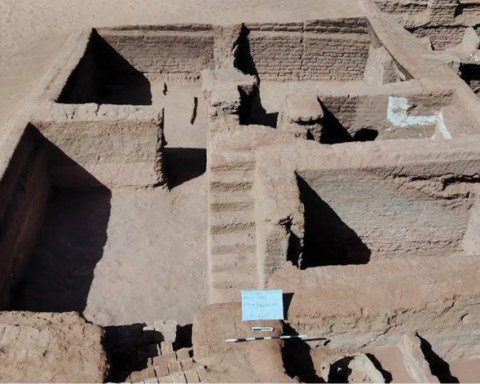
A Tunisian-Spanish-Italian Archaeological Mission is currently investigating an area of the Roman colony of Cillium, present-day Kasserine in Tunisia, where two ancient olive-oil production facilities are located, one of which is the second largest example ever found in the Roman Empire. The site of Henchir el Begar sits at the heart of an ancient rural estate known as Saltus Beguensis, which documentary sources indicate was owned by a senator called Lucillius Africanus in the 2nd century AD. The c.33ha settlement was divided into two main sectors, each equipped with oil presses, water-collection basins, and several cisterns. The larger oil-producing complex features a monumental torcularium (pressing hall) with 12 beam presses, while the other has eight presses of the same type. Both structures were in use between the 3rd and 6th centuries AD.
Text: Amy Brunskill / Image: Christoph Gerigk © Franck Goddio/Hilti Foundation