Subscribe now for full access and no adverts
The Accademia dei Concordi, located in the heart of Rovigo in north-east Italy, is one of the country’s oldest cultural and artistic institutions. Founded in 1580 by Count Gaspare Campo, it initially served as an organisation for writers, musicians, and artists. Over the centuries, the Accademia engaged in a broad range of cultural activities, including the promotion of arts, literature, sciences, and agriculture. In the early 18th century, under the patronage of the Venetian Republic, the institution underwent a period of renewal. Towards the end of the 18th century, an academic building was commissioned and was constructed based on the designs of local architect Sante Baseggio. From that time forward, the Accademia dei Concordi became increasingly important as a focal point for cultural institutions, associations, and individuals in Rovigo and the surrounding Venetian area.
The building also houses nearly 600 ancient Egyptian artefacts, which, although relatively modest in number, are extraordinary in their historical value and rarity, as well as constituting the largest collection of pharaonic antiquities in the entire Venetian region. The objects represent the entire timeline of Egypt’s pharaonic past, from its earliest dynasties through to the Roman occupation.

The collection owes much of its existence to the efforts of Commendatore Giuseppe Valsè Pantellini (1826-1890), a native of Rovigo who spent a considerable portion of his life in Egypt during the second half of the 19th century. Pantellini, who owned hotels in Alexandria’s Piazza dei Consoli and in Cairo’s Ezbekhya district, acquired Egyptian artefacts with the intention of donating them to the nascent museum in his hometown. The items were sent to Rovigo between 1878 and 1879, as documented in the Accademia’s own archives. Following Pantellini’s example, other individuals associated with the Accademia also contributed, though on a smaller scale, to the museum’s collection of Egyptian antiquities. These contributions primarily consisted of smaller funerary items, though precise information regarding the provenance of these pieces is often lacking.
In the period between 2008 and 2012, the Accademia commissioned my colleague Simone Musso and me to carry out a project to study and edit an official catalogue of its Egyptian collection. This was published in 2012.

The collection
The oldest object in the collection is a green serpentine cylinder seal dating to the earliest pharaonic dynasties, between Dynasty Zero and the Third Dynasty (c.3000-2613 BC). The seal bears the name of Kafyt and includes additional hieroglyphic symbols that probably had both decorative and apotropaic significance.

Door jambs
Important parts of the collection are two tomb reliefs dating to the Fifth Dynasty (c.2494-2345 BC). These reliefs (shown above) probably formed part of the jambs of a false door within a mastaba from Saqqara. They depict a woman and a man accompanied by smaller figures, likely to be their children, Neferku and Beby. The figures are portrayed in low relief, a style that was characteristic of the period.
Another key item in the collection (shown below) is a door jamb from another mastaba. It is missing the upper part, which has been detached along a transverse cut. The block is decorated on two faces, with hieroglyphic text on the front, and two scenes – one above the other, separated by an engraved line – on the side. In the upper scene, a male figure is depicted walking, bare-chested, wearing a knee-length kilt and a usekh collar. In each hand, he holds a duck by the neck. In the lower scene, there is a female figure on the right, and on the left a smaller male figure, both depicted walking. The woman, whose name is given above as Shesheti, is wearing an ankle-length dress and a short wig. In her right hand, she holds a basin with a small jar, while in the other hand she holds a sort of situla (pail). Inscribed above the man next to Shesheti is his title (but not his name), identifying him as a hem ka (a funerary priest). He wears a rectangular item on his head, which he supports with his right hand; in his left hand, he holds an object that is hard to identify. The inscribed front face of the block, although missing the initial part, features the following text:
The overseer of the properties[?], the overseer of all the wood of the Two White Walls, the youth/apprentice of the palace, Iymery.
The object contains a unique toponym (place name), found nowhere else to this day, leaving its exact significance ambiguous. It is unclear whether it designates a specific location in the Memphite area, or serves as a synonym for another term entirely.

Stelae
The family stela is another fascinating and rare object in the collection. Made of limestone, it features a tapering rectangular frame and an arched top, with a relatively simple list of names inscribed on it. Its true value, however, lies in the lunette, where two wadjet-eyes are carved facing each other. These eyes are distinguished by an unusual feature: the ‘hawk tears’ are inverted. This exceptional stylistic detail is also shown in another stela with the same dimensions and execution, from Abydos, now housed at the Hermitage Museum in St. Petersburg, and dating to the Twelfth Dynasty (c.1985-1773 BC).
Another elegant polychrome stela in plastered and painted wood dates to the Ptolemaic Period, and belonged to a man called Pawer. It is a commemorative or decree-type stela, which would have rested on a pair of stepped plinths, now lost. Its lunette depicts a scarab beetle supporting a winged sun disc with two pendant uraei. The scarab is flanked by two jackal figures facing inwards, representing Wepawet or Anubis. The body of the stela depicts a seated figure of Osiris attended by Isis and Nephthys, who hold up their hands in a gesture of protection. Anubis leads the deceased with his right hand, and in his left holds the papyrus containing the decree.

Coffins and cartonnage
The most historically significant piece in the collection is a model coffin, crafted from plastered and painted wood with traces of gilding. This coffin, measuring only 28cm in length, was intended to house a shabti. The coffin belonged to Prince Ahmose, also known as Sapair, the first-born son of the pharaoh Seqenenra-Djehuty-Aa of the Seventeenth Dynasty (c.1580-1550 BC). His white limestone statue, which portrays the royal child seated on a low seat, is housed in the Louvre. The prince, who died at the age of around six, was later deified, and a cult dedicated to him persisted for centuries.
A fragment of polychrome cartonnage from an anthropoid coffin of the Twenty-fifth Dynasty (c.747-656 BC), originating from Thebes, displays the remains of a floral usekh and three vertical columns of hieroglyphs on a white background, framed by rishi-friezes and part of the wings of a central god or goddess. The owner was Shepenmehit, daughter of Padiamun-neb-nesut-tawy, a god’s father of Amun and ‘chief of the balance attendants in Amun’s temple’ – a very rare title probably attached to the officials responsible for keeping account of the prebends (fees) and/or offerings made to the temple.
A further outstanding item is a coffin mask from the Twenty-sixth Dynasty (c.664-525 BC), part of the lid of an anthropoid coffin. The mask, which has a strikingly enigmatic expression, features large, closely set eyes and a slight smile. The face is beautifully sculpted, with inlaid eyes that were originally made of glass or semi-precious stones but are now painted white with a small black pupil. The mask’s wig is painted in alternating bands of yellow and blue, and its ears are pierced, suggesting that earrings may have once been worn, and that the owner was a woman.


The model coffin of Prince Ahmose-Sapair.

Shabtis
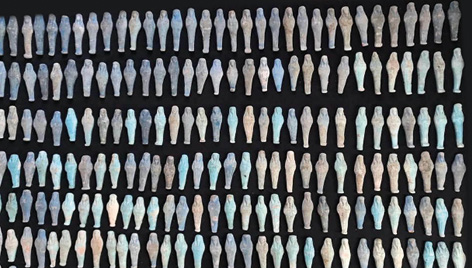
The collection contains around 70 shabti figurines, too, both intact and fragmentary, of which 16 are particularly noteworthy. These terracotta shabtis, dating to the Twenty-fifth Dynasty (Napatan Period), have all been created using the same mould, and feature flat backs. These figurines are unusual in that they deviate from the canonical Egyptian model. They appear to be inspired by a passage from the Book of the Dead about a man being called on to carry sand from the east to the west. The statuettes depict figures with truncated conical baskets on their heads and hoes in their hands, a design that represents labour. These figurines are rare in Egypt and limited to the Theban area, and their presence in the collection suggests a possible connection with Nubian culture, particularly with female royal burials from the el-Kurru cemetery during the Napatan Period, where many of them have been found.
The origins of these figurines remain uncertain, but it is believed that they may not have come from Pantellini’s collection. Alternatively, they may be part of the donations made by Giovanni Miani, a renowned explorer and Egyptologist from Rovigo, who travelled extensively in search of the sources of the Nile, even in Sudan. Miani’s contributions, along with Pantellini’s, were documented in the archives of the Accademia dei Concordi, and form a key part of the museum’s Egyptological holdings.
Mummies from this era were generally embalmed using the methods described by the historian Herodotus.

Mummies
The Accademia dei Concordi houses two mummies, both of which were recently restored. The first was about 20-25 years old at death and displays unusual embalming characteristics, lacking much of the traditional bandaging. Its date remains uncertain, adding an element of mystery to the specimen. The second is that of an adolescent, probably dating to the Roman Period, and is still wrapped in its shroud.
The first of these two mummies, that of a young woman, stands out because of its lack of original bandaging. Her arms are crossed over her chest, with her left hand clenched into a fist, and her right hand open – a posture that is quite rare in mummification. This ‘Osirian’ pose, in which the arms are crossed, is typically found in adult mummies, particularly in males. It was a practice that emerged during the New Kingdom and was initially reserved for royal burials. By the Ptolemaic Period, it had become more common, eventually extending to all individuals regardless of gender.
However, mummies from this era were generally embalmed using the methods described by the ancient historian Herodotus. These techniques focused on creating intricate external bandages, while the mummy in the Accademia’s collection appears to have been embalmed using a more advanced method, one that has contributed to its good preservation to the present day.

A Late Period painted wooden funerary mask.
The mummy’s skeleton is in remarkable condition, with the arms and lower limbs wrapped separately, along with the fingers of both the hands and feet, which still show visible traces of the bandages. There is no evidence of damage to the ethmoid bone (separating the nasal cavity from the brain), and an X-ray scan reveals the presence of opaque material within the skull. This suggests that the brain was removed and replaced with hot resin introduced through the occipital foramen (the space through which the spinal cord connects to the brain). The evisceration was done via a traditional incision on the left side of the body, a method typical of ancient Egyptian embalming. Inside the ribcage, on the right side, there is an elongated package probably consisting of resin-soaked bandages. This mummy presents a fascinating blend of embalming techniques from different historical periods, which makes it particularly intriguing for researchers.
The second mummy, that of a child, was found wrapped in its shroud, but with significant differences from the adult. The bandages completely cover both the upper and lower limbs, with the wrapping around the feet notably thicker, almost resembling sandals. The skull appears flattened at the back, with no visible neck. This anomaly stems from improper embalming practices, possibly due to the delicate nature of the child’s bones. It is suggested that, during modern restoration, purple ribbons were added near the ankles to secure the limbs, which may have been fragile and prone to detachment.

The history of this child’s mummy is particularly curious. Historical documents reveal that it was placed inside one of four wooden coffins sent from Egypt, but rather than being intended for the Accademia, the mummy was originally meant to be sent to a friend of the institution, Cavalier (Sir) Antonio Minelli. How the mummy ended up in the collection is still unclear, and, while it is possible it was donated by the Minelli family after the death of the Cavalier, there is an unusual lack of archival documentation confirming this bequest.
Neglected treasures
Small collections of antiquities, like this one in Rovigo, often reveal rarities and unknown masterpieces of Egyptian art – pieces that have yet to receive the recognition they deserve. Despite many efforts to promote its value, the pharaonic collection in Rovigo remains neither permanently accessible to a broad audience nor displayed in a public context, due to bureaucratic challenges and a lack of private or state investments. These lesser-known treasures hold immense potential for deepening our understanding of ancient Egyptian culture, making their promotion crucial for providing wider access to Egypt’s rich and diverse artistic heritage.

Simone Petacchi is a scientific collaborator with the Museum of Mediterranean Archaeology in Marseille. His article on the Marseille collection appeared in AE 145.
All images: the author, unless otherwise stated