Subscribe now for full access and no adverts
Khakaura Senusret III (c.1874-1855 BC), also known as Senwosret III or, in Greek, Sesostris III, was perhaps the most significant king of the Twelfth Dynasty – a line of already important rulers. There were many innovations in religion, culture, and art during his reign. The administration also underwent substantial change, so much so that the period after Senusret III’s rule can be considered a totally different phase in Egyptian history when compared with the early Middle Kingdom. The country became very centralised, with the largest and most important centres being Thebes, Abydos, and the Fayum region.
Senusret III was the son of Senusret II and his wife Khenment-nefer-hedjet Weret. He probably had several brothers and sisters, but it is often difficult to be sure of a certain relationship. A ‘king’s daughter’ buried next to the king’s pyramid could be his daughter, but she could also be a sister. His wives have been confirmed, as Khenment-nefer-hedjet Weret (II), Neferethenut, and Itakayet each had a small pyramid next to the king’s Dahshur pyramid. Possible daughters are Menet, Sithathor, Mereret, and Senetsenebtisy. His successor Amenemhat III was probably his son.
On becoming king, Senusret III received the royal fivefold titulary:
Horus name: Netjeri-kheperu
The Two Ladies name: Netjeri-mesut
Golden Horus name: (Bik-nebu)-kheper
Throne name: Khakaura
Birth name: Senusret

Classical sources
Senusret III is best known for his military campaigns in Nubia and the southern Levant, which were so important they were remembered in Graeco-Roman times. The historian Manetho, who compiled an Egyptian history for the early Ptolemies, wrote:
Sesostris, for 48 years: in nine years he subdued the whole of Asia, and Europe as far as Thrace, everywhere erecting memorials of his conquest of the tribes. Upon stelae he engraved for a valiant race the secret parts of a man, for an ignoble race those of a woman. Accordingly he was esteemed by the Egyptians as the next in rank to Osiris.
Translation follows The Fragments of Manetho, Loeb Classical Library edition, 1940


The Classical historian Herodotus reports:
Therefore, passing these by I shall make mention of the king who came after these, whose name was Sesostris. He (the priests said) first of all set out with ships of war from the Arabian Gulf and subdued those who dwelt by the shores of the Erythraean Sea [the Red Sea], until as he sailed he came to a sea which could no further be navigated by reason of shoals: then secondly, after he had returned to Egypt, according to the report of the priests he took a great army and marched over the continent, subduing every nation which stood in his way: and those of them whom he found valiant and fighting desperately for their freedom, in their lands he set up pillars which told by inscriptions his own name and the name of his country, and how he had subdued them by his power; but as to those of whose cities he obtained possession without fighting or with ease, on their pillars he inscribed words after the same tenor as he did for the nations which had shown themselves courageous, and in addition he drew upon them the hidden parts of a woman, desiring to signify by this that the people were cowards and effeminate.
Herodotus II.102; trans. G C Macaulay
In the Alexander Romance (a more fantastic narrative on the life of Alexander the Great), it is even stated that Alexander was ‘the new Sesostris, ruler of the world’. Several other Greek and Latin sources describe one especially curious episode, in which Senusret went out once a year on a chariot drawn not by horses, but by the kings of newly conquered provinces. This story is related by Diodorus of Sicily (1.58.1-2), Lucan (Pharsalia 10.330), and Pliny the Elder (Naturalis Historia 33.15). We now know that, at the time of Senusret III, Egypt did not yet have horses and chariots.


Military campaigns
It is clear from these sources that Senusret III was still a well-known figure in Greek and Roman times, at least for educated people. But how do these stories by Classical authors relate to what we actually know about the king? Egyptian sources are, as often, fairly scarce. However, even here, Senusret III appears as a king most often involved in military enterprises. Indeed, it is from ancient Egyptian sources that we know the king made three incursions into Nubia.
The first campaign seems to date to the eighth year of the king’s reign. Not much is known about individual events, but in that year the king set up a stela at the fortress of Semna to mark the southernmost border of Egypt. In a second campaign two years later, the Egyptians went even further south. One rock inscription was found at Dal, below Semna, and therefore south of the Egyptian–Nubian border.

In Year 19, a third campaign is attested, again mainly known from passing references in inscriptions. However, a second stela was set up for the king at Semna. This longer text is unusual in that it is the first time in Egyptian history that a king speaks to us ‘directly’:
I have made my boundary further south than my fathers, I have exceeded my descendants. I have given orders to my frontier, beyond which none shall pass among them [the Nubians]. To preserve it, one is to kill him who transgresses it.
The Nubian campaigns are not easy to understand. The king’s great-grandfather Senusret I (c.1965-1920 BC) had already conquered Nubia up to the Second Cataract at Semna. He also erected huge fortresses in Lower Nubia to protect the region. So why did Senusret III go back? There are two possibilities: Egypt may have lost control of the region; or perhaps there were many uprisings, forcing the king to bring it under tighter control. The Dal inscription provides another hint: the fact that the king went further south. In the Second Intermediate Period (c.1650-1550 BC), the Kerma Empire became a major player in Sudan, posing a serious threat to Egypt. It is possible that in the Middle Kingdom, the empire was already strong enough to cause the Twelfth Dynasty kings to act against it.

The impact of Senusret III at Nubia is clearly visible in the archaeology. The king built, rebuilt, and enlarged many fortresses in Lower Nubia. In the New Kingdom, he was worshipped as a god in the region, and his image is found on several temples and stelae, sometimes together with his goddess-wife Meretseger, who is only known from New Kingdom sources, and therefore probably fictional.
The king was also involved in wars against cities in the southern Levant, but the sources for these are even more fractured. The main evidence comes from the stela of the military officer Khusobek (also known as Sebek-khu), found at Abydos and now in the Manchester Museum. His detailed biography tells us he was born during the reign of Amenemhat II (c.1922-1878 BC) and was promoted several times. He fought for Senusret III in Nubia, but went with the king to the southern Levant, too:
His majesty proceeded downstream to overthrow the Bedouins of Asia. His majesty arrived at the region named Sekmem, when his majesty was making a good beginning to come back to the royal residence, the Sekmem and the worthless Retjenu fell. I was serving [at] the rear of the army. Then the soldier of the troop engaged to fight with the Asiatic people.

Further evidence for military actions in the Levant comes from the tomb of the ‘high steward’ and vizier Khnumhotep at Dahshur. On the tomb’s façade there was a long biographical inscription that is not well preserved, but seems to report Egyptian military involvements at Byblos and other Levantine towns. The evidence is limited, but clearly shows that Senusret III undertook military action in the Levant. Unlike Nubia, however, this did not lead to the conquest of land or cities. These campaigns seem to be short expeditions for looting and to demonstrate Egypt’s power.

Administration
Within Egypt, Senusret III completely reformed the running of the country and the administration was heavily tightened. Previously officials often held several titles indicating they held multiple responsibilities. Under Senusret III, each official had one specific task. This is most visible at the provincial level. In the early Middle Kingdom, local governors often held long title strings. As many titles/offices were connected with estates that generated large revenues, they enjoyed incomes from several sources. Under Senusret III, however, the title string of a local governor was reduced to the title ‘governor’ (hati-a in Egyptian), sometimes with the additional title ‘overseer of priests’ indicating that he was also in charge of the local temple. As a result, the local governors were now no longer able to build the large rock-cut tombs that were so common in the early Middle Kingdom.

Another major administrative invention was the division of the office of the vizier, the highest official at the royal court. Now the office was split in two, with one vizier for Lower Egypt (whose main office was in the royal residence at Itjtawy), and another for Upper Egypt, based in Thebes, which became an important administrative centre. The overwhelming workload connected with administrating the Nubian provinces might have been one reason for the division of the office. Thebes was closer to Nubia, and indeed many seal impressions from documents show that the province was administered from Thebes, with the vizier as highest official in charge.
Several viziers are known for the king’s reign. In addition to the Khnumhotep, whose mastaba was found at Dahshur and who was mentioned above, two other named viziers are known. At Dahshur, there is the huge mastaba of the vizier Nebit. Not much is known about this person, but the size of his burial structure shows that he was an important man at the royal court. Another vizier was Saaset (‘son of Isis’), who is known from several monuments. He was high steward, and later held the positions of treasurer and vizier at the same time. His huge mastaba is not far from the Pyramid of Amenemhat II, so he probably began his career under that king, reaching his highest position under Senusret III.
After the vizier, the ‘treasurer’ was one of the most important officials at the royal court. As well as the above-mentioned Saaset, we know of several named treasurers: Sobekemhat, whose huge mastaba was built next to the pyramid of the king; Senankh, who is known from an inscription on the island of Sehel, not far from Aswan, where he reports the opening of a canal; and finally Iykhernofert, who is known from many stelae and was involved in arranging the Osiris festival at Abydos.


Funerary complexes
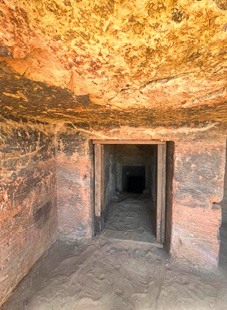
Senusret III showed special interest in Abydos, the site of the tombs of First and Second Dynasty kings. In the early Middle Kingdom, the tomb of the First Dynasty king Djer was identified with that of the Underworld god Osiris, and Abydos became a major religious centre. Many kings built or enlarged the temples there. Senusret III, however, went one step further, erecting a complete funerary complex, with an attached town called Wahsut. The funerary complex consisted of a valley temple, and a main funerary monument close to the desert mountains. This was surrounded by a huge enclosure wall, with an entrance to a long corridor leading to underground burial chambers.
The king built a pyramid at Dahshur, too, which has twice been the target of excavations. At the end of the 19th century, Jacques de Morgan excavated the whole complex and found many treasures belonging to the king’s daughters. An American team under Dieter Arnold has been excavating there since the 1990s, and made many new and important discoveries. The pyramid was originally about 105 metres wide at the base, and around 62.57m high. The pyramid proper is surrounded by the smaller pyramids of royal women.
To the south there are three large pyramids. One of these belonged to Khenmet-nefer-hedjet Weret II, the king’s wife, while the middle monument was built for Khenmet-nefer-hedjet Weret I, the mother of the king. The third was a satellite pyramid often found in royal pyramid complexes, the exact function of which remains unknown. It was perhaps the burial for the ka of the king. The pyramid belonging to the king’s mother is of particular interest. Instead of an actual burial chamber, the structure contained a room that was far too small for a coffin. So this was a dummy pyramid. The king’s mother was most likely buried at Lahun, near her husband Senusret II, but her son wanted to have her close by for all eternity, and therefore arranged this ‘fake’ burial space. The pyramid of the king’s wife Khenmet-nefer-hedjet Weret II contains a corridor system that leads under the king’s pyramid, where she was buried.

On the north side of the king’s pyramid are four smaller monuments, all belonging to royal women. Only two can be attributed to named royals: Neferethenut and Itakayet. The pyramids were connected by an underground corridor system. In the south, this system ended in a gallery with several burials of the king’s daughters. Here a clear difference is visible. The king’s wives were buried under a pyramid; the king’s daughters were buried in a communal gallery. The king’s burial is under the main pyramid. There is a corridor on the north side leading to three burial chambers, one with the sarcophagus of the king. Around the pyramid were found the remains of temples, including smaller funeral chapels for each one of the royal women. The temples and chapels were once decorated with reliefs, but only the smallest fragments have been found. However, even in fragments they provide valuable information about religious belief and kingship.
Why did the king have funeral complexes in both Abydos and Dahshur? Furthermore, where was he actually buried? This is a mystery that we have not yet solved. Both complexes contain a sarcophagus. The burial chambers at Dahshur were found otherwise empty, with few signs of any burial goods, but that might be due to tomb robbery and early explorations of the complex that took away all material left by ancient looters.

The face of power
Perhaps the most noticeable innovation of the reign is seen in the king’s portrait. For almost a thousand years, the Egyptian king was shown as a young man. However, the sculptures of Senusret III – some of the finest sculptures ever produced in ancient Egypt – are strikingly different: the king is shown almost careworn, unsmiling, with large ears and heavily lined facial features. Here, one really has the feeling we are looking at a portrait.
Many statues of the king survived. Some are inscribed with his name, but where only the face is preserved, the outstanding features make it clear that the depiction is that of Senusret III.

Burial customs
Burial customs in Egypt changed markedly during Senusret III’s reign as well. In the early Middle Kingdom, wealthy people were often buried in coffins that were decorated inside and out with coffin texts and depictions of burial goods, and accompanied by wooden models of servants and craftsmen – the most iconic group of Middle Kingdom objects. Under Senusret III these tomb models suddenly vanished. Coffins became much simpler and were now decorated only on the outside. Instead of tomb models, objects from daily life became more common in burial chambers. It is evident that religious beliefs altered, although we cannot know how and why these changes occurred.
A confusion of dates
When the king’s reign came to an end is a point of debate within Egyptology. Later sources indicate that he might have ruled for about 39 years. However, of the many monuments and documents dated to Senusret III, none date to after Year 19. Then again, recent scholarship suggests that the king had a 20-year co-regency with his son Amenemhat III. The evidence for this is based on a number of higher year dates on the buildings attributed to Senusret III. But this is not conclusive, and others argue that these higher dates belong to Amenemhat III. What can be said for sure is that Senusret III ruled for 19 years more or less independently. If there was a co-regency with his son, the king no longer played a major role during that period.

Strong ruler or tyrant?
The king’s severe image portrayed by his statues, his military enterprises, and his suppression of the power of local governors has led some modern historians to see Senusret III as a typical oriental tyrant. The Middle Kingdom in general sometimes has a rather bad reputation, being seen as a kind of police state which reached its peak of oppression under Senusret III. In her 2021 book The Good Kings: absolute power in ancient Egypt and the modern world, Kara Cooney selects six Egyptian kings as examples of ancient Egyptian rulers who ruled like dictators, with Senusret III as the example for the Middle Kingdom. However, it is unlikely that this king was worse than others of this period, or compared with any king in the ancient world. Some aspects of the power that these kings held may be more visible under Senusret III, but in practice he was most likely just one of many rulers who were very far removed from any modern concept of social justice.
Further reading:
• D Arnold (2002) The Pyramid Complex of Senwosret III at Dahshur: architectural studies (Publications of the Metropolitan Museum of Art Egyptian Expedition 26, New York: Metropolitan Museum of Art).
• W Grajetzki (2024) The Middle Kingdom of Ancient Egypt: history, archaeology and society (2nd revised edn, London: Bloomsbury Publishing).
• P Tallet (2015) Sésostris III et la fin de la XIIe dynastie (revised edn, Paris: Pygmalion).