The power of nature: Seeking the origins of Hindu, Buddhist, and Jain devotional art

Start
This article is from World Archaeology issue 132


Subscribe now for full access and no adverts

Today, Buddhism, Hinduism, and Jainism have almost two billion worshippers around the globe. While the origins of these religions lie in India, images of the deities and enlightened beings sacred to them can be found in many countries. The playful elephant-headed god Ganésa, for example, is associated with wisdom and new beginnings, and revered by some members of all three religions. Today, he may be encountered in a multitude of settings, including temples, homes, and workplaces. While the familiarity of such devotional imagery can give it an almost timeless quality, its origins lie in an extraordinary era from 200 BC to AD 600, when the sacred art associated with these three religions in India underwent nothing short of a revolution.

This is one of the rich seams delved into by the major British Museum exhibition Ancient India: living traditions (see ‘Further information’ below). It showcases how this period upended tradition by bringing a shift that broadened the repertoire of devotional art associated with these three religions to include imagery that went beyond purely symbolic representations of divine and enlightened beings. By the time that this transformative era drew to a close, the core range of characteristics that remains familiar today was set. This different take on conceiving divine and enlightened figures was not entirely new, though. Instead, it drew liberally on existing imagery associated with a particular group of popular and potent deities in India: nature spirits.

A stone plaque from India showing a five-headed cobra representing a nāga: a male snake spirit. It dates to the 17th century and stands c.43cm high. Image: © Trustees of the British Museum 

Rural religion

While the subcontinent was studded with towns and major cities in the 3rd and 2nd centuries BC, the majority of the population lived in the countryside. Inevitably, the lives of the people comprising these agricultural societies were framed by the passing of the seasons. After all, their well-being was dependent on successful harvests and the resources that could be foraged from elsewhere in the landscape. Unsurprisingly, then, nature was a matter of grave concern to these communities. If the monsoon rains failed, people would starve. Equally, if they were too heavy, then crops would be washed away, and once again people would be left with nothing. As a result, these societies would have been only too aware that there were two sides to nature: it could bring plenty, or it could take everything. Measures to engineer a favourable outcome involved placating the nature spirits that these communities believed inhabited the world around them. These included yaksas and yaksīs, who were male and female spirits, and could be found associated with trees – often specific species of trees – bodies of water, and mountains. Alongside them were other deities associated with animals, such as the nāgas and nāgīnis: male and female snake spirits, who could bestow fertility and also control water to ensure bountiful harvests.

Such spirits would be venerated at appropriate spots in the landscape. Trees and watery places were suitable for both groups, while snake worship was associated with caves and termite mounds as well – both places that these creatures are known to frequent. Indeed, an early written record of snake-veneration in the north-west of India comes from an account of Alexander the Great’s activity in the region during the 4th century BC, as set down by the Roman author Aelian: ‘when Alexander threw some parts of India into a commotion and took possession of others, he encountered among many other animals a serpent that lived in a cavern and was regarded as sacred by the Indians, who paid it great and superstitious reverence. Accordingly, they went to great lengths imploring Alexander to permit nobody to attack the serpent; and he assented to their wish. Now, the army passed the cavern and caused a noise… And it hissed and snorted so violently that all were terrified and confounded’. For a long time, the focus for offerings to nature spirits was stone altars placed in suitable settings. At some point in the 4th or 3rd centuries BC, though, a major change in approach is detectable: nature was given a face.
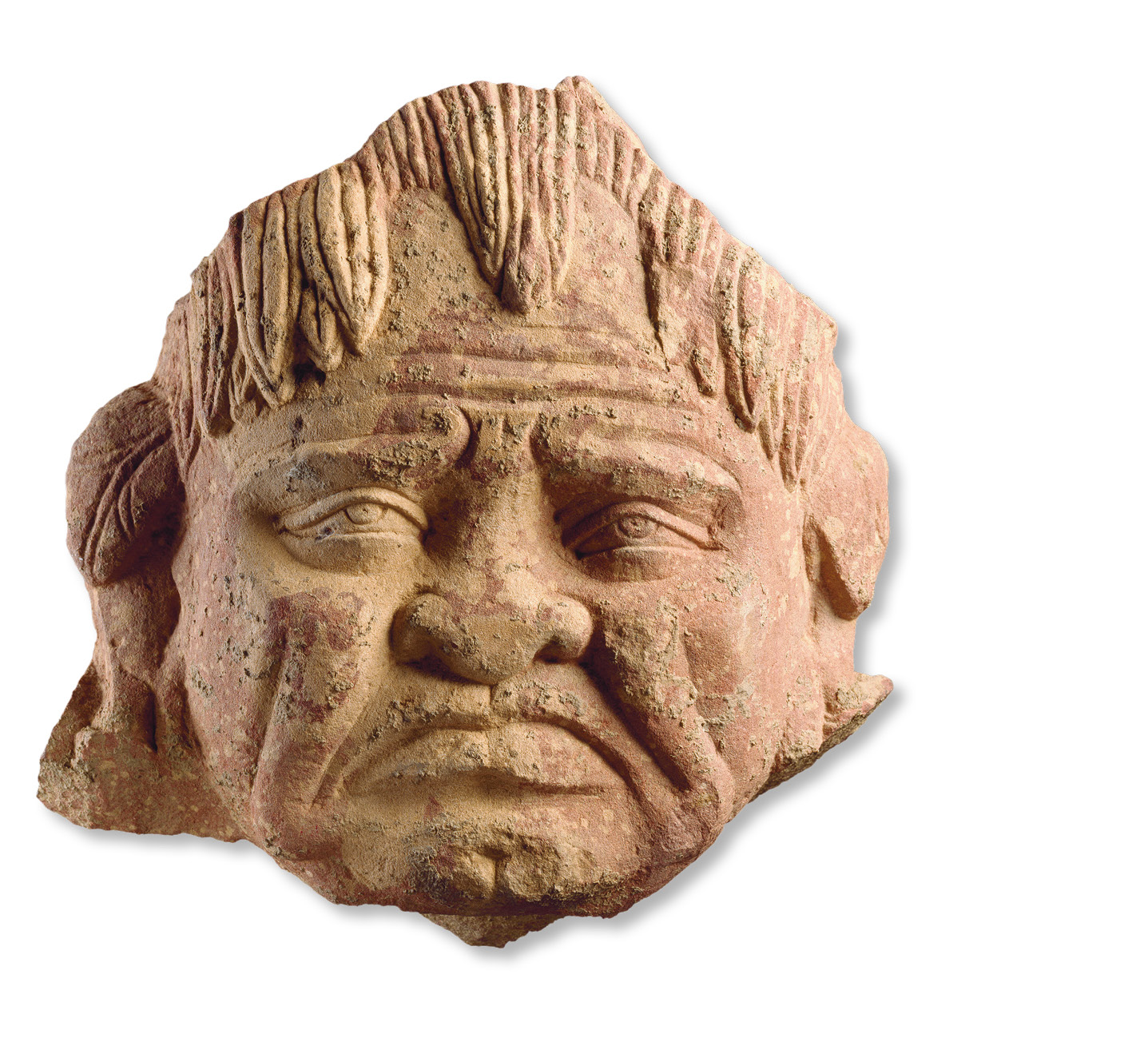
 The sandstone head of a grimacing yaksa, which dates to AD 100-300 and comes from Mathura, India. Leaves sprout above his ears, which possibly connects him with trees. Image: © Ashmolean Museum, University of Oxford

This new take on representing nature spirits is apparent from stone and terracotta statues showing them in human or hybrid human-and-animal forms. Early representations came in various sizes, ranging all of the way from something that would fit in your pocket to monumental statues. These latter can stand up to 3m tall, making them an imposing presence in the landscape. Such colossuses did not, though, greet devotees with a welcoming smile. ‘Their expressions are stern and really quite jarring,’ says exhibition curator Sushma Jansari. ‘We have a life-sized print of one in the exhibition. When you look at them, you really are put in your place by the awesome power of nature. The smaller representations of these spirits are also far from being happy, smiling deities. Thousands of terracotta figures have been found, dating from the 2nd century BCE to the 1st century CE. In most cases we don’t know whether they were votive offerings, kept in a household, or carried around in a little bag. What we do know is that some of them were mass-produced in moulds. They are also very tactile: the face of a rare bronze yaksa has been worn smooth from people repeatedly touching it.’
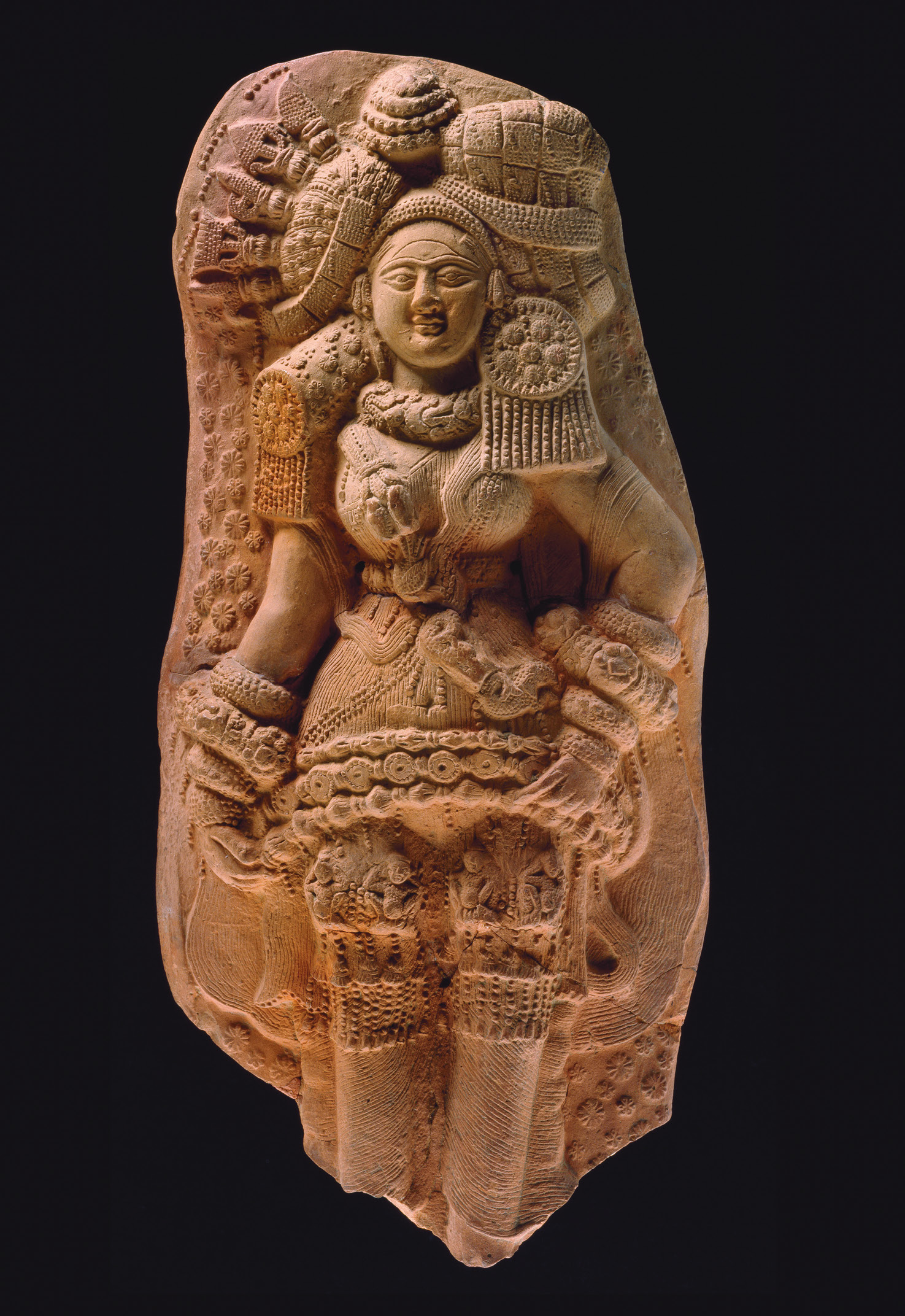
A terracotta plaque measuring 21.3cm high and showing a yaksī – that is, a female nature spirit – wearing a rich array of jewellery and associated with flowers. While the impression of abundance this conveys is a standard feature, the weaponry protruding from her hair – to the left, as seen by the viewer – is a more unusual touch. This object dates to the 1st century BC and comes from Tamluk, India. Image: © Trustees of the British Museum
A terracotta figure of a yaksa from Mathura. This male nature spirit is shown baring his teeth and holding a goat. The object is 8.2cm tall and dates to roughly 300-100 BC.
Image: © Ashmolean Museum, University of Oxford

‘The design of the terracotta images is very interesting. Some of the male yaksas are shown holding animals or flasks of alcohol, giving a sense of what was being offered to them. And they’re often grimacing, like they’ve had a really bad day. These figures also have lovely rounded bodies, often with pot-bellies; they’re not like the buff Roman gods, it’s a very different aesthetic. These are normal, earthy, everyday figures: they are not deities who are being distanced from humanity by their perfection. These terracotta plaques can also force you to challenge your assumptions of what you are looking at. There’s one showing a voluptuous female yaksī, who is adorned with symbols of abundance, such as flowers and jewellery. But when you look more closely, you can see there are weapons including a spear, axe, and tridents emanating from her hair. So she has a martial quality, which emphasises her power. What we’re really seeing here is an awareness that there isn’t just one way of looking at nature, it’s much more ambivalent than that. These deities aren’t simply good or bad; they’re both. Take the snake spirits, which are closely associated with wealth, and so offer something very desirable. If you don’t placate them, though, they can literally kill you with a single bite. It really conveys that two- fold experience of nature.’

A sandstone sculpture of a jina with the endless knot symbol on his chest. This piece was created at Mathura in c.AD 200-300, and stands 35.5cm tall. Image: © Trustees of the British Museum

We do not know why veneration of these nature spirits began to incorporate images of them in human or human-and-animal form, but there is no question that it proved to be a highly influential – and presumably therefore also popular – step. When these earliest figures of nature spirits were being produced, Hindu, Buddhist, and Jain veneration remained focused on symbolic representations of divine or enlightened beings. The rituals associated with this were much more ephemeral, and did not require sculptures. For example, the god of fire could be represented by fire itself, while a pinch of turmeric or clay would evoke Ganésa. After a ritual was complete, these elements were wiped away. Even when the first sculptural representations of the Buddha began to be produced during the era of the Mauryan Empire (c.323-185 BC) – whose powerbase was centred on the Ganges valley – he was shown in a symbolic form, appearing as footprints, an empty throne, and a sacred parasol. It is only in the 1st century BC and 1st and 2nd centuries AD that Hindu, Buddhist, and Jain sculpture begins to feature human forms. While these images differ, they all show some intriguing similarities to the earlier representations of nature spirits.

An enlightened Jain teacher seated in meditation. This marble sculpture dates to AD 1150 1200 and comes from Gujarat, India. Image: © Trustees of the British Museum

A revolution in representation

‘We think the Jain sculptures are the first of the three religions to show human forms,’ says Sushma. ‘That had been done by the nature spirits for a few centuries at this point. The earliest definite examples of representations of enlightened Jain teachers date to the 1st century BCE and come from Mathura, which was a really important ancient city and region. It was a big trading centre, very wealthy, with plenty of religious structures, and lots of workshops producing the most incredible art. Now, those early Jain sculptures look very similar to the nature spirits. And, when you think about it, one reason for this is because it is the same sculptors in the same workshops who are making both sets of images. So, they use the nature spirits as essentially prototypes to start shaping the bodies of the enlightened teachers into human form. Once again, the jinas have lovely rounded figures, and there is also a debt to the nature spirits in the way that they are holding their arms. When you look at the colossal nature spirit statues, they will always have one hand raised in blessing, while the other will be by their hip, perhaps holding something. When you start seeing the early sculptures of the Buddha, the posture is very similar.’

This gold reliquary is known as the Bimaran casket, and might represent the earliest dateable image of the Buddha shown as a man, as coins found with it could date to the late 1st century AD. The Buddha stands with his right hand raised in the gesture of reassurance and is flanked by the gods Indra (on the right) and Brahma (left). Image: © Trustees of the British Museum

‘Over time, the sculptures of Jains became more elaborate, but otherwise they didn’t really change. There are only two styles: the figures are always shown either standing or seated in meditation, and that remains the same. They also have certain symbols – such as an emblem known as an endless knot – that allow us to recognise them. If those symbols are absent then we can’t be sure of their identity, because the whole point is that they are all human and so they are all the same. This new approach to the sculpture must have been successful, because the key attributes have not changed in 2,000 years. It seems astonishing, really.’

As we have seen, depictions of the Buddha undergo more changes, with his first sculptural appearances occurring in symbolic form. Even here, though, some overlap with the nature spirit tradition is apparent. The empty throne, for example, is often shown beside a sacred fig tree, referencing the place where Siddhārtha Gautama meditated in order to achieve enlightenment and so become the Buddha. According to the tradition, a great storm raged during this period, and a snake spirit by the name of Mucilinda emerged from the tree and protected Siddhārtha Gautama with his hood, so that he could continue meditating.

Above & below: These photographs show two sides of the same slab from the Buddhist stu¯pa at Amarāvati: a carving from the mid-1st century BC (above) showing veneration of symbolic representations of the Buddha, with his footprints visible below an empty throne, with a parasol and fig tree above it; then, on the other side (below), the Buddha is depicted in a 3rd-century sculpture as a figure standing in the entrance to the stu¯pa. Images: © Trustees of the British Museum  

So far as we can tell from the existing evidence, the change to showing the Buddha in human form seems to happen independently at three different centres: the Swāt Valley, in Pakistan; Gandhāra, in Pakistan and Afghanistan; and Mathura. Once again, the precise impetus for this shift is unclear and remains debated. It was once wondered by some scholars if it could be a response to demand from Greek patrons, who wanted sculptures of the Buddha in Graeco-Roman style. It is now clear, though, that the artistic origins of these images lie in more local traditions, and so this change in approach is presumably also rooted in the cultural environment of the subcontinent. Whatever the cause, these new representations clearly proved popular, because all three centres produced large quantities of such sculptures.

An elegant illustration of this switch in approach can be seen in the exhibition, in the form of a two-sided slab from the Buddhist stūpa at Amarāvati, in Southeast India. One side was carved in the mid- 1st century BC, and depicts the Buddha symbolically via footprints, a throne, a parasol, and the fig tree he meditated underneath. Then, when the stūpa was renovated in the 3rd century AD, the panel was turned around and recarved. Recycling it in this manner ensured that the spiritual merit gained by the donor of the original image would be maintained. The slab also records that the individual responsible for the new sculpture was a nun. This time, the decoration featured the great domed structure of the stūpa itself, resplendent with sculptural scenes and garlanded with flowers. Standing in the doorway to the structure is a figure with distinctive curled hair and elongated ears: unmistakeably the Buddha in human form. His right arm is raised in a fashion that borrows from the nature spirits, but the gesture remains recognisable as a protective measure to ward off fear. Here, too, then, the initial appearance of devotional images showing the Buddha in human form rapidly resulted in the emergence of key features that remain recognisable.

A sandstone sculpture of Ganésa holding sweetmeats. This was made in Mathura and dates to the 4th century AD; it is 21.5cm high. Image: © Trustees of the British Museum

Continuity and change

When it comes to the deities worshipped in Hinduism, one of the most popular today must be the elephant-headed Ganésa. In his case, the nature spirit background is not just visible in the style of the sculpture, but also in the origins of the god himself. ‘Ganésa comes out of the animal-headed nature spirit tradition,’ says Sushma. ‘When you see the pot belly, the snake-cord tied around his torso, the ideas of plenty – he carries a bowl that looks like it contains ice-cream scoops, but they’re really sweets – and of course his head. The popularity of Ganésa, and the way that he has a role in Buddhism and Jainism too, is a reminder that in the past people had a very different experience and practice of religion. It was much more fluid back then. You wouldn’t just belong to one religious tradition; you’d be able to venerate at many different shrines. There are several deities that come from a nature spirit background and are venerated across religious traditions, even if they play different roles within them.’

‘Part of the popularity of Ganésa is that he is a wonderfully playful god. He is the first deity that you invoke when you do any Hindu ritual. The stories about him show him to be open and welcoming, presenting an almost child-like quality. You can see him as a happy and joyful protective spirit, who can remove obstacles from your path. But like all of the nature spirits, there is also an ambivalence, and if he’s not appropriately placated and venerated, he can put obstacles in your way, too.’

Ganésa, shown dancing, on a sandstone sculpture from Uttar Pradesh, India. The piece stands 99cm tall and dates to c.AD 750.Image: © Museum Fünf Kontinente München, photo Nicolai Kästner

‘The sculptures of Ganésa are another example of ones that you can see evolve over time in the exhibition. The earliest sculpture is very simple, very straightforward, and also very small. It was made in Mathura in the 4th century CE, and you can see it is clearly Ganésa from the head. What we don’t know is whether there were earlier images. But there is a beautiful terracotta plaque – a very generous loan from the Ashmolean – that dates to the 1st century BCE, and shows what seems to be a musician playing a drum and wearing an elephant mask. That sort of imagery prompts you to start thinking about the importance of elephants in the subcontinent. They were part of the landscape, they were feared, they were revered – you can even find figures of elephants that were created by the much earlier Indus Valley Civilisation (c.3300 BCE- 1300 BCE). Some of those figures were anointed with red pigment, which is incredibly sacred. Obviously, I’m projecting backwards, because we don’t have any texts that we can read from the Indus Valley. It is interesting, though, that some of that ritual process of applying certain pigments to these figures of elephant heads could show potential continuity. So, did this veneration of an elephant-headed god come out of how elephants themselves were perceived in India? They were clearly a sacred animal for a long time, and people could wear elephant masks as part of rituals or activities of some kind. While we once again don’t know the precise origins, there are hints that they lie some distance in the past.’

A figure – seemingly a musician wearing an elephant head – playing a drum on a 1st century BC plaque from Chandraketugarh, India. Image: © Trustees of the British Museum

This willingness to adopt not only sculptural styles, but also the nature spirits themselves is manifested in many ways. All Jain enlightened teachers have two nature spirit attendants, for example. But this incorporation of earlier artistic forms as well as nature spirit deities should not just be seen as an act of tolerance and continuity. After all, it was because the nature spirits were so powerful that they were originally co-opted by these three religions. Equally, once that happened, they were tamed, subdued, and reimagined. The female nature spirits, for example, were now all given male consorts, even though they had previously been independent. A different example of nature spirits taking on new roles can be seen in the actions of the snake spirit Mucilinda while Siddhārtha Gautama was meditating: it serves as a helper and protector of the future Buddha, rather than a powerful spirit in its own right. There are many other instances of such once-independent forces being presented in different ways to fit the religions that they had been incorporated into. This adoption, then, came with significant adaptation.

Beyond the subcontinent

Continuity and change are also apparent as sculptures associated with these religions spread out from the subcontinent. ‘This is a story that comes all of the way through to the present day,’ says Sushma. ‘In the past, it was particularly Hindu and Buddhist art and ideas that travelled along the Silk Roads into central and eastern Asia, and along the maritime routes to Southeast Asia. In fact, the largest temple complex in the world is still in Southeast Asia at Angkor Wat: it’s not in India. Equally, most practising Buddhists today are not in India: they live in other parts of the world. But it is important to emphasise that this process was not a transplant of Indian ideas and Indian imagery to other places. It’s very much a merging of those elements with the expectations of local groups. Sometimes, for example, you’ll find that the gods were combined with local ones – much as the Romans did in Britain and elsewhere, to create deities like Sulis Minerva at Bath. In China, for instance, you can find local gods that were paired with Buddhist enlightened beings known as Bodhisattvas. In some ways, there are similarities with the earlier process involving the nature spirits.’

 This sculpture of Ganésa was made from volcanic stone in Java, c.AD 1000-1200. It shows his traditional attributes, such as his broken tusk, axe, and prayer beads, alongside some different elements. Javanese artists often portrayed Ganésa with his feet together and carrying an empty bowl rather than one filled with sweets, indicating that varying communities understood and worshipped him differently. Image: © Ashmolean Museum, University of Oxford

Of course, not all of the sculptures leaving India were linked to the spread of the three religions. Instead, artefacts have been collected for centuries, and the exhibition takes care to look at how such objects ended up in the care of institutions like the British Museum. It is, once again, a story with many threads to it. ‘What has struck me is how different the various personalities involved in collecting the material are,’ says Kajal Meghani, who has recently submitted a doctorate on the subject. ‘There are south Asian people, there are British people, and there are many different structures that allowed these sculptures and images to become part of European archaeological collections. One example is the story of the India Museum, which was founded in London by the East India Company in 1801. When it closed in 1879, the sculptures – including the two-sided slab from Amarāvati – came over to the British Museum.’

This stone comes from Amarāvati, and shows elephants at a stūpa on one side, while a male nature spirit acts as an Atlas figure on the other. It was once part of the collection of the East India Company’s India Museum, and passed from there to the British Museum. Image: © Trustees of the British Museum

‘There’s also the case of Major General Charles Stuart, who was living in India in the late 18th century and early 19th century, and began to adopt Hindu customs. He was collecting sculptures and created his own museum-style space in Calcutta, where he was living. Allegedly, he hired pundits – Hindu priests – to come and look after the sculptures and images, and he also wrote a pamphlet about why people should adopt Hindu customs. He had a very different outlook to his peers, who considered him eccentric and took to describing him as “going native”. Stuart’s collection ends up being auctioned off in the UK, and is purchased by John Bridge, a goldsmith, in 1830. He develops a museum in Shepherd’s Bush to display this collection, and, when Bridge died, his family donated the material to the British Museum.’

‘There are manuscripts from the Wellcome Collection in the exhibition that were potentially collected by an Indian doctor called Paira Mall on behalf of Henry Wellcome. Mall travelled around north India in the early 20th century, visiting lots of libraries, and asking the pundits in charge of them if they would sell manuscripts. So he was working as an intermediary, and such cultural brokers were often able to speak the language and thus connect with these people in ways that European collectors perhaps could not.’

‘You also have Indian collectors, such as Achinto Sen-Gupta, who was born in what is now Bangladesh. He moved to Germany to study, became a food scientist, and eventually settled there. Achinto Sen-Gupta collected the small bronze yaksa with the worn face in Mathura, which he then donated to the British Museum in 2003. He has a very strong relationship with the museum and has made repeat donations.’

 This rare bronze yaksa has a face that has been worn by people repeatedly touching it. This figure stands 6cm high and dates to AD 1-300. It was donated to the British Museum by Achinto Sen-Gupta. Image: © Trustees of the British Museum

‘It is very interesting to look at provenance in this way. It allows us to consider these entangled journeys of objects and people, with the latter having so many backgrounds and agendas. Of course, there is uncertainty, too, because in some cases we don’t have all of the information to tell this part of an object’s story. But we still want to share what is known, and have added the occasional “probably” or “likely”, just to show where there isn’t enough evidence for us to be certain about all of an artefact’s history.’

Seen this way, the exhibition is only the latest step on the journey being taken by these extraordinary artefacts. It is also one that has been very carefully considered. ‘There’s the visible part of the exhibition, and then there are the bits that you don’t see,’ says Sushma, ‘in the sense that we worked really closely with a community panel throughout the process. For example, the exhibition catalogue is vegan, the materials used in the exhibition are also vegetarian or vegan as far as possible, and this came from our Jain community partners in particular, because for them absolute non-violence – so, you don’t eat meat, you don’t harm any other living creatures – is really important. We worked together to make that happen. And this sort of approach extended to the way that objects were handled, and even the goods that are on sale in the shop. We’ve taken a very different approach to putting together this exhibition, from the ground up.’

Further Information:
Ancient India: living traditions will run until 19 October in the Sainsbury Exhibitions Gallery at the British Museum. For further information, visit http://britishmuseum.org/ancientindia.
• A fascinating and beautifully illustrated volume has been produced to accompany the exhibition: S Jansari and S Muthukumaran (2025) Ancient India: living traditions (British Museum Press, ISBN 978-0714124995, £45).

By Country

Popular
UKItalyGreeceEgyptTurkeyFrance

Africa
BotswanaEgyptEthiopiaGhanaKenyaLibyaMadagascarMaliMoroccoNamibiaSomaliaSouth AfricaSudanTanzaniaTunisiaZimbabwe

Asia
IranIraqIsraelJapanJavaJordanKazakhstanKodiak IslandKoreaKyrgyzstan
LaosLebanonMalaysiaMongoliaOmanPakistanQatarRussiaPapua New GuineaSaudi ArabiaSingaporeSouth KoreaSumatraSyriaThailandTurkmenistanUAEUzbekistanVanuatuVietnamYemen

Australasia
AustraliaFijiMicronesiaPolynesiaTasmania

Europe
AlbaniaAndorraAustriaBulgariaCroatiaCyprusCzech RepublicDenmarkEnglandEstoniaFinlandFranceGermanyGibraltarGreeceHollandHungaryIcelandIrelandItalyMaltaNorwayPolandPortugalRomaniaScotlandSerbiaSlovakiaSloveniaSpainSwedenSwitzerlandTurkeySicilyUK

South America
ArgentinaBelizeBrazilChileColombiaEaster IslandMexicoPeru

North America
CanadaCaribbeanCarriacouDominican RepublicGreenlandGuatemalaHondurasUSA

Discover more from The Past

Subscribe now to keep reading and get access to the full archive.

Continue reading