Subscribe now for full access and no adverts
Imagine that, 1,500 years from today, an archaeologist finds the remnants of your garbage in a dump. They might find your shopping lists, receipts, insurance contracts, bank statements, your will, personal letters to family and friends, and maybe even pages from a journal therapy course. Perhaps they might find religious or spiritual writings, a few old newspapers, and a few torn pages from your favourite thriller or romance novels.
Such a scenario should give you a flavour of what Bernard Grenfell and Arthur Hunt found in their excavation of a site at Oxyrhynchus in Egypt between 1896 and 1907. Here, within a city rubbish dump, the archaeologists found a seemingly inexhaustible trove of papyrus documents dating to the Ptolemaic and Roman Periods that have revolutionised our understanding of late-ancient Hellenic Egyptian society and culture.

Conservation
Oxyrhynchus, or Oxyrhynchon polis (modern el-Bahnasa, Minya Governorate), was a prosperous Hellenic city in Middle Egypt, located on a branch of the Nile leading to the Fayum. The Greek name means ‘City of the Sharp-nosed Fish’ and it is likely the elephant-nose fish was revered by the Greek-speaking people of Oxyrhynchus. As a busy regional centre, the city would have generated a vast number of administrative documents, and some of these have survived for two fortuitous reasons: there is almost never any rainfall in the region, and the rubbish-dump mounds were above the water table. These papyri therefore remained dry and in a condition that made restoration possible.

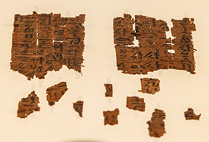
Of course, they did not remain in perfect form, and many of the manuscripts found looked a bit like cornflakes – in hundreds of tiny fragments! There are 6,000 texts that have been restored, transcribed, translated, and published, but this forms only a very small proportion of the entire find – perhaps as little as 1%. The cornflake-like pieces had to be put together in a similar way to a really difficult jigsaw. Furthermore, the papyri contain many letters that are unclear or faded, and usually without clear spaces between them because the writers liked to fit in as much writing as possible because of the high cost of papyrus. In some cases, the reverse of the papyrus is used and, even more confusingly, writing is sometimes crossed – meaning that lines are written horizontally and vertically, also as a matter of thrift.

Content
As with other document troves, the Oxyrhynchus corpus contains a wide variety of types of text. Unlike some others, such as the Dead Sea Scrolls, only about a tenth of the Oxyrhynchus find constitutes literary, philosophical, and religious books. Among this tenth are early editions of well-known ancient works, including those that were lost in the early modern period. Examples include the comedies of Greek writer Menander (c.342/341-290 BC) and the poetry of Sappho (c.630-570 BC).

Religious texts include pieces of the New Testament and the Septuagint – the first major Greek translation of the Hebrew Bible, which was commissioned by Ptolemy II Philadelphus (309-246 BC).
To make the Septuagint, Ptolemy II is believed to have appointed 72 Hebrew translators – six from each of the Twelve Tribes of Israel. He ordered them to travel from Jerusalem to Alexandria to translate the Old Testament from Hebrew into Greek. The product of their labours would be placed in the Great Library of Alexandria, allowing him – a pagan – better to understand ‘the laws of the Jews’. This is mentioned in a text known as the Letter of Aristeas to Philocrates (3rd or early 2nd century BC), partly paraphrased by the Roman-Jewish historian Josephus (AD 37-c.100).


Non-literary importance
The Oxyrhynchus Papyri are not just fascinating because of these elite literary, philosophical or religious texts. Perhaps their true value lies in what they can tell us about daily life and the ordinary people in this period of Egyptian history. Included in this bounty is an abundance of public and private documents that constitute the other 90% of its content, such as loan agreements, land leases, sales records, wills, accounts, census returns, court records, petitions, tax statements, and even horoscopes and magical spells to address personal difficulties.
These texts reveal the everyday matters of ordinary people, but these are not just routine: there are some extraordinary stories and characters that emerge, giving us a mixture of amusement, frustration, sadness, and concern. Here are just a few examples.
Schoolwork
Many of us might have old school exercise books at the bottom of our drawers or in our attics. P. Oxy. 1 124, from the later Roman Period (AD 200-299), is a schoolboy’s writing exercise about the mythological king Adrastus of Argos:
Adrastus, king of Argos, married one of his own rank and had two daughters, Deïpyle and Aegialia, who, though not ugly, were unlucky as to marriage; for no suitors offered themselves. Adrastus therefore sent to Delphi and inquired about the cause.
This text shows that passages of history and culture were used as language primers, and that, at this time just as today, lots of children faced sometimes onerous exercises copying sentences.

Accidents will happen
We are all familiar with the formalities of accident and emergency. In P. Oxy. 3 475 from the Roman Period (dated AD 182), we find a letter from a military official – Hierax – of the Oxyrhynchus district to a clerical orderly Claudius Serenus. This letter encloses a report sent to Hierax recording the death of the young boy Epaphroditus who, while leaning out to watch a procession of dancing girls, fell from the upper storey of an apartment building and died:
At a late hour of yesterday the 6th, while a festival was taking place at Senepta and the castanet-players were giving their customary performance at the house of Plution, my son-in-law…, his slave Epaphroditus, aged about 8 years, wishing to lean out from the bed-chamber[?] of the said house and see the castanet-players, fell and was killed. I therefore present this application and ask you, if it please you, to appoint one of your assistants to come to Senepta in order that the body of Epaphroditus may receive proper laying out and burial. [Date and signature of Leonides]

Hierax instructs Serenus to take a physician to view the body of the child, organise the burial, and then report back to him in writing. In this letter and the enclosed report, there is a bureaucratic but nonetheless concerned approach to determining the cause of death and the arrangement of a dignified burial, much as we do today. It is interesting that the deceased is a slave boy, and the one who petitioned Hierax was his mother, showing such official dignity was afforded to the lower stratum of society in death, even if not always in life.

Romantic break-up
The next example is P. Oxy. 1 129 (dated AD 501-600 AD), which is reminiscent of modern- day soap operas. By way of historical context, this text is much later than the previous two, being dated to a period that saw the advent of the Islamic Conquest (Amr ibn al-As conquered Egypt shortly afterwards, between AD 639 and 642). In this formal notice, a man called John dissolves the engagement of his daughter Euphemia to Phoebammon:
I John, father of Euphemia, my unemancipated daughter, do send this present deed of separation and dissolution to you, Phoebammon, my most honourable son-in-law, by the hand of the most illustrious advocate Anastasius of this city of Oxyrhynchus. It is as follows. Forasmuch as it has come to my ears that you are giving yourself over to lawless deeds, which are pleasing to neither God nor man, and are not fit to be put into writing, I think it well that the engagement between you and her, my daughter Euphemia, should be dissolved, seeing that, as is aforesaid, I have heard that you are giving yourself over to lawless deeds and that I wish my daughter to lead a peaceful and quiet life. I therefore send you the present deed of dissolution of the engagement between you and her, my daughter Euphemia, by the hand of the most illustrious advocate aforesaid with my own signature, and I have taken a copy of this document, written by the hand of the most illustrious advocate aforesaid.
Like a soap opera cliffhanger, we can only speculate what foulness Phoebammon was engaged in: was it apostasy, heresy, or incest? Although intriguing, we will probably never know.

Slavery
One of the more controversial items from the corpus (by today’s standards) is a fragment of a document detailing the sale of an eight-year-old slave girl. This would probably have been a requirement for tax and legal purposes made by the magistrates who oversaw such activity.
‘aged 8[?],
whom he/she bought from
his/her blood brother
Demas, from the same
city, through the city of Oxyrhynchi in the
notarial office (agoranomeion) in the month of Caesarius
of the present year,
for 10 talents 3,000 [drachmas] of bronze. Farewell.’ ‘Year 2 of
Imperator Caesar
Nerva Traianus Augustus
Germanicus, month of Caesarius,
intercalary day 6.’
[In a second hand]‘Clemens: register [it].’
(Translation by Amin Benaissa)
The price of the child is recorded as 3,000 bronze drachma, but this currency was obsolete at that time (c.AD 99) and the amount should have been recorded in the equivalent value of silver. This error makes the document historically notable. While many of the seemingly mundane documents of Oxyrhynchus show us situations of affinity between people of the ancient world and now, this document marks the huge ethical difference. It should be noted that the slavery traditions of the ancient world were not identical to those of the transatlantic trade of the 16th to 19th centuries, and to conflate them is anachronistic. However, this text does remind us that the abuses of the period still persist in our time in the form of modern slavery.


The loss of a pet
We end with an example that might be familiar to all pet lovers. P. Oxy. 2 219 is dated within a range that could be very close to the birth of Christ. We might think that care for animals was less prevalent then, but the text does not support that assumption. This papyrus describes an unknown man’s lament for a cock, which Grenfell and Hunt in their volume tell us is unlikely to be an erotic allegory (as the Greek word used can mean ‘consort’):
…I am at a loss where to go. My ship is shattered. I weep for the loss of my sweet bird. Come, let me take the chick he nurtures[?], he, my warrior, my beauty, my Greek cock. For his sake was I called great in my life, and deemed happy, comrades, in my breeding cares. I am distraught, for my cock has failed me; he fell in love with Thacathalpas[?] and deserted me. But I shall find rest, having set a stone upon my heart; so fare ye well, my friends.

It seems that the bird absconded with another person, or even eloped with a hen. Nevertheless, the loss has impacted the owner so deeply that Grenfell and Hunt consider he made an allusion to suicide in the line: ‘But I shall find rest, having set a stone upon my heart; so fare ye well my friends.’ As the bird was probably a fighting cock (he describes it as his ‘warrior’), we can only speculate on whether the man mourned for the love of his pet, or for the financial benefit it provided him.
We can only speculate on whether the man mourned for the love of his pet, or for the financial benefit it provided him.
Revealing stories
For me, these everyday stories from the Oxyrhynchus Papyri are far more interesting than the pieces of literature or religious writings. The texts I have discussed, and the vast number of others that are awaiting interpretation and publication, give insight into the hopes, fears, dreams, frustrations, ambitions, needs, and loves of the people who must have encountered Christian ideas in Egypt at this time period. Though of equal importance is what these texts tell us about the commonality, as well as the differences, between humankind then and now. The Oxyrhynchus Papyri are a rich corpus of fascinating texts, and I highly recommend them to anyone wishing to gain an insight into late-ancient Egyptian life.

Further reading: For more information about the Oxyrhynchus Papyri collection, visit https://oxyrhynchus.web.ox.ac.uk.
Dr Richard J Britton is an author and independent scholar. His research is focused on the ancient world of the New Testament and the many other Near Eastern traditions and texts. He is employed as a Probation Officer in his day job, and is also an ordained Elder and Lay Preacher in the United Reformed Church. Richard’s book Romans and the Power of the Believer (SBL Press Atlanta, 2022) examined some of the Oxyrhynchus texts in depth to provide insight into how people might understand St Paul’s Epistle to the Romans.