Surveying Khirbet al-Khalde: Global trade and ancient mobility in southern Jordan

Fresh knowledge about global trade and travel is coming to light in the Jordanian desert. A survey project is revealing information about the chronology of a small fort or fortlet and presumed caravanserai at the site of Khirbet al-Khalde in southern Jordan. Taking us through archival data, new archaeological finds, and the use of drone imagery, the co directors of the project Craig Harvey, Emanuele Intagliata, and Rubina Raja unravel new narratives about this fascinating desert site.
Start
This article is from World Archaeology issue 123


Subscribe now for full access and no adverts

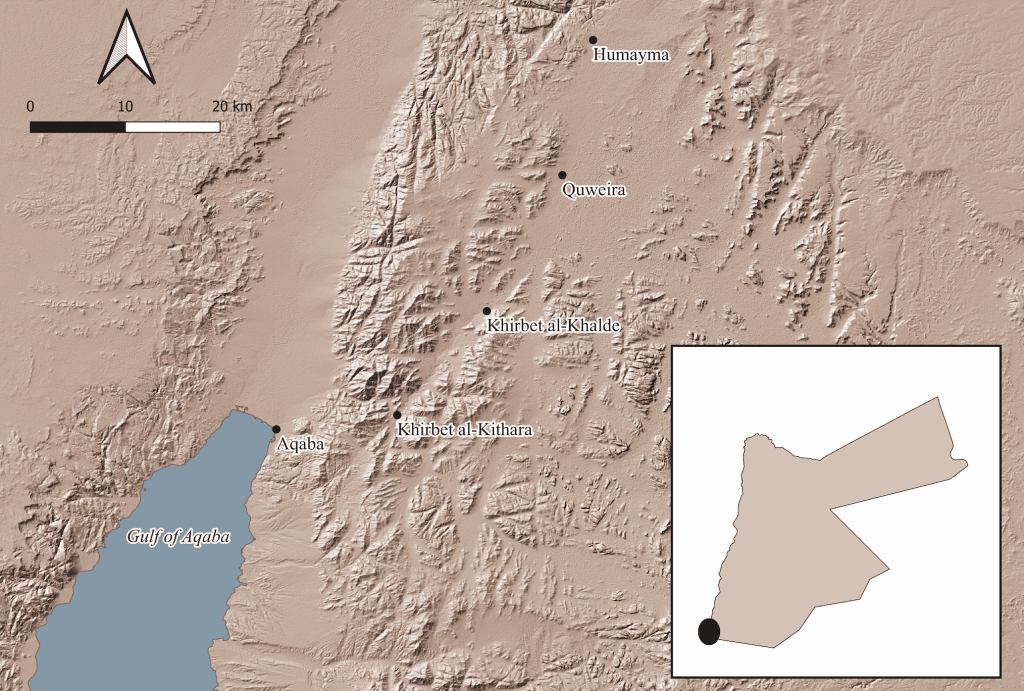
It is 4am when alarm clocks go off in darkened rooms at a hotel south of Aqaba, close to the Saudi Arabian border. It is July 2023 and our small team of nine people is staying there, enduring temperatures that do not drop below 28°C at night. Inevitably, the rising sun stokes this furnace, with the mercury often reaching 44°C while the team is in the field. It is dry, hot work, with the sun blazing and what feels like no shade for kilometres. Instead, as we survey the southern Jordanian desert, we are surrounded by tumbled walls and stony terrain for as far as the eye – or drone – can see. A remarkable archaeological site is responsible for luring us out into these sweltering conditions. Today, it lies far from the beaten track, but this was not always the case. Once these ruins were located directly on the Via Nova Traiana, a major Roman frontier road that was constructed during the reign of Emperor Trajan (r. AD 98-117). This thoroughfare ran for about 400km from the Red Sea, up through modern Jordan, and into parts of what is now Syria. The site, which today goes by the name of Khirbet al-Khalde, was known in antiquity as Praesidium. It appears as such on the Peutinger Table, a map of the Roman road network that appears to be a later copy of a Roman original. Praesidium also receives a mention in the Notitia Dignitatum, a document probably dating to the late 4th century AD, which gives a list of civil and military officials in the Roman Empire, providing us with valuable insights into its organisation in Late Antiquity.

Recent survey work has shed fascinating new light on a concentration of features at Khirbet al Khalde. Here we see the Roman castellum (centre) and the presumed caravanserai at the site (centre right), as viewed from the north.
The location of Khirbet al-Khalde and nearby sites in southern Jordan.

Our team is, then, just the latest in what was once a steady stream of travellers venturing to Khirbet al-Khalde. At 4am, we have a cup of Nescafé and maybe a bit of bread, but it is too early for a serious breakfast. Then we drive for about an hour to get to the site, which is located north of Aqaba, well off the main highway to Amman. Several kilometres after the customs checkpoint between the tax-free zone of Aqaba and the rest of Jordan, we make a turn to the right and, thanks to our four-wheel-drive vehicles, head on to tracks that we can barely see in the creeping light of dawn. The tracks are not often used and, this year, the entire stretch of the broad wadi was flooded until recently. This inundation blurred long stretches of the track and, in parts, washed it clean away. As a consequence, according to people who know the area well, the desert is greener than it has been for many years – to our eyes, it remains devoid of vegetation. On a few mornings, camels block the tracks, and the cars have to wait until the animals decide to amble off. It is hard not to feel that the camels look almost as tired as the team members. Most mornings, though, the way to the site is entirely desolate, inviting contemplation about what it must have been like to travel here in antiquity. Work at the site begins around 5.45am – if the camels allow it – when there is just enough light to begin our survey. This is the first such campaign of work undertaken at the cluster of archaeological remains visible at Khirbet al-Khalde, which include a small Roman fort, fortlet, or castellum, and what may have been a roadside inn of some sort, usually termed a caravanserai. Our goals are to understand better the site chronology, its material culture, and the nature of the buildings, which today are no more than ruins.
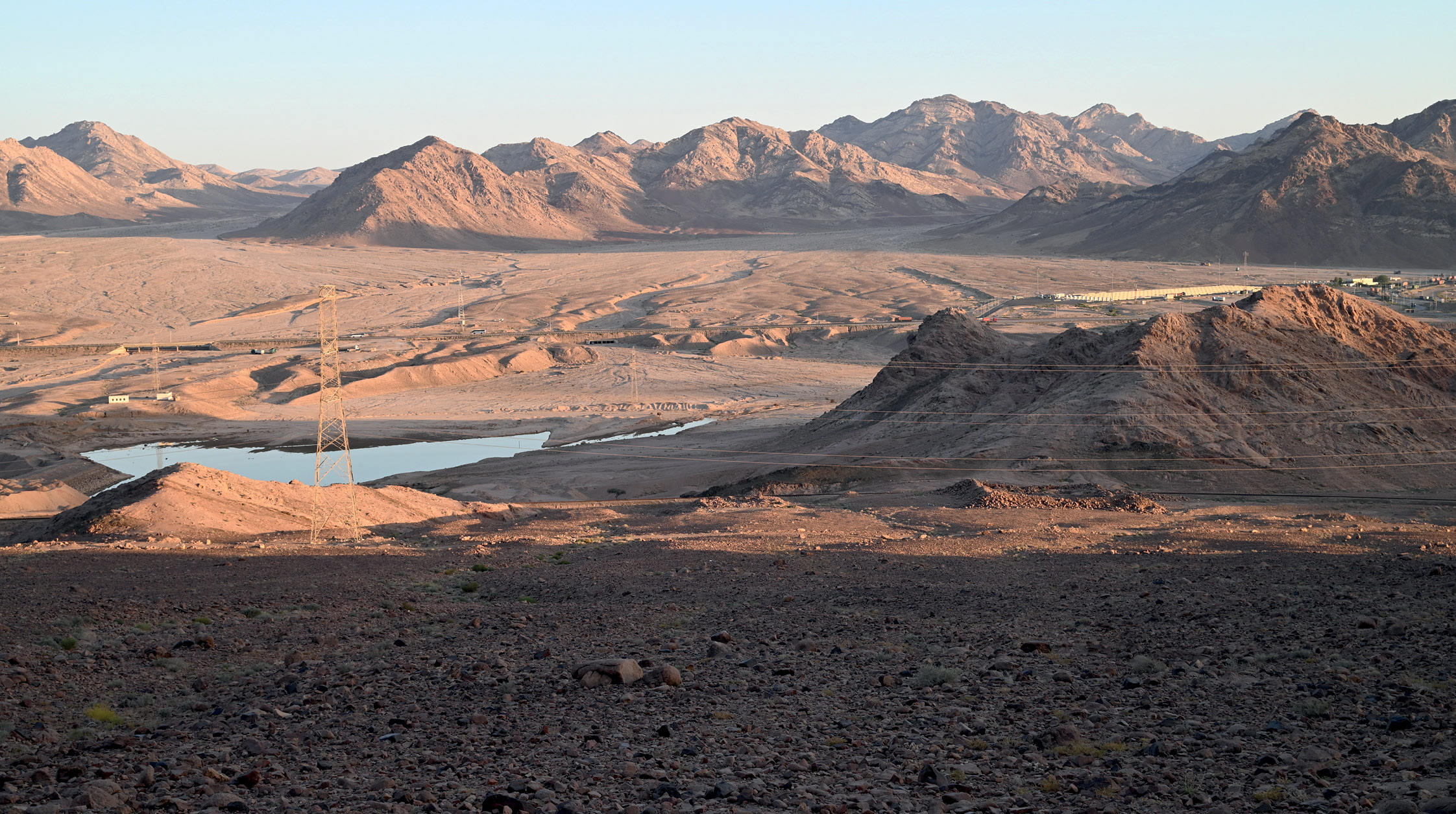
Khirbet al-Khalde lies deep in the Jordanian desert. The landscape surrounding the archaeological features (the presumed caravanserai and castellum are visible in the centre and centre right of the photograph respectively) is both dramatic and arid.

In some aspects, our team reflects the sort of global society that we might imagine passed by the site in antiquity, or stayed over in the caravanserai, or was even stationed in the military base established there. Our project is a new international collaboration headed by directors from Canada, Denmark, and Italy. The team members come from those countries, as well as Germany, Slovenia, and the United States. A truly multinational undertaking – just like Khirbet al-Khalde was for centuries.

The location of the main archaeological features at Khirbet al-Khalde

Trade and mobility

Khirbet al-Khalde is situated in the Wadi al-Yutm, a wide, rocky gorge mostly composed of granite and basalt. The archaeological site is surrounded by low hills and is barely visible from the modern highway. In total, the archaeological remains encompass the castellum and the presumed caravanserai, as well as watchtowers, cisterns, an aqueduct, and cemeteries. These visible remains have suffered extensive damage from modern disturbances over the last century or so, which include looting and even the bulldozing of parts of the ruins when the Ma‘an-Aqaba railroad was built, running right past the site, in the 1980s.

Khirbet al-Khalde’s ancient name – Praesidium – has been known for decades, after being placed back on the map by Aurel Stein in the late 1930s. It is located only 26km from the Red Sea and the important harbour of ancient Aila, today’s Aqaba. In antiquity, Red Sea trade travelled in both directions from this major maritime entrepôt. From Aila, these goods could be sent on to many parts of the ancient world – including lands that lay far beyond the dominion of the Roman Empire. Indeed, Khirbet al-Khalde itself was founded on the fringes of that empire. We must imagine it and Aila as bustling places that once played host to caravans brimming with spices, incense, and textiles.
Khirbet al-Khalde’s position on the Via Nova Traiana, as well as its location close to the Red Sea, would have given the site a central role in securing movement, trade, and military interests along what was simultaneously a commercial highway and frontier road. After all, this was not just a major regional trade route – it also formed an integral part of a much wider ancient global exchange network.

Two watchtowers were established on high ground, offering fine views over the surrounding terrain. Here we see one example, which has been dug into by looters.

Although the site has attracted some earlier scholarly interest, its location has never been studied in depth or examined using a high-definition approach to the archaeology. Undertaking a painstaking study of the archaeological record and adopting a longue durée perspective on the evolution of the site promises to address the exact nature of how the various features making up the site developed. These individual elements have also yet to be set within the wider framework of the transport network and economy. Although Khirbet al-Khalde has suffered from erosion and human activity – both licit and illicit – much of the site remains undisturbed and promises to extend our understanding of resilience, development, and long-distance trade at the site and throughout the wider region.

Perceiving Praesidium

In the 19th and 20th centuries, Khirbet al-Khalde was a calling point for both travellers and archaeologists. Their reports were typically terse, but do cast important light on the site’s chronology, which until recently was said to have stretched from the Nabataean period to the Byzantine period, from roughly the 1st century AD into the 5th century AD. Perhaps the most obvious ruin at Khirbet al-Khalde is a rectangular enclosure measuring approximately 65m by 40m. This was the Roman castellum, which was protected by a rampart and corner towers, now tumbled, from which the garrison could keep watch and secure the surrounding area. Initial study of the castellum curtain wall suggests that it was reconstructed at some point during its history, although without excavation it is difficult to pinpoint exactly when. Access to the castellum interior was via a single gate, with the internal space itself consisting of a courtyard divided into irregular halves by a row of rooms – a very peculiar arrangement for this sort of structure. Two watchtowers stood sentinel on hills nearby. These elevated posts are tricky to reach, because of the crumbly granitic and basaltic ground underfoot. When they were manned, though, the watchtowers would have made it possible for the forces stationed at the site to maintain surveillance over the entire hinterland, thereby keeping an eye on anyone approaching the site.

Our survey represents the first multi-scalar study of the site, by focusing in combination on high-definition mapping, chronology, and resource-exploration, as well as an assessment of damage and threats to the archaeological remains. In addition, our investigation included collection of surface finds, an architectural survey, 3D modelling of features, drone-imaging, damage-assessment, and a consideration of existing reports, travel accounts, historical and aerial photographs, and earlier satellite imagery.

Dawn over the Ma‘an-Aqaba railroad. Although not currently in use, the railway was constructed in the 1980s, damaging elements of the archaeology at Khirbet al-Khalde. 

Our multi-scalar survey involved the team carrying out a ground survey combined with drone photography, which was conducted by a private firm. We also completed an architectural survey of the ruined structures of the castellum, the presumed caravanserai, the two watchtowers, and an aqueduct that ran for almost 1km.

The castellum takes the form of a rectangular enclosure measuring approximately 65m by 40m. Here we see a view over the interior.

The results of the ground survey were stunning: within our two-week campaign, about 25,000 ceramic sherds were picked up from the site surface and brought to the registration office. There, they were sorted, counted, characterised, documented, and photographed. Our team collected ceramics ranging from the 1st century AD (Nabataean period) until maybe the 5th century (Early Byzantine period). This broad chronology is supported by the various fragments of glass, stemming from both vessels and window panes, that were recovered. A handful of poorly preserved coins found by the team corroborate this evidence, by providing confirmation that the site was occupied into the Late Roman period. One unexpected development was that various sherds tentatively dating to the Middle Islamic period were also collected, suggesting that the site received attention of some sort much later than had been anticipated.

Selected ceramic fragments from Khirbet al-Khalde: Nabataean Painted Fineware sherds (above), Dekor-phase 3c, c.early to mid-2nd century AD; and an Aila-ware sherd (below) painted with Nabataean decoration, c.3rd-4th century AD. 

One small but significant find also offers an insight into the site’s life – or more accurately someone’s death there – in Late Antiquity. A small marble fragment of a grave inscription was found wedged between stones beside the castellum. Sadly, there are not enough surviving letters for us to be able to reconstruct the name of the individual being commemorated, but it is clear that the text formed part of a grave epitaph. That it was inscribed on marble is notable, too. Such stone is not found locally in the Near East, so all marble had to be imported from other regions of the Mediterranean, usually Italy, Greece, or Asia Minor. While it is far from exceptional to find Roman-era grave inscriptions inscribed on marble, it is surprising to find one in the context of such a small site as Khirbet al-Khalde. That a portion of the inscription was preserved down until the present is rather fortunate as well. Marble objects were often burned to create lime in Late Antiquity, and sure enough there is even evidence for lime-production at Khirbet al-Khalde. Our team identified what appears to be a limekiln – which has sadly been ransacked by looters – just next to the presumed caravanserai structure. Presumably, the fragment of the grave inscription had survived because it passed unnoticed by those operating the kiln.

An apparent limekiln, which had attracted the attention of looters, was detected to the south of the caravanserai. 
This funerary inscription, found by the castellum, was inscribed on imported marble.

New plans of the castellum and caravanserai structures created by our team offer fresh insights into the building techniques used in this region, while at the same time raising various questions about the ways that the castellum was used. One notable feature of its interior is a Roman-style hypocaust tucked into the northernmost corner of the defences. Given the temperature hereabouts, at first glance the need for heating might seem excessive. This feature, however, suggests that the castellum once held a bathing suite, no doubt offering a welcome dash of luxury for the soldiers garrisoning this stretch of the Roman frontier. Bathhouses are commonly found associated with Roman forts throughout the Empire, with the quantity of such facilities likely to have been among the many reasons why Roman bathing culture caught on in the provinces. That said, the presumed military installation at Khirbet al-Khalde is rather unique, as it is not typical for forts this small in this region to contain baths within their walls. Instead, when present, one might expect to find these facilities outside the installation, as is the case at numerous other sites in the region, including Humayma and ‘Ayn Gharandal. Contemplating the practical considerations that accompany operating a hypocaust helps to bring some colour to garrison life. After all, operating this hypocaust would have required plenty of fuel – probably in the form of wood, olive pressings, and/or dung – all of which had to be gathered and brought to the site: an arduous task in such an arid environment.

The remains of a cistern were visible inside the castellum.

Something else that a bath suite would have required is water. This, of course, had an importance that went far beyond garrison rest and relaxation, as proper water infrastructure ensuring a constant supply was essential for surviving in the desert. This need was met by a large, aqueduct-fed cistern within the castellum. The aqueduct in question was supplied by a spring high up on a hillside to the south-east of the site, while its channel ran in an almost straight line down into the castellum. A survey of the entire course of this aqueduct was undertaken, which proved to be a challenging job, as long sections of the channel had been washed away over the millennia, leaving only scattered fragments of pipe and short sections of foundations. At the aqueduct head, we found that the spring was still active, although barely flowing. In antiquity, a large rectangular basin had collected the water from this spring and channelled it into the aqueduct. Unfortunately, like many of the remains at Khirbet al-Khalde, this basin has been heavily looted in recent times and only a few fragments of its walls remain. Careful study of the aqueduct fabric suggests at least two phases of its construction, indicating that this important piece of infrastructure was repaired or replaced at some point during its use.


The castellum was served by an aqueduct. Here we see its course leading up to the spring that fed it (above). A large basin originally collected the water issuing from the spring, but this basin has since been looted (below)

In addition to this aqueduct, those garrisoning or passing by this outpost could have sourced water from two rock-cut cisterns that lay to the north of the site. The remains of these are still visible beside the dirt road leading from the highway to Khirbet al-Khalde. Now filled with accumulated soil, these cisterns once collected and stored water that fell during the infrequent rainstorms that periodically deluge the desert, and were covered with stone arches and slabs to prevent contamination and evaporation. Similar rock-cut cisterns are found throughout the region, and were once an important lifeline for the Nabataeans, who built and maintained them. Elsewhere, some of these cisterns still survive in a functional state and remain an important resource for locals in a region where water is both scarce and hard to find.

Surveying the past, preserving the future

By integrating the field data from the damage-assessment with information collated from historical aerial photographs, satellite imagery, and old travel accounts, the team has been able to shed light on the most recent history of Khirbet al-Khalde. Developments taking place over the last century, including the construction of the modern highway and a slightly later and more westward-running access road, as well as the construction of the Ma‘an-Aqaba railroad in the 1980s, have created easier access to Khirbet al-Khalde and brought more attention to its archaeology, not all of it welcome. The railway, although currently out of use, runs a mere 8m north-west of the castellum, which was damaged during the rail line’s construction. Evidence of looting at the site is extensive. More than 50 modern pits disturbing the archaeology were documented by the team during the survey. Some of these had only been dug a few centimetres deep, but others created sizeable holes that have greatly disturbed the site stratigraphy. Sadly, the cemetery has been heavily looted, too. Most of the burials have been completely dug out by looters seeking rich pickings among the grave goods. Only a handful of human bones and even fewer finds have been left behind. However, since the site is far from Aqaba and is not fenced or signposted, it is difficult for the Department of Antiquities of Jordan to monitor activity there. By undertaking a damage-assessment at the site, the survey project has documented important information for future studies at Khirbet al-Khalde.

The remains of a cistern by the wadi on the way to the site. 

Our work has helped to confirm the chronology of the site, which primarily stretched from the 1st century AD (Nabataean period) until the 5th century (Early Byzantine period). Intriguingly, the tentative Middle Islamic finds may suggest at least some sort of sporadic activity at the site much later than previously suspected. While large parts of the castellum, the caravanserai, and the cemeteries have sadly been looted, the survey finds have underlined the importance of continued archaeological work at Khirbet al-Khalde, in order to understand its significance in the Roman period and beyond.

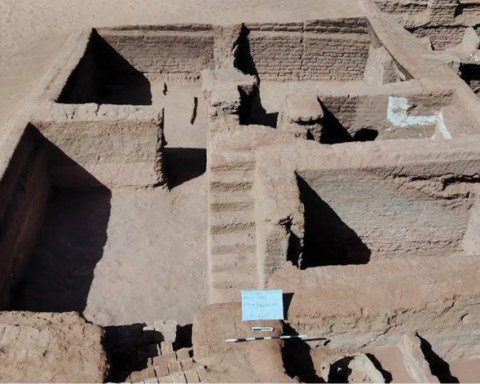
There are extensive signs of looting at Khirbet al-Khalde. Here we see where an illicit dig in the caravanserai has fully exposed a room (above), and the looted cemetery to the north-east of the castellum (below)

Further Information:
• The Khirbet al-Khalde Archaeological Project is an international collaboration since 2023 between Aarhus University, Denmark; the University of Alberta, Edmonton, Canada; and the University of Milan, Italy. The project is funded by the Augustinus Foundation, the Carlsberg Foundation, and the Danish National Research Foundation under the grant DNRF119, as well as an ACOR grant from the S. Thomas Parker Memorial Fund.
• We are very grateful to the Department of Antiquities of Jordan for granting us permission to
survey the site and to Maher Amreen, our DoA representative, for having followed the work of
the team in the field. Besides the authors, the international team for the 2023 survey season included, in alphabetical order, Dr Amanda Hardman, Katarina Mokránová MA, Dr Matt Naglak, Dr Julia Steding, Dr Sarah Wenner, and Mara Zoppi MA.
• More can be read about the project and its aims and results on the webpage: https://projects.au.dk/khirbet-al-khalde, as well as on the UrbNet webpage: https://urbnet.au.dk.

Images: Khirbet al-Khalde Archaeological Project

By Country

Popular
UKItalyGreeceEgyptTurkeyFrance

Africa
BotswanaEgyptEthiopiaGhanaKenyaLibyaMadagascarMaliMoroccoNamibiaSomaliaSouth AfricaSudanTanzaniaTunisiaZimbabwe

Asia
IranIraqIsraelJapanJavaJordanKazakhstanKodiak IslandKoreaKyrgyzstan
LaosLebanonMalaysiaMongoliaOmanPakistanQatarRussiaPapua New GuineaSaudi ArabiaSingaporeSouth KoreaSumatraSyriaThailandTurkmenistanUAEUzbekistanVanuatuVietnamYemen

Australasia
AustraliaFijiMicronesiaPolynesiaTasmania

Europe
AlbaniaAndorraAustriaBulgariaCroatiaCyprusCzech RepublicDenmarkEnglandEstoniaFinlandFranceGermanyGibraltarGreeceHollandHungaryIcelandIrelandItalyMaltaNorwayPolandPortugalRomaniaScotlandSerbiaSlovakiaSloveniaSpainSwedenSwitzerlandTurkeySicilyUK

South America
ArgentinaBelizeBrazilChileColombiaEaster IslandMexicoPeru

North America
CanadaCaribbeanCarriacouDominican RepublicGreenlandGuatemalaHondurasUSA

Discover more from The Past

Subscribe now to keep reading and get access to the full archive.

Continue reading