Subscribe now for full access and no adverts
It is estimated that some 160,000 burial mounds (kofun in Japanese, meaning ‘old mound’) were constructed between the middle of the 3rd century AD and the early 8th century. These tombs were the final resting places of Japan’s ancient elites, and form part of a broader East Asian funerary tradition, aspects of which they emulate. Such burial mounds are so distinctive a feature of the archaeology that the era from AD 250-710 is known as the Kofun period. The construction of burial mounds was not restricted to these centuries, though, as important people were being interred within them from the preceding Yayoi period (which spans the Neolithic to the early Iron Age) onwards. Most recently, in 1989, even the Showa Emperor Hirohito was buried beneath a mound with some personal grave goods, unlike the great majority of the population of contemporary Japan who are cremated.

Naming tombs

In the late 19th century, following the restoration of imperial power in 1868, the Japanese government assigned many tombs to personages mentioned in ancient chronicles, specifically the Kojiki (‘Records of Ancient Matters’) dating to 712 and the Nihon Shoki (‘Chronicles of Japan’) drawn up in 720. As the emperor was regarded as divine, these tombs took on special sacred significance. Following Japan’s defeat in 1945, and the Showa Emperor’s renunciation of his divinity, the 900 or so tombs attributed to imperial ancestors came into the guardianship of the Imperial Household Agency as private graves. Access to them continued to be forbidden, a decision around which controversy has swirled. Many questions remain, such as who was buried within? Do the tombs contain proof that the Japanese imperial family was in fact of Korean descent? Why not permit normal archaeological investigations now that they are no longer sacred places?
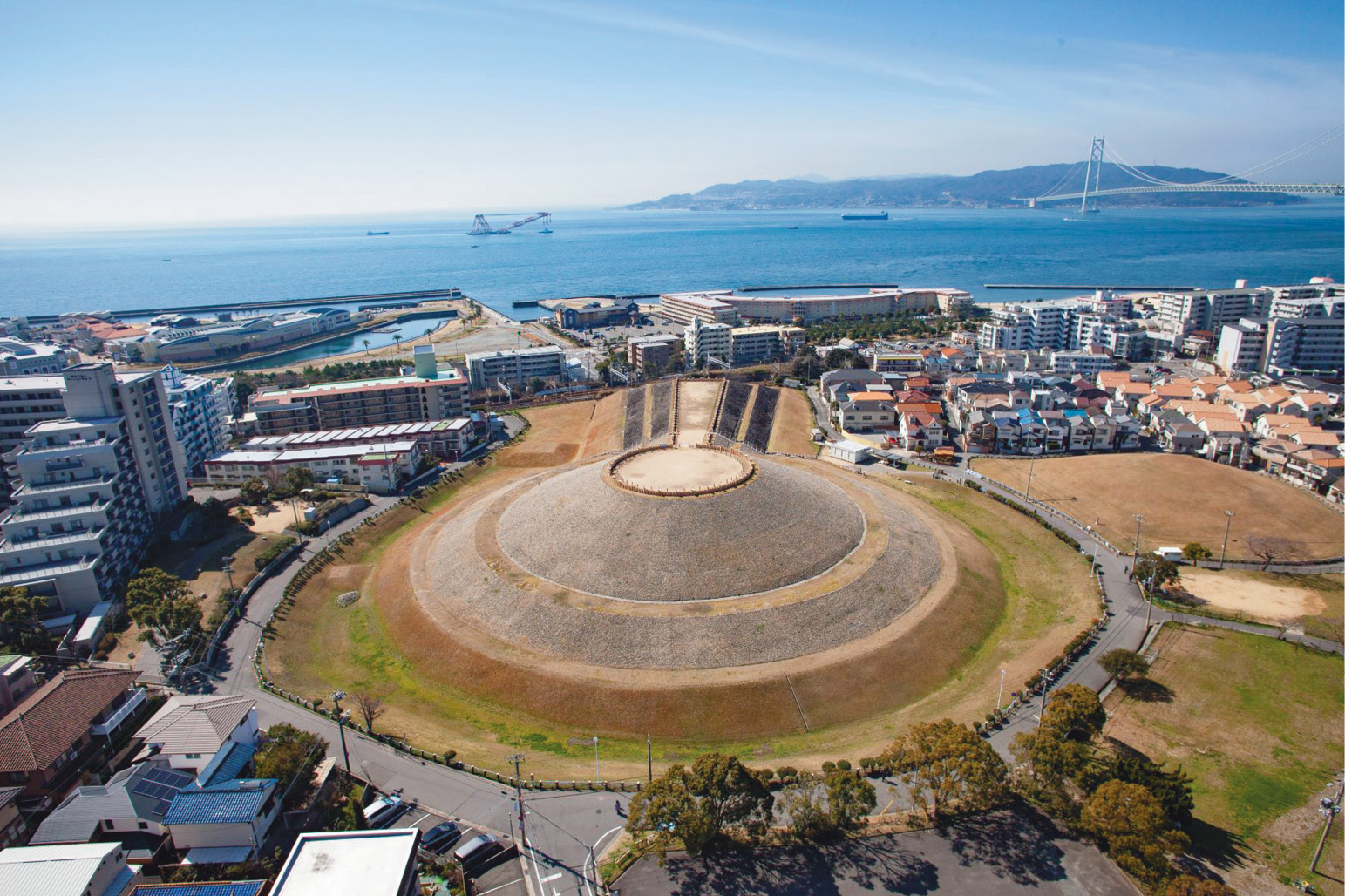
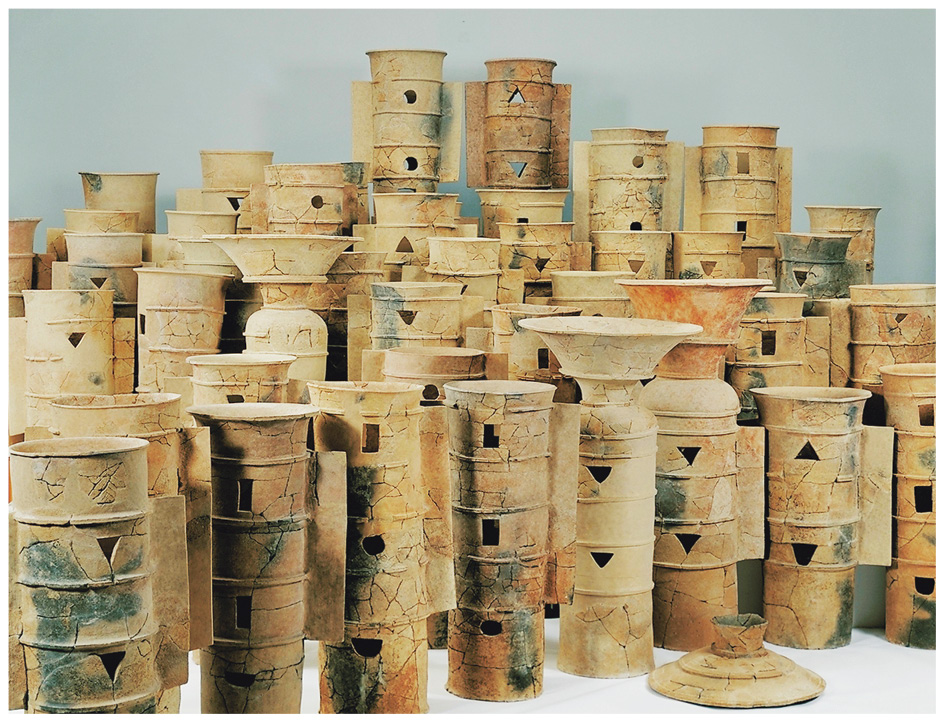
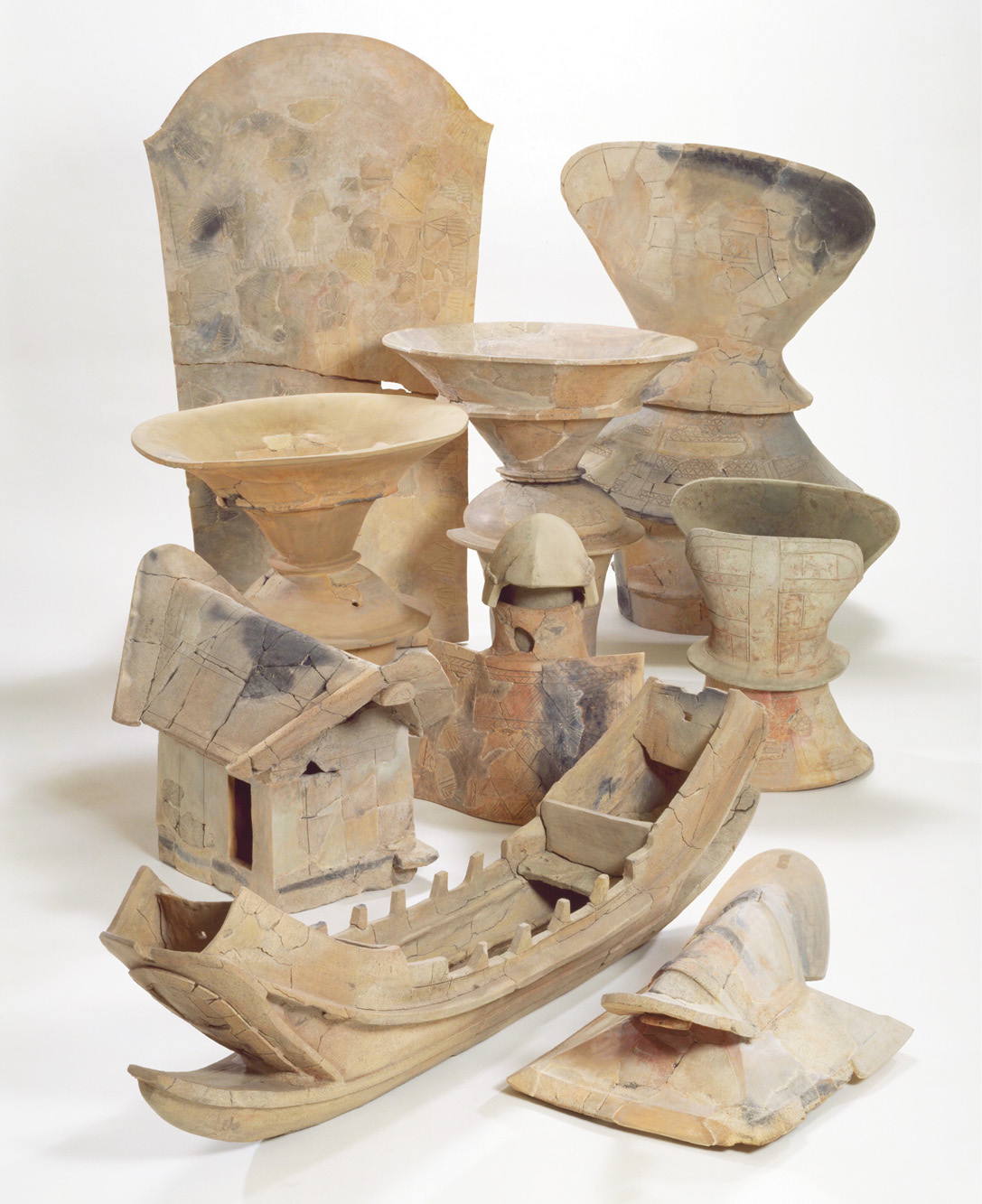
Above: The mound at Goshikizuka lies in the outskirts of Kobe and has been reconstructed to look as it did in the 5th century AD. It dominates the maritime approaches to the port at Naniwa. It was associated with a large quantity of terracotta objects known as haniwa (below). Image: Kobe City Board of Education
In 2019, two large tomb clusters on the Osaka plain, at Mozu and Furuichi, which include massive ‘keyhole-shaped’ mounds attributed to the semi-legendary emperors Nintoku and Ojin, were inscribed as UNESCO World Heritage sites. At 486m long, the mound attributed to Nintoku is one of the largest burial monuments of the ancient world. The nomination dossier submitted to UNESCO used both the names of the people purportedly interred within, as well as the local topographical names preferred by archaeologists (in the case of Nintoku’s tomb, Daisen, and in the case of Ojin’s tomb, Konda Gobyoyama) – although precedence throughout the dossier was given to the former. Despite recent official statements suggesting some change in policy, access continues to be largely denied to anyone beyond the Imperial Household Agency.
The two clusters of kofun at Mozu and Furuichi comprise a total of 49 tombs. The huge mounds are considered to be a clear expression of the kingly power that emerged in this part of Japan from the 5th to 6th centuries AD. It was from here that the Yamato clan went on to establish hegemony over the other regional polities that developed during the later part of the Yayoi period, to create the first state-level society in Japan, with capitals in Asuka, Naniwa (Osaka), and Heijo (modern-day Nara). The kofun elites knew of their continental counterparts, and the geopolitics of the period linked the Yamato clan with the kingdoms of Paekche, Shilla, and Goguryeo on the Korean peninsula, as well as the succession of dynasties that ruled China between the fall of the Han and the establishment of the Tang. Korean and Japanese rulers emulated the Chinese court, adopting Chinese writing and legal systems, as well as – from the middle of the 6th century – Buddhism, palace architecture, and more. Japanese elites were buried with elaborate grave goods that would have been instantly recognised in Korea: bronze mirrors, prestigious accessories, and – from the 5th century in particular – large quantities of iron armour, weaponry, and horse trappings. The result is a display of conspicuous consumption on a huge scale for a country that was largely dependent on importing iron ingots from the Korean peninsula.
The kofun range in scale from the immense keyhole-shaped mounds that are still a major feature in the landscape of many parts of Japan, to much more modest structures, including those created for paramount rulers towards the end of the mound-building period. Long regarded as a distinctive Japanese burial form, in recent years examples of keyhole-shaped mounds have been found on the Korean peninsula. In earlier examples, the primary inhumation was set in the summit of the mound, with the flaring portion of the ‘keyhole’ regarded as a platform for various ceremonies. Many other mounds contained substantial burial chambers, often megalithic in nature, entered through passageways cut into the side of the mound. In China, the burial of rulers was often accompanied by large numbers of human sacrifices. There is no archaeological evidence for such practices in Japan, but references in the ancient chronicles suggest that it occurred until the legendary 11th Emperor Suinin replaced it with the setting up of large numbers of terracotta tomb figures known as haniwa. The kofun presented monumental statements of power in the landscape. Surrounded by wide moats and with their surfaces covered by gleaming stones, they would have been visible from afar. One huge mound, Goshikizuka in the western suburbs of the modern city of Kobe, has been reconstructed to look as it did in the 5th century, dominating the approaches through the Inland Sea to the port of Naniwa. Across Japan, large tombs were built by regional leaders.
Inside the kofun
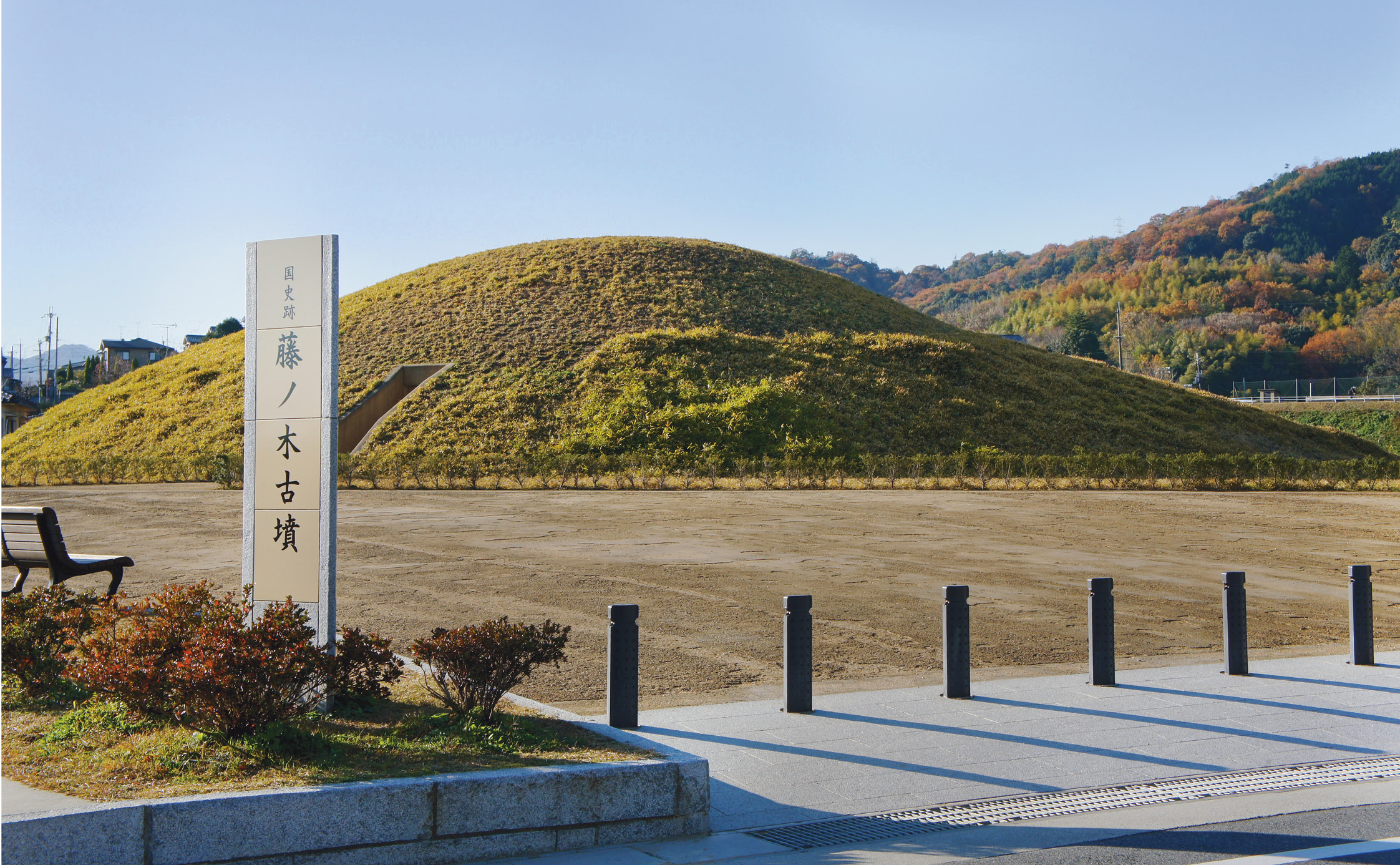
Excavations of kofun generate considerable public interest. One of the most sensational was at Fujinoki in Nara, near the World Heritage site of Horyuji temple. From the outside, this relatively unprepossessing tomb, originally some 48m in diameter and 9m in height, seemed unpromising, as it is dwarfed by the massive keyhole-shaped tombs that are found in such numbers in Nara and Osaka. However, investigation of Fujinoki in the mid-1980s determined that unlike so many other tombs, it had not been robbed in antiquity. Inside, a 6m-long megalithic stone burial chamber stood a so-called house-shaped stone sarcophagus. Initial exploration, involving the insertion of fibre-optic cables to avoid speeding up the decomposition of any contents by opening the sarcophagus, confirmed that the tomb was untouched. Thousands of fragments of gilt-bronze objects were recovered, along with pieces of silk brocade, and the remains of at least two individuals. Conserved and restored, the assemblage of burial goods included grey stoneware Sue pottery and red, lower-fired Haji ware, mirrors, beads, and exceptionally stunning gilt-bronze items. These featured sets of horse trappings with harnesses and a saddle decorated with fish, elephants, phoenixes, rabbits, and more – comparable in style to artefacts found in the Northern Yan kingdom of north-eastern China, but never found before in Japan or Korea – as well as oversized funerary shoes and a crown. The incumbents were most likely imperial princes, one possibly assassinated during a notorious purge in June 587.
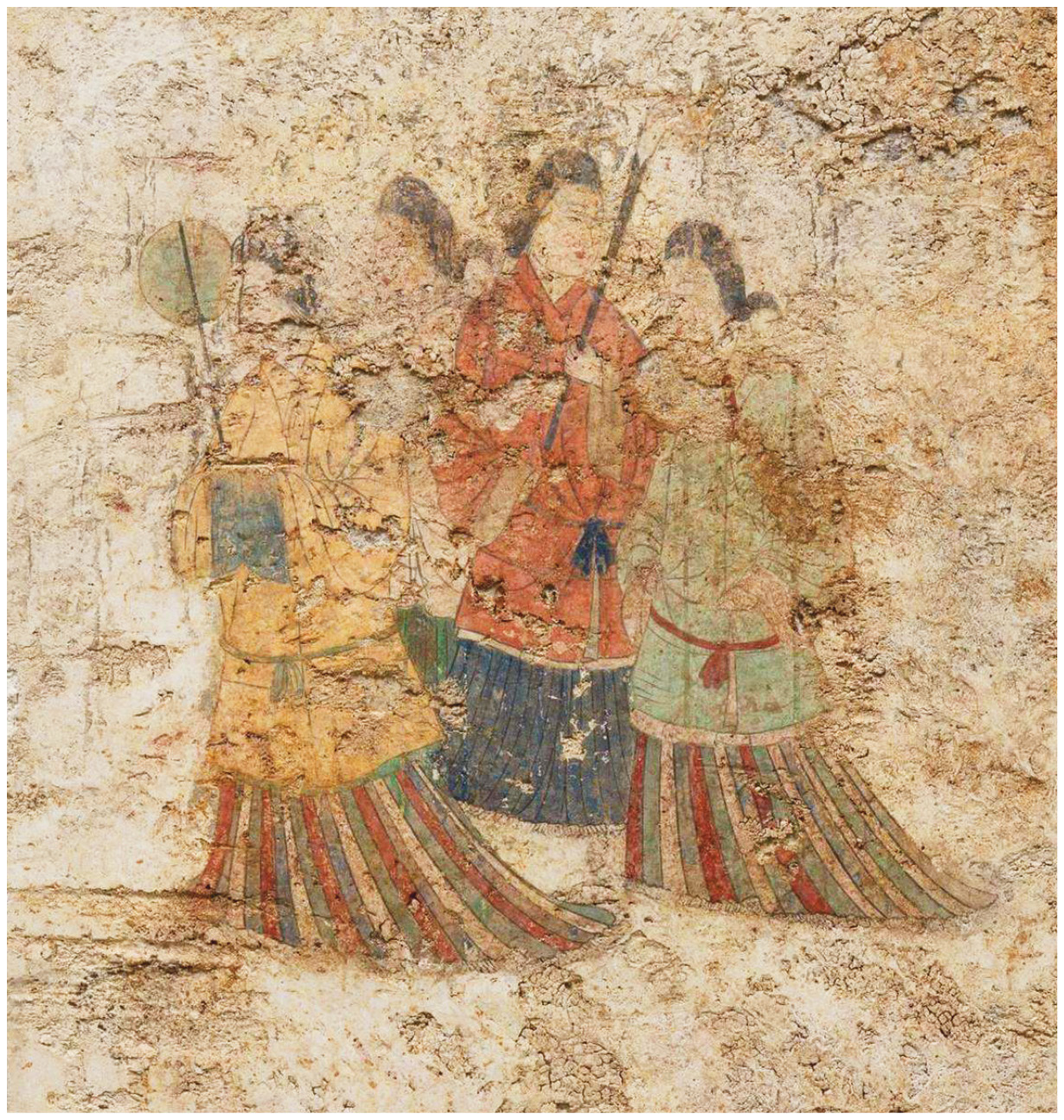

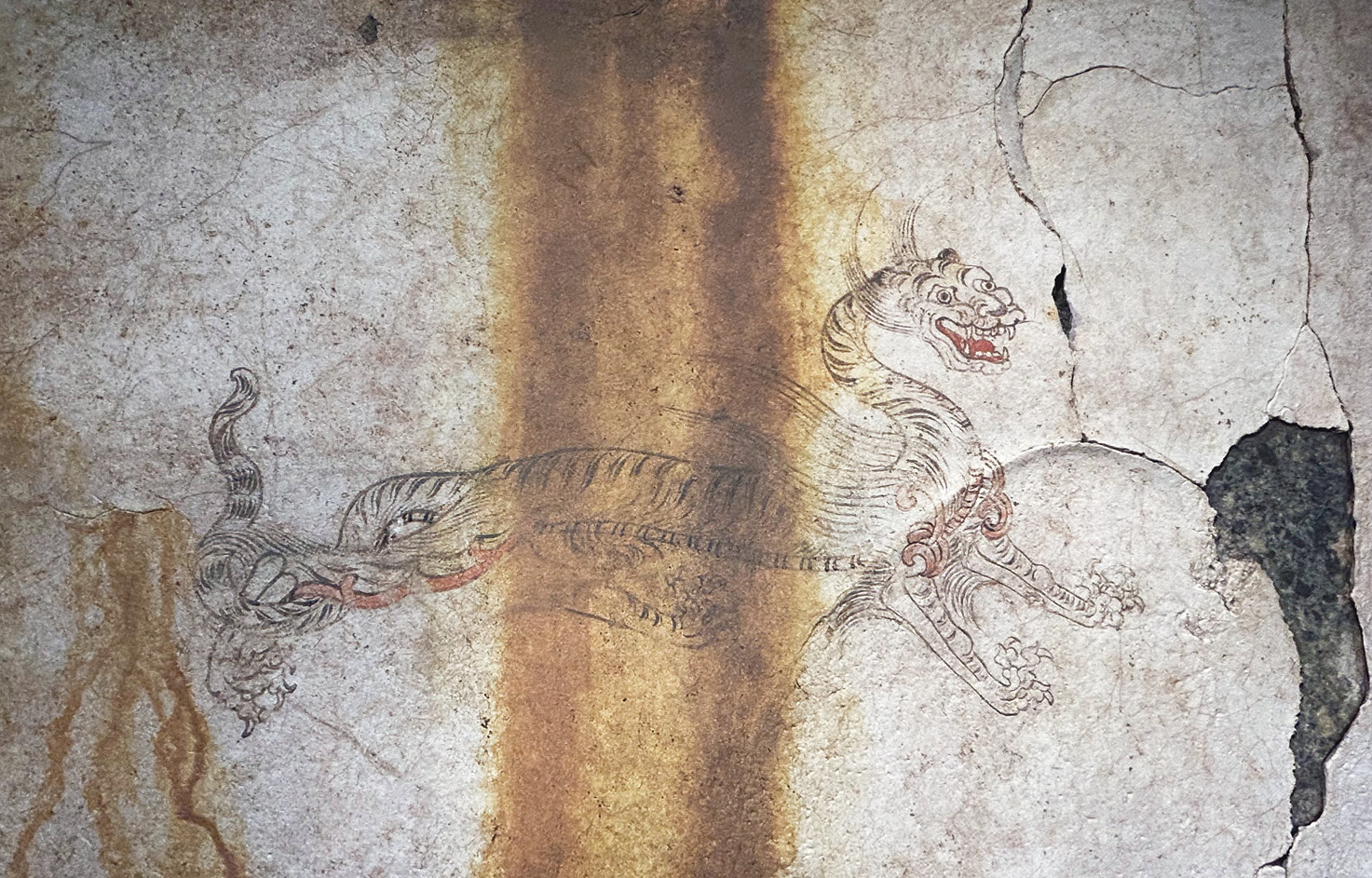
The paintings in the tomb at Takamatsuzuka include a group of four women (above top); the Black Turtle, a creature that is part snake and part turtle (above); and the White Tiger (below). Images: Simon Kaner, from replicas displayed at the Asuka Historical Museum, and Wikimedia Commons
A small number of tombs were decorated with wall paintings on plaster. Indeed, one of the challenges for the archaeologists charged with curating sites in the exclusion zone around the stricken nuclear power plant in Fukushima following the Great East Japan Earthquake and Tsunami of March 2011 was the conservation of decorated tombs. Far from there, in the Asuka region at the southern end of the Nara Basin, are two of the most famous decorated tombs. These date to the very end of the period of burial mound construction, which overlapped with the construction of the earliest Chinese-style capital cities. During excavations in 1972, a stone burial chamber was discovered within the Takamatsuzuka tomb mound, which measured 5m in height and 20m in diameter. The chamber was made of 16 slabs of dressed volcanic tuff, a locally available material, and was entered through a side passage. Excavations in the 2000s revealed the structure of the mound in more detail: a series of thin tamped earth layers, between which was placed straw matting. This was presumably to bind the layers together to avoid collapse, an especially important precaution as the area is prone to earthquakes, which caused several fissures visible within the fabric of the mound.
The inner walls of the Takamatsuzuka tomb chamber were plastered and bore painted representations of courtiers in Chinese-style dress and four mythological creatures. On the east wall was the Azure Dragon along with the sun in the centre, and two groups of people, with four women in the background and four men in the foreground. On the west wall was the White Tiger, the moon, and two further groups of people, with women on the right and men on the left. All the humans were wearing clothes familiar from tomb paintings from the kingdom of Goguryeo, which occupied the north of the Korean peninsula and part of the north-eastern portion of modern China. On the north wall was the Black Turtle, also known as the Black Warrior, a composite creature that was part snake and part turtle. The south wall had been damaged by apparent grave robbers in antiquity, but it most likely bore the Vermilion Phoenix. On the ceiling of the tomb was a star chart, the constellations shown in gold leaf, connected by vermilion lines. Similar paintings are known from a tomb in Mongolia. Inside the Takamatsuzuka tomb chamber were the remains of a black-lacquered wooden coffin, in which grave goods had been placed, including an elaborate mirror decorated with marine mammals, amber beads, and a single-edged long sword. This was clearly the grave of a significant individual, possibly an imperial prince.

A short distance from Takamatsuzuka lies the small Kitora mounded tomb, some 3m high and 14m in diameter, which also dates to the late 7th or early 8th century. Once again, the stone burial chamber was plastered, and it was painted with the same set of mythological creatures, but, instead of groups of people, a collection of zodiac figures with animal heads atop human bodies was painted around the lower part of the walls. Another star chart was depicted in gold on the chamber ceiling. Here, too, remains of a lacquered wooden coffin, a sword, and fragments of the bones of an adult man were recovered. Various suggestions have been put forward as to whom the incumbents of these tombs were. Takamatsuzuka was originally believed to be the tomb of Emperor Monmu, but a 19th-century reassessment of the evidence considered him to be buried elsewhere. Other candidates include a son of one of the last kings of the Korean kingdom of Paekche, an important member of the influential Mononobe clan – who was left in charge of the old capital of Fujiwara-kyo when the capital was moved north to Heijo – or one of three sons of Emperor Tenmu. Tenmu himself is thought to be buried in a separate octagonal mound, originally 45m north-to-south and 9m high, a short distance to the north of Takamatsuzuka. This is one of the tombs in the guardianship of the Imperial Household Agency, and we are dependent on reports written when the tomb was robbed in AD 1235. These talk of a red-painted inner chamber behind a gilt-bronze door, holding the lacquered linen coffin of Tenmu beside an urn containing the cremated remains of his empress, Jito – hers was the first imperial cremation – and grave goods, including a Buddhist rosary of amber beads on copper wire. Sadly, mould attacked the paintings at Takamatsuzuka, and they were all removed during painstaking excavations in 2007 and continue to undergo conservation.
Elite lives
Much remains unclear about the domestic lives of the early Japanese elites. In other parts of Japan, for example at Mitsudera in Gunma prefecture, a moated elite residential enclosure was discovered beneath volcanic deposits resulting from the mid-6th-century eruption of Mount Haruna. Elsewhere within the landscape buried by this catastrophic eruption are the remains of a farmstead, complete with horse paddocks and paddy fields, at Kuroimine.
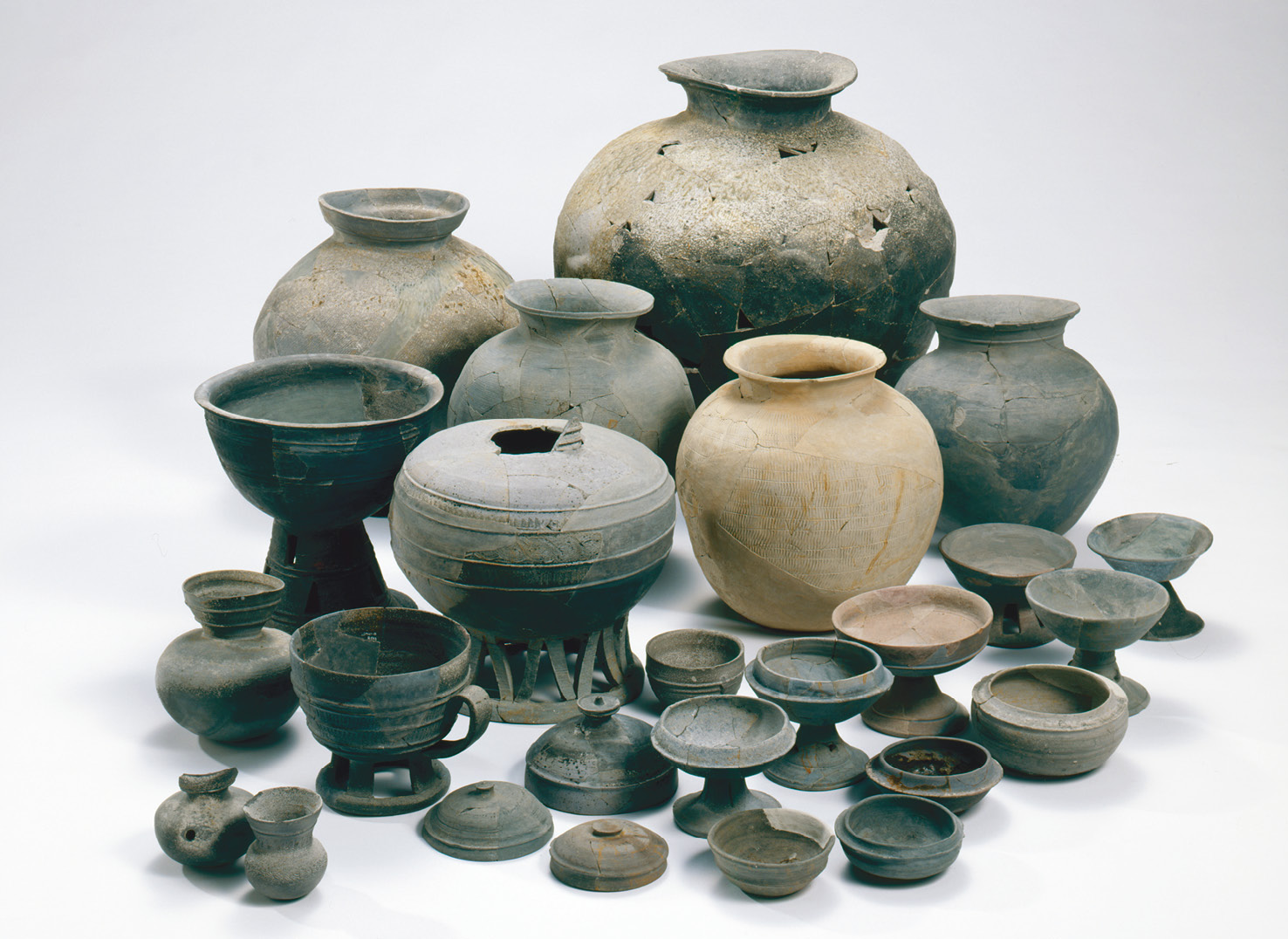
Sue Ware dating to the middle of the Kofun period. Such vessels were fired in a new style of kiln that was introduced from the Korean peninsula. Image: courtesy of Osaka City Cultural Properties Association; courtesy of Tokushima Prefectural Buried Cultural Properties Research Centre, Rekishiru Tokushima
Buildings are sometimes represented among the terracotta funerary objects known as haniwa, as at Kanakurayama in Okayama prefecture, where a model of a moated elite residential compound was found during investigations of a large kofun. There have been no large-scale excavations of Kofun period settlements in the Kansai region, but sites in other regions give a good indication of how they were organised, for example at Irinosawa in Miyagi prefecture, the most northerly large settlement from the early part of the Kofun period. The settlement of Makimuku in Nara, albeit excavated piecemeal as small plots of land came up for development, produced evidence for larger, palace-like buildings. These lay at the centre of exchange networks extending across western Japan, and had artisan quarters with specialist workshops, something also identified in regional centres from the Yayoi period. As the demand for iron for weaponry and agricultural tools intensified, industrial-scale ironworking sites developed, as at the Kamiya and Kajiyasako kofun cluster in Okayama. Large kilns were constructed close to the kofun for firing haniwa (as at Nita in Saga prefecture) and the grey high-fired Sue stonewares. These kilns represent a new technology introduced from the Korean peninsula, in which temperatures in excess of 1,000°C were achieved through prolonged firing processes still used by potters in Japan today. Most of the Sue vessels were destined to be interred as part of funeral rites at the kofun.

An elite female burial at Inuyama-Tenjinyama was associated with a secondary, male, burial containing this bronze mirror (above) and comma-shaped jadeite bead (below). Not shown to scale. Images: courtesy of Osaka City Cultural Properties Association; courtesy of Tokushima Prefectural Buried Cultural Properties Research Centre, Rekishiru Tokushima

Haniwa provide an excellent insight into various aspects of Kofun life. In some areas, in particular in the later part of the Kofun period, human-shaped haniwa were set up around the tombs, including representations of warriors, performers, courtiers, even possible sumo wrestlers, and recently, at Kabutozuka kofun in Tochigi, two women engaged in weaving. Despite Japan’s current poor record in gender equality (extending to forbidding accession to the Chrysanthemum throne), some women – at least in the Kofun period – wielded power, with female emperors playing an important role in ancient Japan. An elite female burial at the Inuyama-Tenjinyama kofun, on the eastern coast of Tokushima prefecture in Shikoku, overlooked the sea route to the political heartland of Nara and Osaka. An elderly woman was interred there during the 5th century, in a stone cist 1.9m long by 0.5m wide. This was the primary burial in Mound 2, which lay adjacent to the somewhat earlier and slightly larger 16m-wide Mound 1, whose male occupant was accompanied by a large (2.8cm-long) comma-shaped greenstone (jadeite) bead and a small bronze mirror, probably obtained by trade. All told, this indicates that the group, in which at least one woman was of great importance, played an important role in long-distance maritime trade. Here, as in so many other ways, the contents of the kofun offer an invaluable glimpse of elite life from the 3rd-8th centuries AD.
All images: courtesy of Simon Kaner, unless otherwise stated