Subscribe now for full access and no adverts
Senusret II (c.1845/1844 to 1837 BC) is one of the lesser-known kings of the Twelfth Dynasty, perhaps due to his short reign of less than 10 years. The king is mainly known from his pyramid at Lahun, close to the Fayum. The pyramid and pyramid complex were excavated under Flinders Petrie in several seasons (1888/1890 and 1914). The structures were found heavily destroyed, but there are some special features that are new and were copied in later periods, paving the way for a new phase in pyramid-building. The reign of Senusret II marks the high point of the Middle Kingdom, when Egypt was wealthy and politically stable. However, under his successor Senusret III, many things would change, indicating that there were forces in the country that are not easy to see in the preserved written and archaeological sources.

Family
The family relations of Senusret II are not that clear. He was probably the son of Amenemhat II, although a final proof for this is missing. His mother is not known for sure either, but she might be Senet, a ‘king’s wife’ and ‘king’s mother’ known from three statues. One of these was acquired by the British king Edward VII in the 19th century, and is currently in the Royal Collection (see AE 149).
Senusret II’s wife was a lady called Khenmet-nefer-hedjet-the-elder. She is attested on quite a high number of monuments. She was also the mother of his successor, Senusret III.
Several daughters are attested. Perhaps the most famous is Sithathoriunet (‘Daughter of Hathor from Dendera’) who is known from jewellery found in her burial next to the pyramid of the king. Another daughter is Nofret. Two life-size statues with her name were found at Tanis, where she bears the title ‘king’s daughter’. The size and quality of the statues, and some of her titles, made several Egyptologists believe that she was a queen. However, none of her titles is exclusively attested for queens, so it is more probable that she was just a ‘king’s daughter’.

Senusret II had a short coregency with his father Amenemhat II. Having ruled for around 35 years, Amenemhat II was old, and may have become ill, so his son was raised to the throne beside him and given the five titles of an Egyptian royal titular:
• Horus: Seshem-tawy (‘The one who guides the Two Lands’)
• The Two Ladies: Secha-maat (‘The one who has caused Maat to appear’)
• Golden Horus: Hetep-netjeru (‘With whom the gods are satisfied’)
• Throne name: Khakheperra (‘The Soul of Ra comes into being’)
• Birth name: Senusret

These five names are remarkable as they are all different. For kings before Senusret II, the Two Ladies name and the Horus name were identical. This means the classical fivefold royal titulary reached its final form under Senusret II, about 1,000 years after it started to develop.
Inscriptions
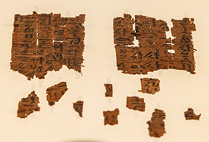
There are very few official inscriptions preserved from the reign of Senusret II, but a few private stelae mention events during his reign. On a stela dated to Year 6 of Senusret II, a certain Sobekhotep reports that he collected taxes in the whole country and purified the temples.
A stela found at the Red Sea port of Wadi Gasus, now in Durham, dates to the first year of Senusret II. It was set up by the chamberlain Khnumhotep, who mentions in the short text that he established a monument in the ‘god’s land’. The location of the ‘god’s land’ is uncertain, but seems to be connected with the mysterious land of Punt that is most likely at the Horn of Africa. Another stela dating to Year 2 was found at the same port. The stela belongs to Henenu – ‘member of the elite’, ‘foremost of action’, and ‘reporter’ – and tells of an expedition to Punt. He is not known from other monuments, but his title ‘member of the elite’ announces that he belonged to the highest court levels with direct access to the king.

An undated inscription from Sinai attests to an expedition to that region which, in this period, was not part of Egypt proper, but was a source of turquoise. The leader of the expedition was the ‘god’s sealer’ Heqaib.
Finally, an expedition is attested to the Wadi Hammamat, where hard stones were collected. The expedition leader was Weriqer, who was ‘overseer of the stone workers’. Many of these expeditions are dated to the very beginning of the king’s reign, and one wonders whether they were related to the early construction of the king’s pyramid.

Lahun pyramid
The pyramid of the king was placed at the entrance to the Fayum, a river oasis with a large lake that received its water from a branch of the Nile. In the Old Kingdom, this region was quite marshy and not suitable for agriculture. In the Twelfth Dynasty, the government developed the region and opened up new land suitable for farming. Senusret II also founded a substantial town that acted for about a century as the main administrative centre of the region, and has since provided valuable evidence about daily life during this period.
The pyramid was erected on a small hill that acted as the core of the structure. This might be a sign that Senusret II was already quite old when he came to the throne, and so did not have much time for more elaborate building projects. The structure displays many innovations. First of all, it was built of mud bricks. All Egyptian pyramids before this were made of stone, albeit often with a core of stone rubble rather than hewn blocks. The pyramid of Senusret II only had an inner stone skeleton, evidently to provide stability.
The outside of the pyramid was covered with limestone blocks with an inscribed granite pyramidion at the top. While we do not have any pyramidia from reigns before Senusret II, we do know that the Old Kingdom pyramidia were uninscribed. Several fragments of Senusret’s inscribed pyramidion were found; sadly, these are so badly destroyed that it is impossible to say what type of text was written there.
Pyramidia from the pyramids of Amenemhat III and the Thirteenth Dynasty king Khendjer are preserved and have spells spoken by different deities. These spells are known from coffins and other monuments, too, but hardly any of the signs preserved on the fragments of Senusret II’s seem to fit those spells. So it seems Senusret II had different religious spells on his pyramidia, while shortly after the texts there became standardised.

Another innovation was the arrangement of the corridors and chambers within the pyramid. Before Senusret II, the inner plan of pyramids was often very simple. The entrance was on the north side, hidden under the surface of the pyramid, leading to a corridor, and finally the burial chamber in the middle of the pyramid structure. The burial chamber could be just one chamber, but there are also pyramids with several chambers, perhaps for different burial goods. However, Senusret II did something new.
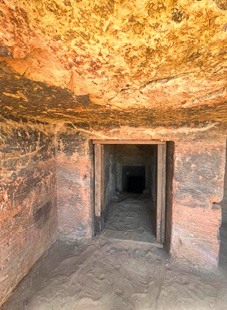
The entrance of his pyramid is on the south side and arranged as if it were the tomb of a princess. Under that ‘fake’ tomb chamber, there is a shaft leading to a corridor that runs under the pyramid to the burial chamber of the king. The king’s stone sarcophagus, which still stands in the chamber, is simple but shows a very high level of perfection in stone cutting. The chamber was found looted, but Petrie found a golden uraeus that might have once adorned a coffin or mummy mask.
Of the rest of the complex, the valley temple built to the west is now completely destroyed, having been used as a stone quarry in antiquity. The pyramid temple was once decorated with fine, painted reliefs, but only small fragments were found when it was excavated.

Subsidiary burials
A further interesting point is that there are several burials of princesses and queens at the south side of the pyramid. They are placed side by side, and one of them hides the entrance to the pyramid. Egyptian tombs, especially those of wealthy people, usually have a chapel for the funerary cult. However, here there are no traces of any chapel. Does this mean there was no funerary cult for the members of the royal family? Still standing at the north side of the pyramid is a row of mastabas and a small pyramid, partly cut into the rocks. There are no signs of burial shafts here. Therefore, it seems that the underground burial chambers were placed apart from the cult chapels: burials to the south of the pyramid, and chapels to the north. These chapels were once decorated, but only one relief fragment was found there, bearing the name of Senusret – most likely Senusret II.

Furthermore, on the north side, Petrie’s team found another tomb consisting of a corridor leading to three chambers, one containing a granite sarcophagus. The walls of the chamber and corridor are covered in stone and the workmanship is again superb. The whole layout is royal in style, and one wonders whether this was the real burial place of the king, hidden next to the pyramid and not under or inside it. One thing is clear: security was the main concern for the construction of the complex. Entrances are now hidden and located in unexpected places, and even cult chapels are separated from the burial chamber, an arrangement not found in previous royal burial monuments.


The jewellery of Sithathoriunet
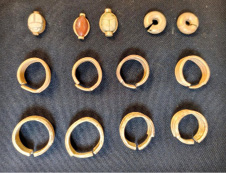
Only one of the royal family burials on the south side can be attributed to a named person. This is the ‘king’s daughter’ Sithathoriunet. Her tomb was found looted, but there was a small niche that robbers overlooked. Here were found the badly preserved remains of boxes containing a number of wonderfully crafted personal adornments, including several cosmetic vessels, armlets and anklets, girdles, and a crown. Two items are outstanding: pectorals bearing the throne names of Senusret II and Amenemhat III (the princess died in the reign of the latter king). The pectoral with the throne name of Senusret II is one of the finest pieces of jewellery ever made in Egypt. Two similar high-quality pectorals were discovered at Dahshur, one again with the name of Senusret II, and a third with the name of Senusret III. These three pectorals are superb in design and craftsmanship, and might possibly have been made by the same master goldsmith. Later pectorals are all inferior in quality. Gold-working reached its peak in ancient Egypt under Senusret II and Senusret III.

Pyramid town and cemeteries
The town, Hetep-Senusret (now known as Lahun), was founded as a local administrative centre and home for the funerary priests of the valley temple. It consisted of several large town houses with granaries, many middle sized houses, and many smaller ones. In the middle there was an administrative building. The place is evidence for substantial population movements in the Middle Kingdom. In its heyday, it was home to several thousand people who must have lived somewhere else before the town was built. One wonders whether the government under the king forced people to relocate here.

Around the pyramid were cemeteries containing the graves of many of the people serving the king. The tombs, however, were found heavily destroyed. Most often only small fragments of the reliefs that decorated the chapels were found during excavations. Mostly the names of the tomb owners are unknown. One exception is Inpy. He was buried under a mastaba that was built on top of a hill, and therefore had a prominent position in the necropolis. In front of the mastaba there was a chapel with several rooms, most of them decorated with reliefs. There are remains of a biographical inscription, and a scene showing Inpy in front of an offering table, with other fragments that preserve his titles. His main function was that of an ‘overseer of the gateway’. This was often a high position at the royal court, but frustratingly there is not much evidence about the functions and tasks of this role. Inpy was also ‘overseer of all royal works in the entire country’. Therefore, he was most likely in charge of many building projects. One wonders whether he was perhaps the mastermind behind the building of the pyramid.

Egyptian provinces
Senusret II reigned in the middle of the Twelfth Dynasty. At many places all over the country, local governors were wealthy enough to have large, well-decorated funerary monuments. One of the best-preserved and best-known tombs is that of the local governor Khnumhotep II at Beni Hasan. He was in charge of a province and its local centre, Menat-Khufu. One of his main titles was that of the ‘overseer of the Eastern Desert’. In this function, he supervised traders coming from the Levant (unless they came by boat, they had to pass through the Eastern Desert to enter Egypt). One encounter with Levantine traders is indeed depicted in his tomb and dated to Year 6 of Senusret II. It shows a caravan of people in colourful clothes carrying foreign weapons. There is much evidence for contacts between Egypt and the Levant during this period.
It is possible that Senusret II had a short coregency with his son Senusret III before he died and was buried at Lahun. The funerary cult of the king lasted for several generations, showing he was celebrated as a great king by later Egyptians.

Wolfram Grajetzki is Honorary Senior Research Associate at University College London, and the author of several books about the Middle Kingdom. You can read more about the jewellery of Sithathoriunet in his book Tomb Treasures of the Late Middle Kingdom (University of Pennsylvania Press, 2014) and in his article in AE 87.
Further reading:
• G Brunton (1920) Lahun I: the treasure (London: British School of Archaeology in Egypt & Bernard Quaritch).
• W M Flinders Petrie et al. (1923) Lahun II (London: British School of Archaeology in Egypt & Bernard Quaritch).
• W Grajetzki (2024) The Middle Kingdom of Ancient Egypt: history, archaeology and society (London: Bloomsbury).