
Subscribe now for full access and no adverts
Napoleon fought a series of battles against the Austrians after leading France’s Army of Italy into Lombardy in the spring of 1796. At the age of 26, it was the first time that he had overall command of a campaign. From now on, he began to project an image of a decisive, successful warlord. He did so with an eye to advancing his prospects in the turbulent world of French revolutionary politics.
The invasion of Italy was part of a wider effort to terminate the Austrian threat to the French state. The intention was to force the Habsburg monarchy to divide its forces by mounting a major assault in Germany, with a secondary thrust in Italy. As it turned out, Napoleon’s involvement turned the latter into the more important front.
In the second article of our special feature for this issue, we focus on two key engagements in northern Italy: at Lodi in May 1796 and Arcola six months later. Neither was a wholly decisive engagement. When Napoleon was given command of the Italian campaign, many senior officers doubted his capacity. He lacked experience of command and was physically unimposing. One eye-witness described him as ‘small, skinny, very pale, with big black eyes in sunken cheeks’, his long hair forming ‘spaniels’ ears’.
But Napoleon soon impressed his subordinates with his natural air of authority and detailed grasp of the realities on the ground. His successes in Italy would help to create the Napoleonic legend. Everything he did was carefully packaged for consumption at home. In his reports to the government – often accompanied by captured flags and trophies – and in a series of newspaper articles, Napoleon shamelessly magnified his own achievements.
Facing the opposition
At the start of the campaign, this must have seemed an unlikely outcome. The invasion force that Napoleon led into Italy was the worst equipped of all the revolutionary armies, with fewer than 38,000 troops capable of fighting. They lacked uniforms and rations, and the crisis-ridden Paris government had failed to pay them for several months. Morale was low, and was further undermined by the work of royalist agents known to be active in the ranks. At home, they were despised as ‘Bonaparte’s brigands’.
Before this unprepossessing band, Napoleon dangled the prospect of loot amid the wealthy cities and fertile countryside of northern Italy. ‘Soldiers! You are hungry and naked,’ he is supposed to have told his assembled troops. ‘The government owes you much but can give you nothing… Rich provinces, opulent towns, all shall be at your disposal; there you will find honour, glory and riches.’
On the other hand, despite its numerical superiority, the Austrian army in Italy had some significant weaknesses too. The Habsburg empire and its main ally, the Kingdom of Piedmont-Sardinia, did not fully trust each other, and communication between the two was poor. In any case, the French ended Piedmont’s participation in the first weeks of the invasion.

Although it had undergone some reforms in the mid-18th century, the Austrian army remained a profoundly conservative institution. It was the personal defence force of the Habsburg monarchy, whose focus on preserving the power of the ruling dynasty engendered a deep-seated suspicion of experimentation in strategy, tactics, or organisation.
The higher echelons of the Austrian officer corps were drawn mainly from the ranks of the nobility and were selected primarily for their loyalty to the crown. The rank-and-file soldiers were recruited from across Austria’s multi-ethnic empire by a combination of selective conscription and voluntary enlistment. The army’s progress was slowed by its dependence on cumbersome supply trains and a network of depots. By contrast, the more mobile French lived off the land.
Austrian soldiers fought bravely. Their artillery was effective, under the command of well-trained, professional officers. But the army was wedded to a rigid set of rules on deployment, which laid emphasis on drill, advancing in closed lines, and volley-firing. The generals made little attempt to cover their lines with skirmishers. Their cavalry was well-trained but rarely used to best effect. This lack of tactical flexibility would prove a source of weakness when faced with a less conventional opponent like Bonaparte.
Partial victory
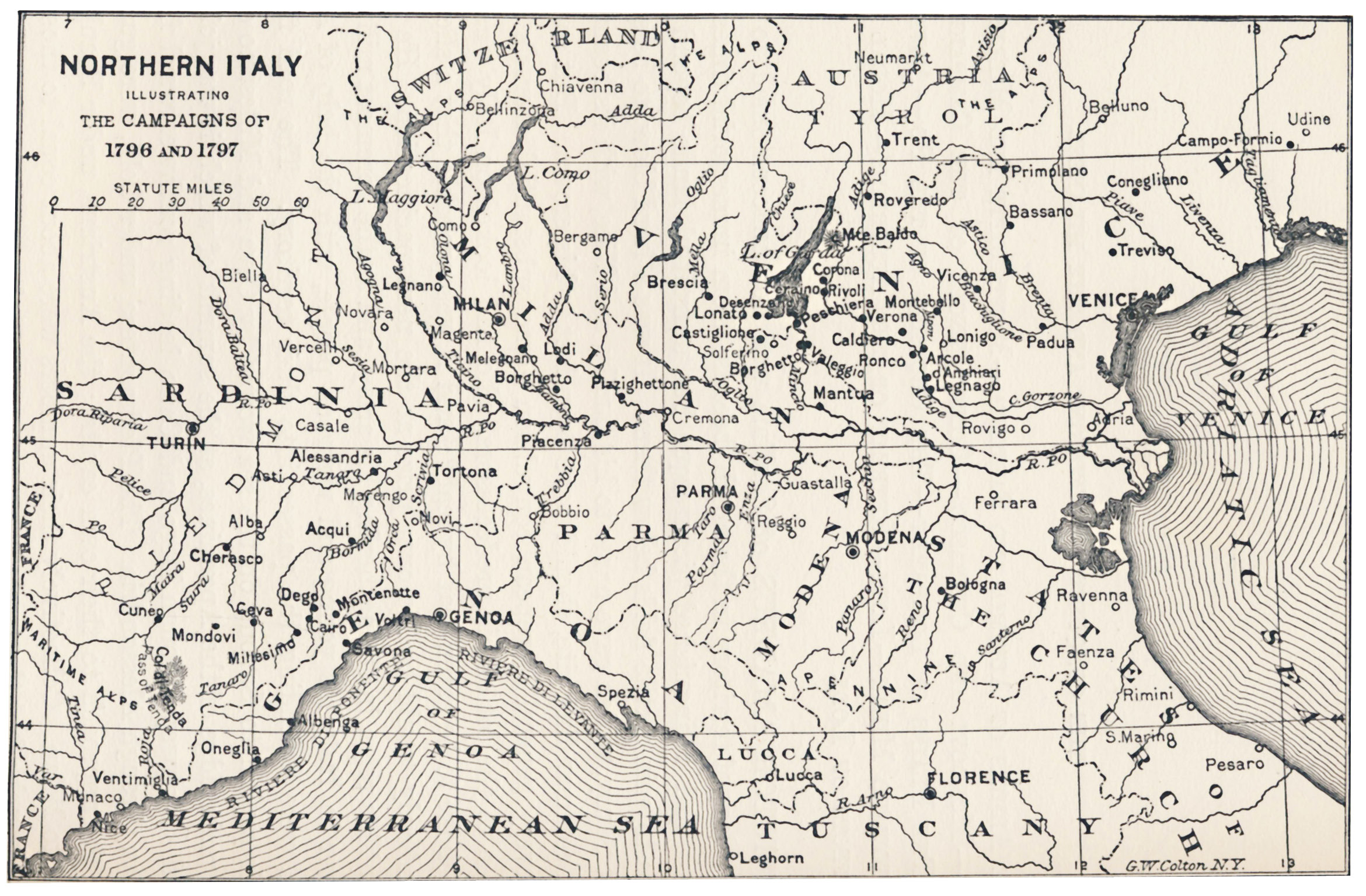
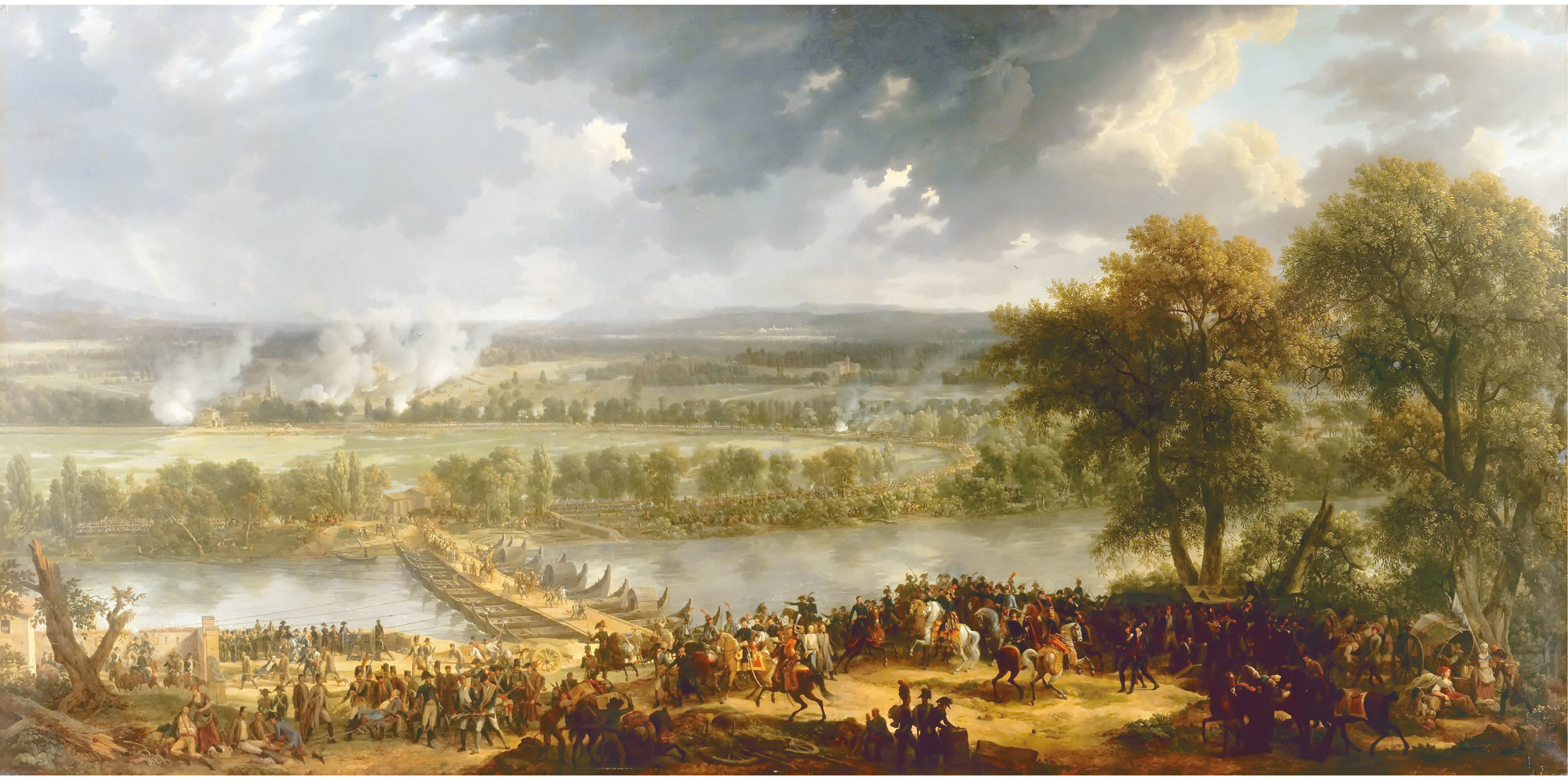
These characteristics were clearly demonstrated at Lodi on 10 May 1796. The battle was fought on the banks of the River Adda, a tributary of the Po, which flows eastwards across northern Italy. Napoleon’s objective was to take the province of Lombardy, including its capital Milan, and then to break out into the Tyrol, to the north-east. His opponent was the ageing General Johann Beaulieu, who was taken by surprise by the speed of the French advance.
After a reverse at Fombio, Beaulieu fell back to the small town of Lodi, 20 miles south-east of Milan. Here the Austrians took up a defensive position on the approaches to the town. Probing moves by the French caught them unawares. With his outposts overrun, Beaulieu gave the order to evacuate Lodi. Leaving a single infantry battalion and two cavalry squadrons to carry out a holding action, the main body of the Austrian army began to cross the narrow wooden bridge that spanned the Adda. In face of French artillery-fire, the whole of the defending force soon began to follow their comrades to the other side.
Beaulieu was heavily outnumbered, with some 9,500 troops and just 14 guns facing some 17,000 French, equipped with 30 cannons. He might have delayed the French advance by demolishing the bridge, which was the only crossing point over the Adda. Instead, the retreating Austrians placed cannon on the bridge and along the banks facing the French. There followed an artillery duel, which continued for some hours.

Not everything went smoothly for Napoleon. A preliminary attempt by French cavalry and supporting artillery to ford the river above Lodi failed. As his infantry began to arrive in growing numbers, Napoleon formed them into a compact column and ordered them across the bridge. At first, they fell back as they encountered the murderous converging fire of the Austrian cannon, firing directly across the bridge and along the bank.
The column then regrouped and – with several senior officers at their head, though not Napoleon himself – the French infantry finally forced their way across the bridge. The intense cannon-fire had produced such a curtain of smoke that the Austrians were temporarily unable to see the advancing enemy. Caught off guard, they had no time to reload and so they rapidly retreated. The attackers also had the good sense to divide as they neared the opposite side, with some jumping into the shallow water to provide covering fire for those still on the bridge.
Lodi illustrates the conventional, textbook-based thinking of the Austrian approach to war. Their gunners used canister shot against the advancing French troops. This was a closed metal cylinder containing round balls or other metal objects such as nails or wire. The casing disintegrated when fired, spreading its contents with devastating effect at close quarters. But canister shot was most effective on an open battlefield. Fired into troops advancing over the bridge at Lodi, it inflicted wounds only on those at the front. The Austrians would have done better to use round shot – solid cast-iron spheres that would have carved great holes down the length of the column.
Creating the myth
Supported by arriving cavalry, and by their own artillery on the bank behind them, the French infantry rapidly established a bridgehead. Splitting up into platoon-sized formations, they began to push the Austrians back. As they saw more enemy reinforcements joining the battle, the Austrians abandoned their positions. They were fortunate that, with night approaching, the French were too exhausted to pursue them. This was understandable, as the invaders had marched 70 miles in two days, at a time when the accepted daily maximum for an army was roughly 12 miles. But it denied Napoleon the chance to inflict a truly crippling defeat.
In reporting back to his domestic audience, Napoleon made sure that his leadership at Lodi took centre stage. He deliberately exaggerated his own role and the odds that he faced. It was here, he later claimed, that he first recognised himself as man of destiny: ‘the ambition came to me of executing the great things which so far had been occupying my thoughts only as a fantastic dream.’ From now on he enjoyed the unqualified confidence of his men, who admiringly nicknamed him the ‘little corporal’ in acknowledgement of his courage and stamina.
Lodi was a small-scale engagement – the Austrians lost just 330 killed and wounded, with 1,700 taken prisoner. Yet it had important consequences. The news raised morale in France at a time when the revolutionary armies were making little headway in the German theatre. Five days after Lodi, Napoleon occupied Milan. The opportunity to loot the city and exact tribute partially alleviated the soldiers’ material hardships. Yet it also alienated the population who suffered from these depredations. The army’s proclaimed mission to spread the revolutionary ideals of liberty rang hollow. Meanwhile, Beaulieu retreated, leaving 12,000 troops to garrison the key fortress of Mantua, which controlled the approaches to the Tyrol and Venetia.
Napoleon rarely allowed himself to be tied down in sieges. But, in the case of Mantua, he was forced to commit significant numbers to besieging the fortress and resisting Austrian attempts to relieve it over a six-month period. To its impressive man-made fortifications were added the natural obstacles of surrounding lakes and marshes. Although a proportion of its defenders succumbed to illness, by remaining in Austrian hands it threatened Napoleon’s control of Lombardy. It forced him on to the defensive in the second half of 1796.
Knife edge
At home the Directory, possibly motivated by jealousy of Napoleon’s success, now proposed to split the command of the Army of Italy. While General François Kellermann was to control the Po Valley, Napoleon was to be sent to intimidate the Papal States and the duchies of central Italy into remaining neutral. The Directory also wanted him to collect more treasure – the revolutionary regime’s lack of resources was a perennial worry. But it abandoned the plan in the face of Napoleon’s passionate insistence on unity of command. He famously stated that ‘one bad general is better than two good ones’. His political masters climbed down, proclaiming ‘immortal glory to the conqueror of Lodi’.
Meanwhile, the Austrians had used the time to regroup, sending one of their more able commanders, Count von Wurmser, to join forces with Beaulieu. This forced Napoleon to abandon the siege of Mantua so that he could concentrate his forces. There followed a series of engagements between July and September, which resulted in Wurmser being bottled up in Mantua with half his army, placing extra pressure on the garrison’s dwindling rations. The other half headed back to the Tyrol.
In early November, a two-pronged Austrian attempt to lift the siege got under way, with General Joseph Alvinczi moving westwards towards Verona, while a force led by his lieutenant, Baron Davidovich, marched down the Adige valley. Between them, they had a combined strength of 46,000, heavily outnumbering the 30,000 troops at Napoleon’s disposal.
The French position was precarious in the extreme, and Napoleon’s initial attempts to counter the Austrian advance met with failure. It was against his instincts to give battle at a numerical disadvantage, but if he withdrew troops from the siege of Mantua, this would allow the defenders to operate in his rear. The fate of the Army of Italy depended on rapid action to prevent the two relief forces from converging.
The Battle of Arcola, fought between 15 and 17 November, took place close to the junction of the Adige and Alpone rivers, to the south-east of Verona. After crossing to the north bank of the Adige by pontoon bridge, the French advanced along narrow causeways through marshy terrain where both sides struggled to gain an advantage. It was a calculated gamble. Napoleon was far from confident, writing that ‘the weakness and exhaustion of the army causes me to fear the worst. We are perhaps on the eve of losing Italy.’
Breakthrough
As they approached the village of Arcola, on the River Alpone, troops under General Pierre-François-Charles Augereau came under heavy fire on the exposed roadway and took cover. This threw Napoleon’s plan into jeopardy. It was essential to capture the bridge at Arcola if the French were to cut off Alvinczi’s line of retreat.
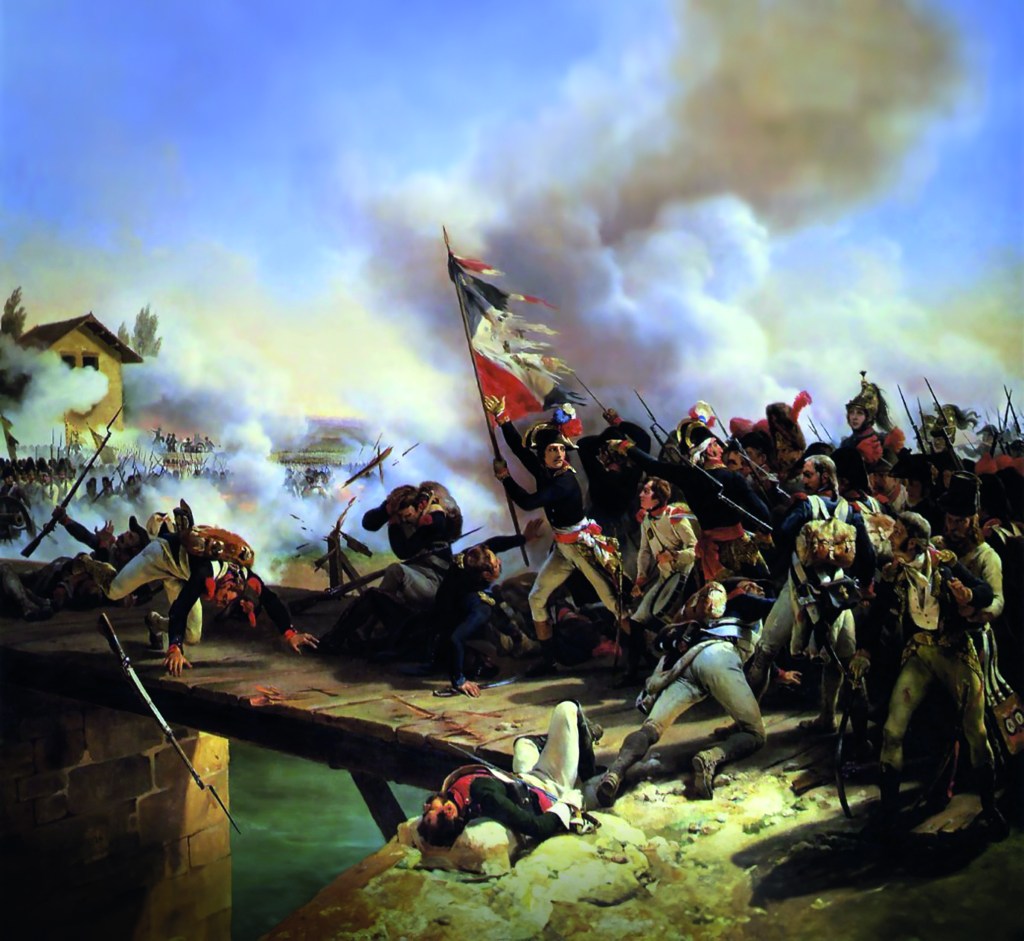
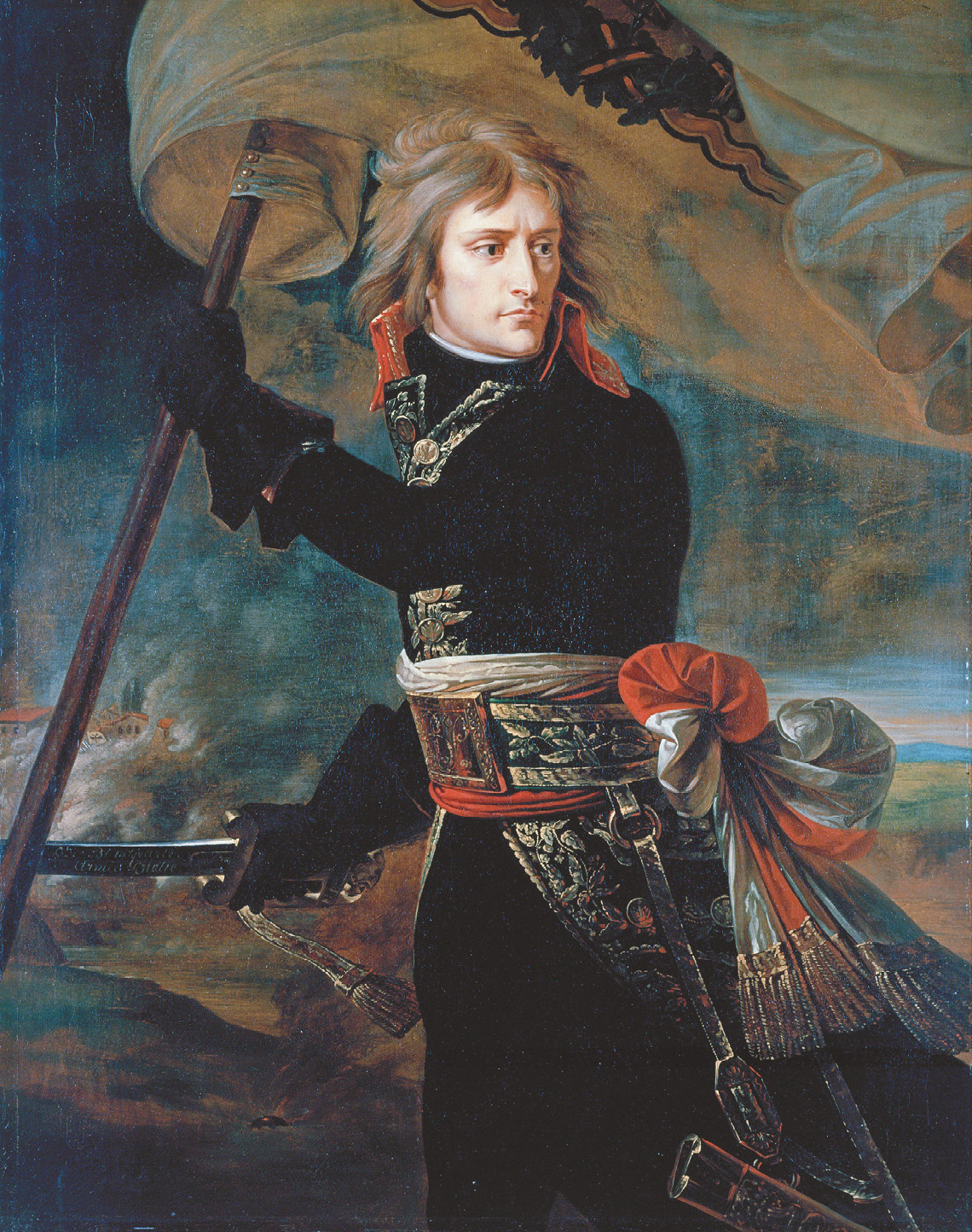
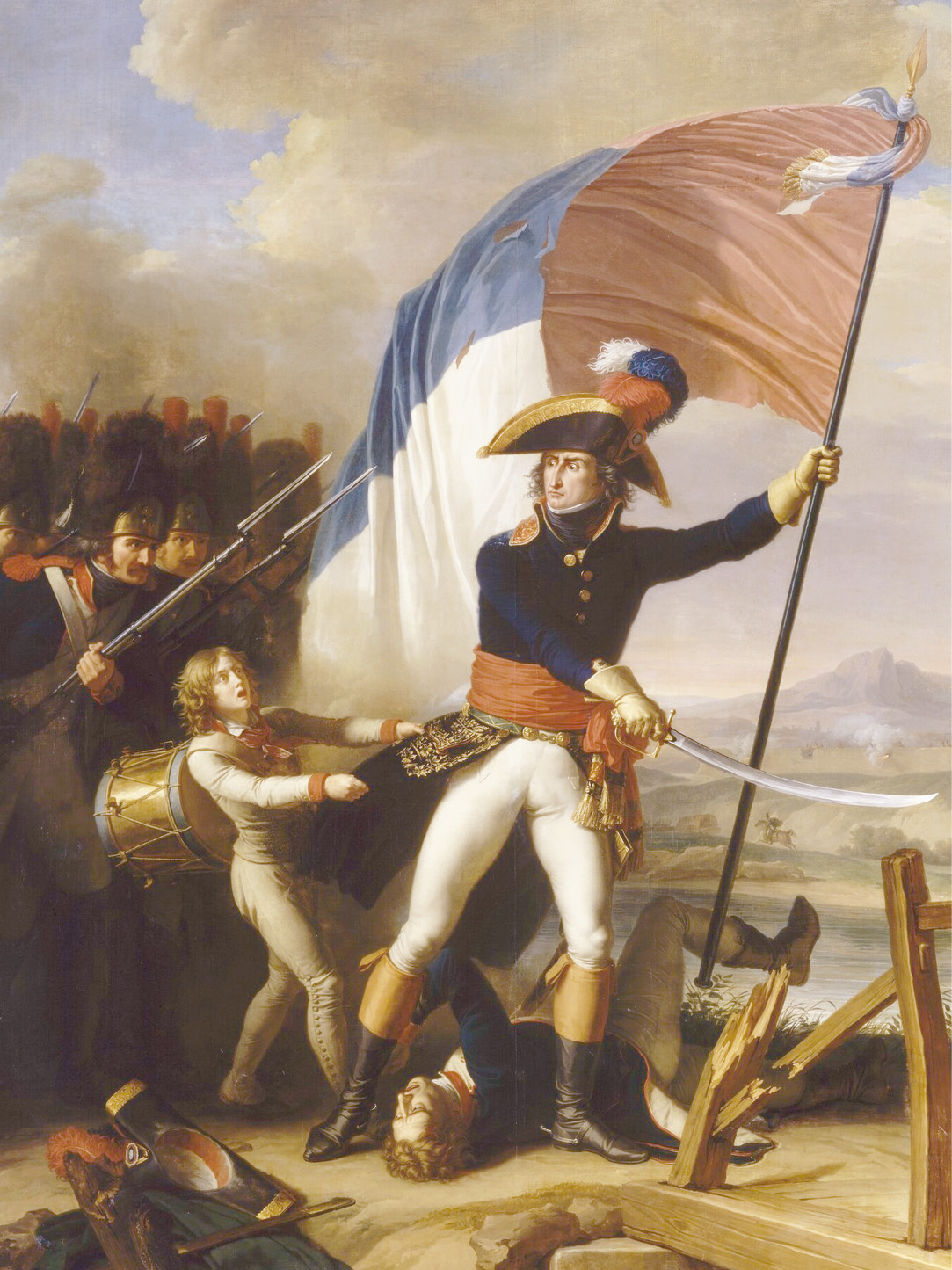
Arcola was to become an integral part of the Napoleonic legend. In Napoleon’s later version of events, he gave the impression that he successfully led the charge across the bridge in person, carrying the French flag. He depicted a dramatic scene, the inspiration for Antoine-Jean Gros’s idealised painting, Bonaparte at the Bridge of Arcola. Even more than in the aftermath of Lodi, Napoleon sought to have himself depicted as the battle’s outstanding individual, resolute and brave at the head of his troops.
The truth was that Napoleon had imitated an initiative taken by General Augereau. He was the first to advance on to the bridge with a group of soldiers, but was forced to retreat under enemy fire. When Napoleon attempted the same feat, several of his companions were killed around him. One of his officers tried to save him and he fell back with other survivors, ignominiously ending up in a water-filled ditch from which he had to be extricated.
The first day of Arcola had been frustrating. The exhausted French troops had failed to close the trap on Alvinczi, who took back control of Arcola overnight. On the second day, Napoleon made another effort to take the town. Gradually the tide began to turn, as the Austrians suffered increasing casualties. Alvinczi’s troops became split into two separate sections, enabling Napoleon to launch one more assault on the third day of the battle.

General André Masséna led a diversionary attack in the surrounding marshland. This was a bitterly fought action, in which at one point the bridge at the nearby village of Ronco collapsed. French artillery-fire, however, proved able to fend off Austrian fire long enough to repair the bridge. Meanwhile, Augereau manoeuvred to take Arcola from the rear. His forces ran into strong opposition, but Napoleon sent a small contingent to the rear to distract the enemy. The commotion made by these men convinced the Austrians, whose morale was already shaky, that they were under heavy attack. They hastily sought safety with the main body of their army.
This ruse, combined with the arrival of a further French column, proved decisive. Alvinczi was soon in full retreat. Davidovich, who had briefly prevailed against another French force north-west of Verona, was also forced back, narrowly avoiding envelopment. Arcola was over. The Austrians had taken some 7,000 casualties for roughly 4,500 on the French side.
Although the Austrians would make a final abortive attempt to relieve Mantua in January, Napoleon had averted the disaster that threatened the Army of Italy. In the process, the 26-year-old cemented his reputation as an outstanding commander, whose boldness and stubbornness had paid off in adverse circumstances.
Further reading:
• David Chandler (1966) The Campaigns of Napoleon (Macmillan).
• Jonathon Riley (2007) Napoleon as a General: command from the battlefield to grand strategy (Hambledon Continuum).
Images: Wikimedia Commons, unless otherwise stated
In the next issue of MHM: Napoleon at the zenith, 1800-1810