Subscribe now for full access and no adverts
This year marks the 80th anniversary of a number of bloody engagements which, eventually, brought about the downfall of Hitler’s Nazis. The recent publicity surrounding the events to commemorate the Normandy invasion of June 1944 was hard to miss – but it is easier to forget the parallel campaign in Italy, or that it caused even more casualties to both the Allies and the Axis powers than operations in France, the Low Countries, or Germany.
Even when the Italy campaign does get taken into account, attention is understandably often focused on the infamous yet photogenic destruction of the great monastery of Monte Cassino – which seems to hold people’s imaginations much more readily than, say, the fighting around Salerno or Anzio. Then, even further down the list, come the great battles of the ‘Gothic Line’ – the Germans’ last major line of defence, which stretched right across the northern summits of the Apennines, north of Florence and south of Bologna and the Po Valley. It was the operations there that would sweep the Nazis right to the northern borders of Italy and beyond, before Berlin capitulated. Here, we will examine just a small part of this mighty sequence of events that took place among the mountains, vines, dust, and mud as final victory beckoned.
Drawing the Line
Once Sicily had fallen in the late summer of 1943, there were a number of courses open to the Allies. An invasion of mainland Italy might have been avoided altogether by a series of amphibious operations aimed at Sardinia and Corsica – leading, eventually, to the southern coast of France. There were many in the Axis high command who expected just that – but the planning conferences in Casablanca in January and Washington in May 1943 had underlined the Allies’ key aims: to tie down and defeat as many German forces as possible, and by so doing to take some pressure off the Soviets; to buy time for the build up of forces in Britain for the invasion of France; and, most importantly, to inflict a crushing physical and psychological blow on the enemy by forcing Italy to surrender. All of these were eventually achieved, not by island-hopping, but by grinding slowly and lethally all the way up the leg of Italy.
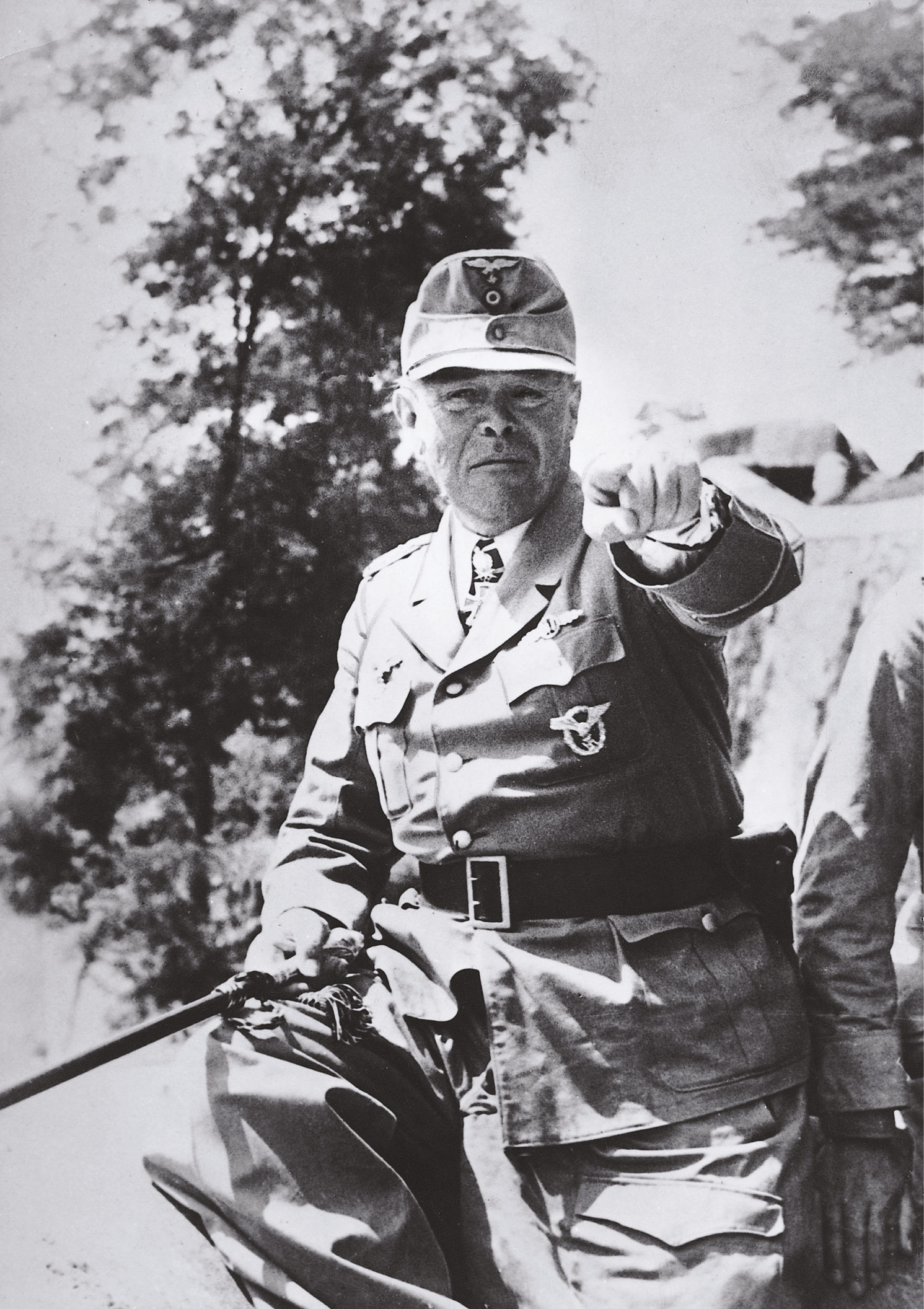
It is not certain whether it was the advice of Erwin Rommel or Albert Kesselring – Hitler’s two most-trusted generals – that won the day. Rommel advocated a light defence along the body of Italy, which would delay and disrupt the Allies, while winning time to build a deep series of redoubts, stretching from the Ligurian port of La Spezia all the way across the north of the country to Rimini on the Adriatic. Kesselring, meanwhile, certainly agreed with such a line, but proposed a series of other defences, like rungs on a ladder, that would kill and blunt the invaders at every step. The resources for this ‘Gothic Line’ (as it was eventually dubbed) would certainly be diminished – but it would provide opportunity for disastrous delays to be imposed on the Allies, disrupting the timetable for the invasion of France, and dismaying the Soviets.
It is now thought that if the landings in early September 1943 of US General Mark Clark’s Fifth Army at Salerno and Bernard Montgomery’s British Eighth Army at Reggio di Calabria – both in the south of Italy – had been delayed a little, and the Italian collapse had happened even a week later than 8 September, Rommel’s advice might have been followed. If that had been the case, the subsequent, costly odyssey of violence – of Salerno and the Volturno, the Winter Line, the Barbara and Gustav Lines, Ortona, Anzio, and a host of other blood-lettings on Italian soil – might have been avoided. Certainly, the first Axis capital, Rome, would have fallen, but the Americans, British, Canadians, Poles, Free French, and all the others would have arrived in Northern Italy with horribly stretched lines of communications and uncertain air cover to face a formidably prepared series of strongpoints manned by experienced, and fresh, troops.
As it was, by August 1944, an exhausted ‘Tommy’ and ‘Tex’ were nudging up to the sangars (stone-built fighting posts) and foxholes of a scarcely finished Gothic Line manned by equally spent ‘Teds’ (a common nickname, from the Italian word for German: tedeschi). In the end, it matters little whether Rommel or Kesselring was right – as we will see by looking more closely at just one tiny but brutal part of the vast struggle that followed across the breadth of Italy, which illustrates perfectly how both sides fought and died.

The tiny part in question was the battle in late summer 1944 for the Coriano Ridge – a hilly spur, north of the Conca River and just south-east of the microstate of San Marino, that was the last major obstacle before the coastal city of Rimini. Just before we get to the detail of the battle, however, we need to add some context. In the western part of the central Apennines, Clark’s US 5th Army was trying to roll up the Nazis’ right flank. Their costly mountainous assaults were coordinated with the 8th Army’s attack along the Adriatic’s coastal plain near Rimini, stretching inland as far as San Marino. By late August, Operation Olive – strictly the British part of the operation – had quickly driven in the outer German defences and was closing with surprising speed on the main defensive positions along what Kesselring’s men called ‘Green Line II’. There the momentum stopped.

Commanding position
In the early days of September, the 56th (London) Infantry Division, assigned to the V Corps of the British Eighth Army, attempted to barrel along the Conca Valley, which runs east–west towards the sea, and passes just to the north of the village of Gemmano. Their plan was to capture river crossings before their enemies were properly ready for them – but they found themselves heavily stalled by the brilliant defence of the hilltop Gemmano position (see MHM 114, March 2020), held by the battle-hardened troops of 100th Gebirgsjäger Regiment. Not only did Gemmano’s lofty mountain ridge dominate its own western bank of the Conca, its height also allowed supporting artillery to fire accurately on the village of Croce on the other side, and to provide flanking fire – in enfilade – right along the spine of the Coriano Ridge, which had been thoroughly prepared for defence.
The 46th Infantry Division had stormed up to a position on San Clemente ridge, opposite the Coriano Ridge – picking up a Victoria Cross in the process. But there the unit lay, nibbling forward with patrols across the valley to its front, helping 56th Division as much as it could, but tired and lacking the guns and tanks to punch north-west just a couple of miles and into the fortress villages of San Savino and Passano which topped the facing Coriano Ridge.
The advance had been rapid, but transport, armour, and, most importantly, logistics traffic lay sprawled along the dusty tracks to the rear of the attacking divisions, outpaced by the speed of events. In turn, troops from Canadian I Corps and Polish II Corps – now in reserve – lay further north towards the coast, struggling to bring up their supplies and stymied by the sudden stalling of the divisions of the British V Corps either side of the Conca Valley.
Lieutenant General Charles Keightley, the commander of V Corps, felt that the tempo of his whole corp’s attack hung in the balance – with his left flank jammed on Gemmano, his centre jaded by earlier fighting, and the Canadians now manoeuvring to get their leading division in place on his right. Was it time to regain the initiative by punching forward north-west with his small but powerful reserve in the form of 1st Armoured Division?

The Germans certainly knew how critical the moment was too. They felt that if they could hold V Corps and the Canadians along the Coriano Ridge, across the Conca Valley and up to lofty Gemmano until the arrival of 71st Panzer Grenadier (Pzg) Regiment during the night of 3-4 September and give some depth to 26th Panzer and 1st Parachute Divisions, who were defending the central and coastal flank of the position, then they might cause the Allies to stall.
Part of the able Major General Dr Fritz Polack’s 29th Pzg Division, 71 Pzg Regiment’s arrival was the start of several reinforcements to the strongpoints on the Coriano Ridge – including part of 98th Infantry Division, commanded by Lieutenant General Alfred Reinhardt, and a ‘blocking group’ of 162nd (Turcoman) Division. Indeed, so secure did Kesselring himself feel that he left this crucial position to make a flying visit to his 14th Army.
Allied advance
Despite the activity, Allied Intelligence seem to have missed the German reinforcements, and by the night of 4-5 September were advising that the southern part of the Coriano position – centred on the village of San Savino – might be ripe for exploitation. Accordingly, 1st Battalion, London Irish Rifles (1LIR) – part of the embattled 56th Division – were told to probe forward.
The LIR history records that:
Everything was unusually quiet as the companies deployed in readiness for the attack. In the stillness of the evening, the surrounding countryside sprang suddenly into life. From positions very carefully concealed on our left flank, the enemy opened up… and pinned the entire leading company down. The situation was awkward, and after several fruitless attempts to go forward there was no alternative but to wait until total darkness.
With plenty of Germans very evidently on the ridge opposite (despite the Intelligence assessments to the contrary), it became the task of Major General Richard Hull, GOC of the 1st Armoured Division, to launch his forces against a target that, if pierced, would unblock the log jam between Keightley and the Canadians (who were to attack in parallel) and jump-start the whole assault.
Then, at around noon on 4 September, Hull’s 2 Armoured Brigade’s reconnaissance parties started to appear near his HQ at San Clemente, opposite San Savino. Their Shermans were still churning up the dusty roads to the east, while far behind them were the infantry of 18 Brigade, followed by the Gurkhas of 43 Brigade – almost a day’s march away.
Originally a cavalryman, Hull was now one of the youngest divisional commanders in the Army. After tank experience in the North African desert, he had risen quickly to be given command of V Corp’s armoured fist, with three tank regiments and a brigade of lorried infantry, which had been reinforced by another three battalions – 43 (Indian) Lorried Infantry Brigade – in recognition of the difficulties of the rocky terrain.
Although air cover was patchy due to the low cloud and drizzle, and despite the Corp’s artillery being only partially in position, here was a relatively smooth and almost obstacle-free valley below San Savino that led towards the Coriano Ridge line opposite: finally, ‘good tank country’ had been found. Indeed, had the six battalions of infantry been used to pave the way and then support the tanks in the inevitable urban fighting that would follow, a swift and bold swipe might have worked. But the only foot soldiers available were the depleted 1st Battalion, King’s Royal Rifle Corps (1KRRC) – the supporting battalion for the tank brigade.
Time was crucial, and the armour of three travel-worn but almost up-to-strength Sherman regiments was only just beginning to arrive. The risk of an unsupported assault was justified, Hull thought, by a coup de main with his armour, and the prize – a narrow but rapid thrust through the crust and deep into the German defences – was worth the hazard. In this way, the scene was set for what became known as an ‘armoured Balaklava’ – a reference to the 1854 battle of the Crimean War, scene of the ill-fated ‘Charge of the Light Brigade’.
Battle commences
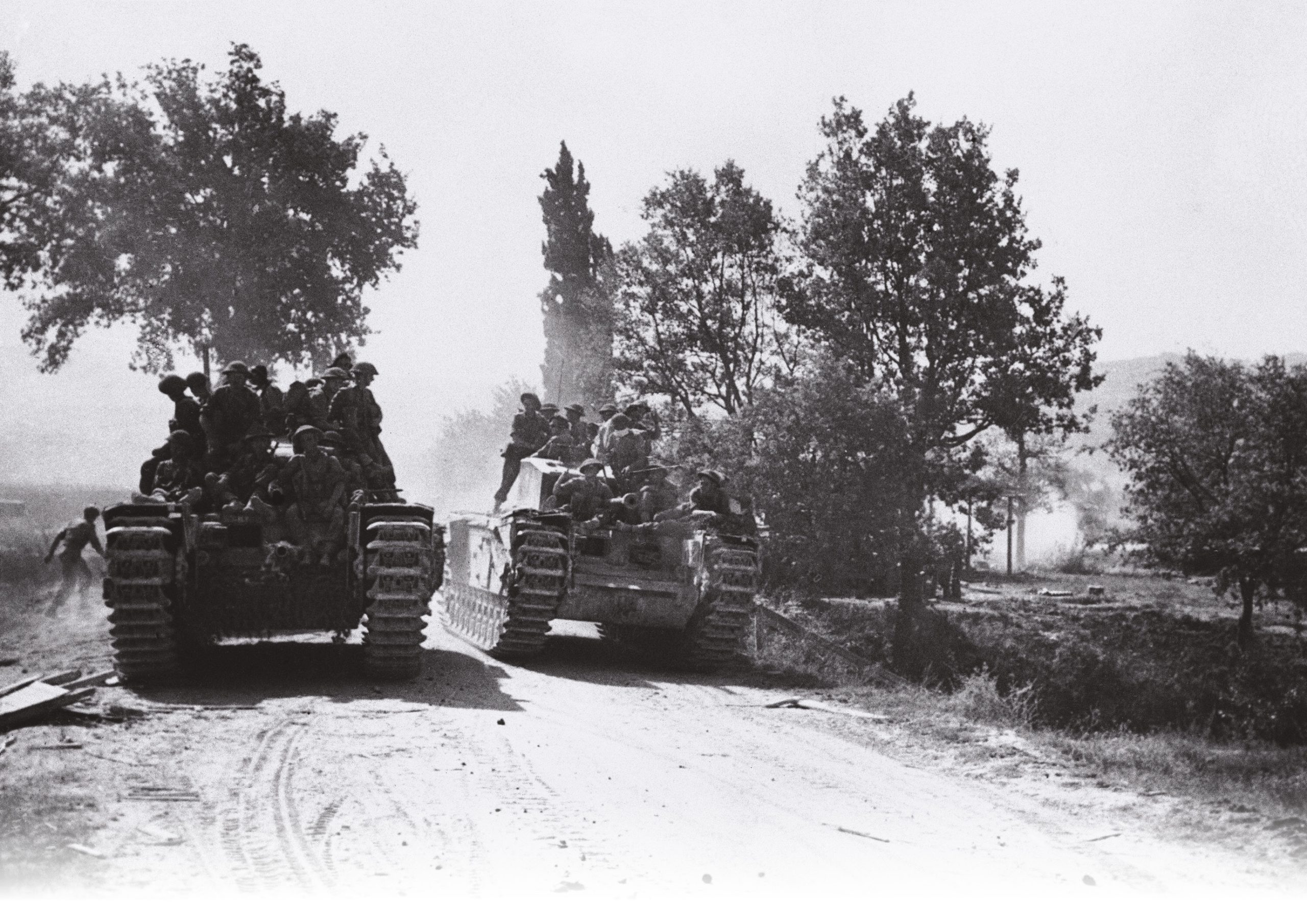
At 0700 on 5 September, the guns opened up and the tanks thrust forward from assembly areas near San Clemente towards the Coriano Ridge. On the left were 9th Lancers (9L), in the centre 10th Hussars, and diagonally on the right – in echelon – the Queen’s Bays (2nd Dragoon Guards). The Divisional Reconnaissance Regiment, the 4th Hussars and 1KRRC supported by sappers had done their best to span streams and clear mines; progress by the tanks was initially good – until carefully sited anti-tank guns began to take their toll. Good tank country is, of course, good anti-tank country as well.
One witness to events, Lieutenant Birch Reynardson, recalled:
My Troop crackled over anti-personnel mines up the slope towards San Savino cemetery. One tank got a glancing shot from an anti-tank gun to our left and rear; my Troop Sergeant’s vehicle was stopped dead and I lost a track on a mine just short of the trees near the church.
Another trooper reflected:
We had the feeling at times that the Enemy watched too many Hollywood Cowboy movies as they tended to kill the Injun Chiefs and the Injuns would run away – didn’t happen that way and only made us determined to kill them – fortunately for them we took prisoners… they still got our leaders though…
Some tanks then hooked north towards the church and into San Savino, only to be brought up short by German infantry fighting from prepared positions: 9L’s burning hulks could be seen – and smelt – for miles. The other two tank Regiments were not as badly mauled, but the wrecks of Shermans dotted the slope from San Savino, through Passano, almost as far as Coriano itself. While the Canadian attack had had some success towards the coast, Hull’s impetuosity had cost him 79 of the 140 or so tanks that had started the charge. No wonder that some compared it to the debacle in the Crimea 90 years earlier.
With the main attack having failed spectacularly, Hull was left with a very messy situation. Some Lancer tanks were stuck up near San Savino church along with a handful of 1KRRC and elements of 1LIR. The only good thing to come from the carnage was a toehold on the ridge, which began to look increasingly forlorn as German shells shrieked into it. Yet Hull decided to hold on at all costs and, despite the risk of throwing more good men into a charnel house, warning orders were sent to 18 Brigade to get their lorried infantry up the traffic-choked roads as fast as they could.

1st Battalion, The Buffs (Royal East Kent Regiment) arrived, but as they moved to their assembly point they were hit by a devastating concentration of artillery. The next available unit was 14th Battalion, Sherwood Foresters (Nottinghamshire and Derbyshire Regiment), veterans of Alamein and Anzio, but very dog-eared after 20 hours’ rattling about in trucks. Even so, Lieutenant Colonel Gofton-Salmond was told to lose no time, and as his dusty companies straggled in, they were told to attack ‘off the line of march’, with very little time for reconnaissance and only hurried orders.
It is a tribute to the Foresters’ discipline that this was achieved, and as darkness fell on 5 September, the Battalion found itself laden with ammunition and filing quietly through the brushwood and vines towards a southern flanking attack. After this, they would shake out, passing through the cemetery and its threadbare garrison, before storming the church and thrusting into the heart of San Savino, using wrecked tanks as markers.
Bayonets were fixed, Brens checked, lips licked, and, as the adjutant put it:
Beyond some shelling, all went well until Beaky Becke’s company got up to the blazing church. The Teds saw them by the light of the flames and Spandaus [machine-guns] killed or wounded all his young officers in a matter of minutes.
But Major Becke pressed on with a handful of lads, grenading the church’s outbuildings, killing several Germans with his Tommy gun, oblivious to the wounds he received, and only being stopped by his company sergeant major when he was seen to be streaming with blood.
D Company took up the advance in the narrow lanes, with Major Bill Holmes leading. In the dark smoke, and amid flying mortar fragments, he thrust 19-year-old Second Lieutenant Tony Hoyle’s platoon into the lead. The young officer remembered: ‘I hesitated at a small crossroads and sent Private Girdlestone forward to test the water. No sooner had he moved off than he was bowled over, by a Spandau.’
A few minutes later Major Holmes also lay dead and command of D Company fell on the shoulders of young Hoyle. But he pushed on, finding a Sherman full of silent Lancers without, apparently, a scratch on it. Then Hoyle realised the company was too strung-out – but as he was trying to consolidate his position inside the village, a German counter-attack sprang from nowhere: ‘A tank came up and started firing AP [armoured-piercing rounds] through the houses where we’d set up shop,’ he recounted. ‘Then Ted infantry were all over the place chucking stick bombs and raking us with automatic fire.’
The adjutant’s views were bitter:
We’d done a bloody good job straight off the trucks after hours on the road. We’d ‘rescued’ the Lancers – although there weren’t many of them left to rescue – broken into the village and held it without support. After fighting all night and getting lots of good blokes killed, we found ourselves back where we started in the graveyard being shelled to bu****y along with all sorts of other units. I never understood why we were sent into such a frightful mess in the first place.
Well might the orders have been questioned. The charge at Coriano in early September had cost 1 Armoured Division dearly in matériel and lives. It achieved little, beyond showing both sides how well the other could fight, and was scarcely more than a vignette among a host of other scraps and skirmishes.
German collapse
Just a week later, the tide turned with a more considered attack by almost the whole of Eighth Army. Properly prepared, and after careful reconnaissance, 9L and 14 Foresters smashed through San Savino, routing Panzer-grenadiers, along with their tanks, guns, and Spandaus, just as Canadians, Gurkhas, Sikhs, Mahrattas, and Poles did on their flanks.
The only good thing the first – failed – attack on the Coriano position had achieved was that it degraded an already tired enemy even further, leaving them vulnerable to the fully coordinated assault that followed on 12-13 September.

In hindsight, the attack by Richard Hull’s 1 Armoured Division on 5-6 September was a bloody and wasteful episode in a much larger operation. The casualties on the Coriano ridge are hard to disentangle due to the fighting’s intensity and the intertwined nature of the several engagements there – but the best illustration might be that 1 Armoured Division was so badly mauled it had to be disbanded. What this episode also showed is how misguided intelligence assessments can bolster false confidence, and that false confidence in a divisional commander is a dangerous thing.
Certainly, Hull was under pressure from above to reinvigorate the attack, and to seize a seemingly perfect opportunity. But he disregarded even the simplest of battlefield rules: he pitched tanks with little infantry and imperfect artillery support against an objective which 1LIR had already proved to be well prepared. He was not inexperienced, so why did he defy everything he must have learnt?
Eighty years on, these questions will never be answered, and perhaps it is as well that the debacle of the first assault on Coriano Ridge was overwritten by total success a few days later. That very success, of course, marked the beginning of the end of the Gothic Line, and the collapse of Nazi hopes and dreams in Italy – but there had been plenty of misjudgement, disappointment, and death along the way.
Patrick Mercer is a former soldier, journalist, and MP. He is interested in any action of the British Army, or Royal Navy, but has made special studies of the Peninsular War, the Crimean War, and the Italian Campaign of the Second World War.