Subscribe now for full access and no adverts
Ancient city culture was inescapable in the societies where it prevailed. It suffused life to encompass almost everyone. Even the dead.
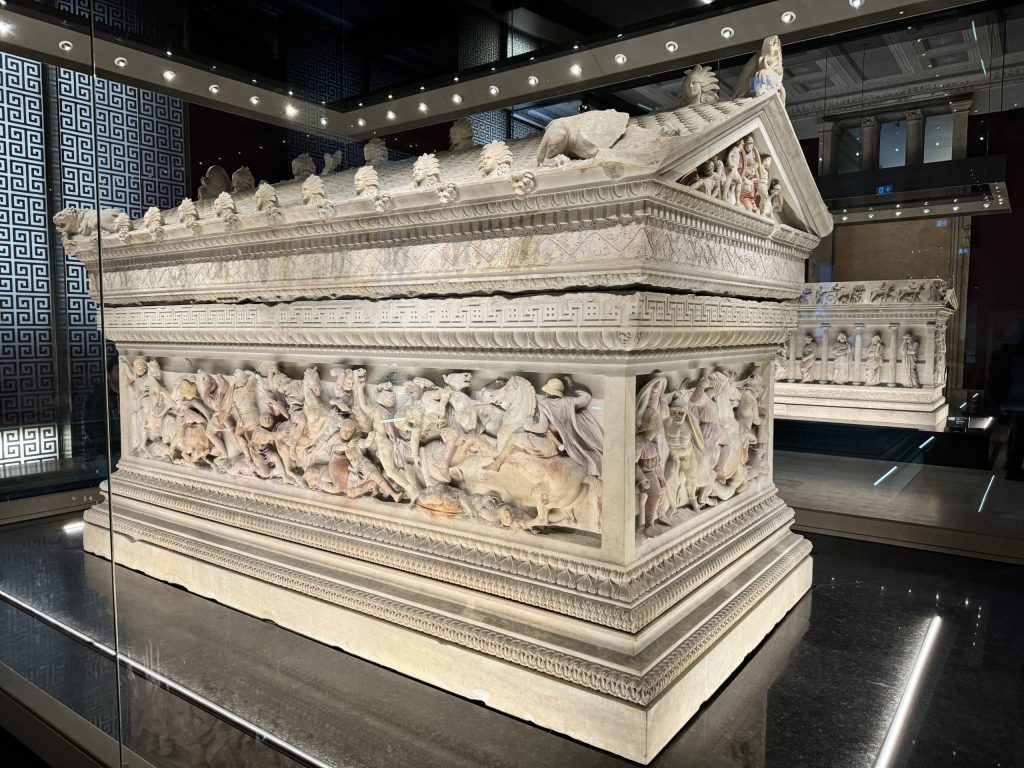
The Alexander Sarcophagus in the Istanbul Archaeological Museum is one of the most famous works of art that has been handed down to us from the Hellenistic period. Anyone who has walked around and looked at this extraordinary survival from the ancient world, now encased in its own glass sarcophagus in the museum, will surely not have come away untouched by its perfection and the way it brings the marble to life – its ornate decoration showing both people and animals engulfed in battle, with winners and losers alike in survival mode amid carnage and suffering – while the narrative of the sarcophagus conveys life and death. Few, however, will think about the fact that such a masterpiece of Hellenistic art was produced within the framework of lavish urban cultures in the Mediterranean East, and only placed in what was the tomb of a Persian governor – a satrap – thereafter.
This debt goes far beyond the shape of the sarcophagus obviously mirroring the symbolic centre and object of pride of every Hellenistic city, by taking the form of a large temple, complete with pediment and cornices. It is more significant that such a product most likely would not have come into existence without the backdrop of a city culture. Cities allowed for the development of chains of production, for the concentration of skills, for education of sculptors, and for the passing on of knowledge, as well as the accumulation of produce, materials, and wealth.
The Caliph’s crafts as expressions of networks
Such widely branching chains – or rather networks – of production were a hallmark of ancient urban culture, even in places where there were seemingly no cities around. For proof, you can travel to Quseir Amra in Jordan, which lies 60km into the desert east of Amman. Here, in this empty landscape, you can find a certified World Heritage Site wonder. On a quiet day, you may even be handed the keys to enjoy it all by yourself. Around AD 730, the future Umayyad caliph Walid II, then crown prince, built a fashionable bath and hunting lodge to cater for his constituency. Its bathhouse still preserves glorious frescos that dazzle with early Islamic splendour – showing everything from kings to concubines, chasseurs and dancers, sages and zodiac signs. One ceiling – the ‘crafts vault’ – features the skilled personnel whom the prince had summoned in order to create this edifice: carpenters, stonemasons, builders, and smiths, all brought out by camel to embellish this mirage of a mansion.
Such skilled artisans were one of the glories of the cities within the former Roman province of Syria. This was one of the richest and most urbanised parts of the late Antique world, and had been conquered by Arab armies in the 7th century. Few things could better symbolise the powers and pleasures that urban networks could bring than a glass mosaic floor and the painted vaults of a hypocaust-heated sauna being carried far into the desert.
To build such a marvel was only possible because urban societies nurtured the networks of procurement, collaboration, and training that maintained the requisite skills and resources. Walid II was keenly aware of the power of his urban subjects, and he wanted his audience to appreciate it in the artful displays he commissioned. Hence the celebration of humble handymen in the fashionable frescos within.
Cities and their material culture – networks in action
The Eastern Mediterranean region is rich in ruins of past cities. The monumental ruins of the countries in this region figure prominently in the travel brochures of tourist agencies attracting people from across the world to explore at least some of this heritage while they holiday in the region. Often, though, the material culture beyond the architecture has been separated from the sites, and most of what was found in former times or during modern excavations is partly displayed in local, regional, or national museums, while the larger part is stowed away in museum vaults and storage facilities. Even so, this material culture made up a vital component of these cities and the lives that played out in and around the buildings that are today left for us to experience in various ruined states when we visit places such as Aphrodisias, Ephesus, Athens, Rome, Pompeii, Jerash, Palmyra, Tyre, and Caesarea Maritima.
Many cities of the Roman period look very similar on the surface, with grid plans comprising a main street and a hatchwork of connected side roads alongside a familiar suite of buildings. These are easily recognisable and include theatres, bath complexes, temples and sanctuaries, bouleuteria, and stadiums or hippodromes. Despite such common features, these cities would surely have had differing local lives, which are best grasped not so much from the architectural layout of the buildings and their locations, but in precisely the material that has so often been removed from these sites, such as the statues, inscriptions, day-to-day objects used in houses, and the decorative schemes of both domestic and public buildings.
Often this separation of the lived culture and networks of these cities from their physical surroundings began when the sites were rediscovered by travellers, collectors, and archaeologists in the 19th and 20th centuries. Large parts of the Mediterranean were under Ottoman rule until the early 20th century, while European travellers to Greece and Italy took an intense interest in the cultural heritage of the region from a much earlier date. This fascination was most often driven by a desire to unearth the splendours that these ancient societies had left behind – primarily in the form of art objects, and only secondarily as evidence for life in Antiquity. In complete contrast to the displays of Quseir Amra, the exhibitions of the modern era have tended too often to conceal the network society that enabled such art in the first place.
Urban legacies in the museums – reintegrating the networks
One can almost become overwhelmed by visiting grand ruined cities, and even get a bit jaded by the way that they look so alike on the surface. When you enter the museums, the material culture that once facilitated life in these cities awaits you to reveal a more personal story. Often, though, these objects are ordered within displays that insist on art and typologies as the primary guiding principle – pottery in its own section, sculpture beside sculpture, coins in neat rows, and so on. This, in turn, complicates attempts to tell stories about the integration between and across such crafts. While we surely will not be able to call for a radical change to the displays in major museums, perhaps we can nudge visitors to bring together the ruins of the grand cities with the displays in museums and collections. They can carry an entire narrative – or several, in fact – in themselves: that of the history of rediscovery, of imperialism of many kinds, of collecting as a way of asserting power, and of the sites and the Mediterranean region in general across more than a millennium of intense urbanism. Museum displays often separate the archaeological heritage into convenient, curatable components, which preserves and presents the material integrity, but splits apart the social. One has to admire how Quseir Amra or the Alexander Sarcophagus bring the urban fabric into their form, even though they were literally detached from this world. We need more displays like them to unite the urban fabric of the ruins with the portable parts making up museum displays. The people of the past, after all, are to be found not in these details, but between them.
Rubina Raja is professor of classical archaeology and art and director of the Centre for Urban Network Evolutions, Aarhus University, Denmark. Together with Søren, she is founding editor of the Journal of Urban Archaeology.
Søren M Sindbæk is professor of medieval archaeology at Aarhus University, Denmark, and co-director of the Centre for Urban Network Evolutions.