Subscribe now for full access and no adverts
Moving very large stones
Stonehenge is often portrayed as if it were a unique monument, which in some respects it is. No other surviving monument uses mortise-and-tenon joints to lock the lintels to the uprights that form the massive stone circle and the inner trilithons (though this kind of joint was probably used in similar monuments built from timber that have not survived). But the use of colossal stones is far from unique, and there are numerous examples around the world that demonstrate the astonishing skill with which our prehistoric ancestors were able to quarry, transport, and erect massive stone monuments.
One of the earliest of these – the Dolmen de Menga, located near Antequera, Málaga, Spain – is the subject of an article in Science Advances (https://doi.org/10.1126/sciadv.adp1295) in which the authors explain how this huge stone construction was built. The Menga dolmen is one of the oldest of the great megalithic structures in Europe (dating to between 3800 and 3600 BC). Built with 32 sandstone slabs, the interior measures 27.5m in length, 6m in width, and 3.5m in height. The principal capstone weighs c.150 tons, making it the largest megalithic stone ever moved in Iberia, and the combined weight of the monument has been estimated at 1,140 tons or, as CNN reporter Katie Hunt put it, ‘heavier than two Boeing 747 airplanes loaded with passengers’.
The stones were sourced from 850m away, at a quarry that sits at a higher elevation than the dolmen, and the builders probably moved them on sledges, riding on wooden track. The bottom third of each upright occupies a deep pit dug into the underlying bedrock. The stability of the outer wall was achieved by leaning the stones inward at an angle of c.85°, so that the top of the chamber is narrower than the base. The edges of the orthostats were shaped so that all the stones interlocked and supported each other.
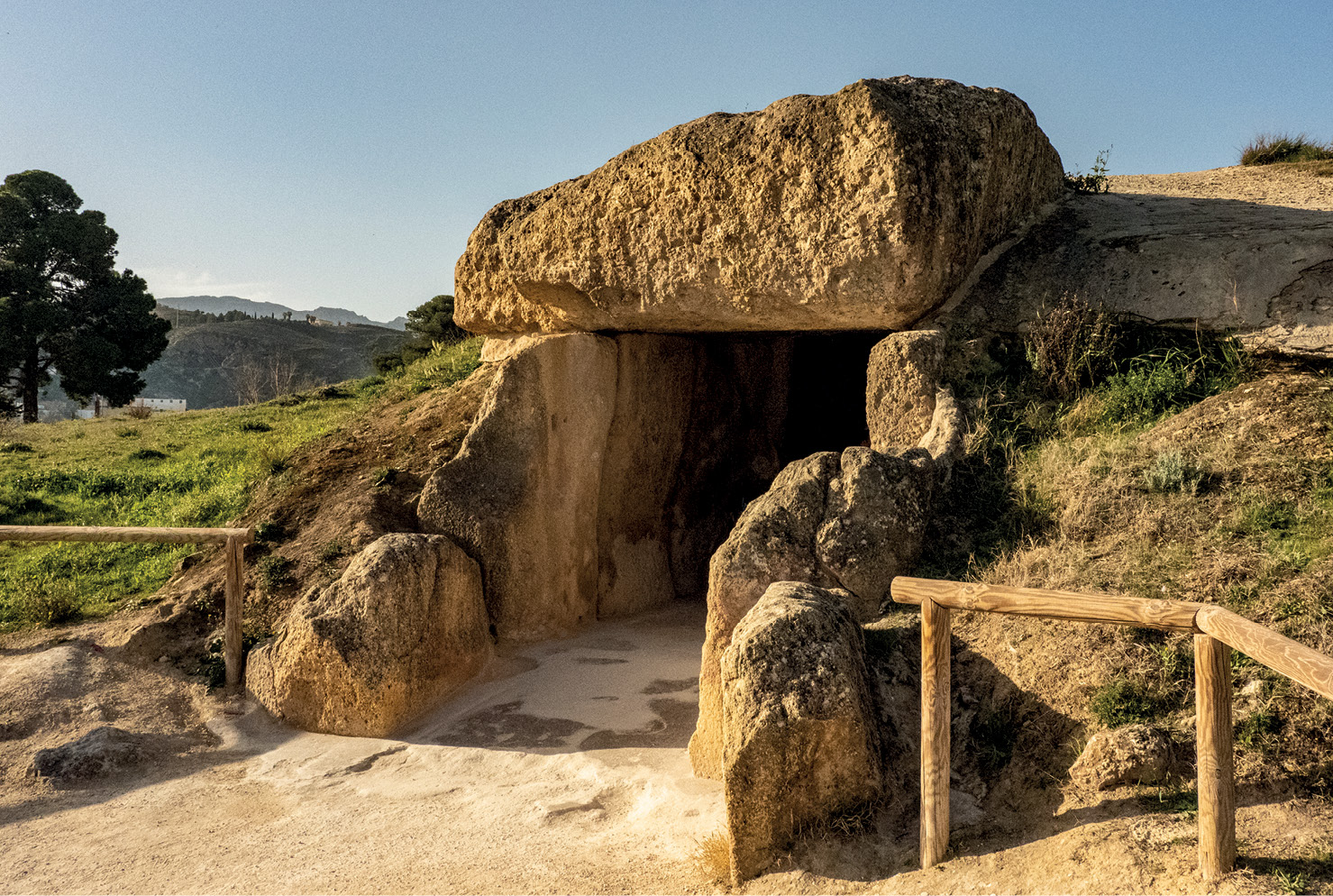
Placing the capstones on top completed what was in effect a rudimentary arch. One of the authors of the paper, Leonardo García Sanjuán, of the Department of Prehistory and Archaeology at the University of Sevilla, said this was ‘to the best of our knowledge, the first time that the principle of the arch has been documented in human history’.
The authors of the report were able to work out from the ways that the stones interlocked the sequence of construction, and they showed that the method used meant that the capstones could be placed on top without having to be lifted very high; the builders then dug out the ground inside to lower the chamber’s floor level, while the outside was covered in clay and soil to insulate the interior from rain and further stabilise the structure.
It is sometimes claimed that Neolithic people lacked the skills for such sophisticated engineering, but the authors of this paper are full of admiration for the creative genius and resourcefulness of the architects and engineers who designed and built the Menga dolmen, with the intention of creating something that would persist as a permanent feature in the landscape. ‘If any engineer today tried to build Menga with the resources that existed 6,000 years ago, I don’t think they could do it’, García Sanjuán said.
Early human arrival on Mallorca
At about the same time as the Menga dolmen was under construction, the occupants of Genovesa Cave on the Balearic island of Mallorca were busy building a causeway to link two parts of the cave system. Analysing the calcium deposits left on the stones used to construct the bridge, scientists have dated its construction to around 5,600 years ago, a date that is consistent with the growing body of evidence revealing progressively earlier human settlements on many islands in the Mediterranean basin. Earlier studies, based on bone and charcoal evidence, dated Mallorca’s settlement much later, at around 4,400 years ago.
The 7.5m walkway, or bridge, was built across the cave’s subterranean lake to serve as a path from the entrance chamber to another dry chamber in the cave, the Sala de les Rates-Pinyades (‘room of the bats’). The dry-stone construction consists of large limestone blocks finished off by a layer of flat boulders of substantial size, the largest being 1.63m in length and 0.6m in width.
The dating of the causeway (published in the journal Communications Earth & Environment: https://doi.org/10.1038/s43247-024-01584-4) was partially based on comparing the structure’s height to the sea-level curve for Mallorca. The rapid rise in sea level that occurred around 5,500 years ago would have left the structure well below the water level, whereas the much lower sea level of 6,000 years ago would have rendered the construction of a bridge unnecessary, hence it is likely that it was constructed at some time between these two dates.
This date bracket was then further confirmed by analysing the chemical composition of limestone encrustations on the boulders and relating them to a carbon-dated master series for the western Mediterranean, giving a date between 5,964 and 5,359 years Before Present (where present is defined as AD 1950). This 600-year period was marked by a sea- level standstill that provided favourable conditions for the distinctively coloured calcium carbonate deposits to be laid down (like a bathtub ring) halfway up the sides of the 0.5m-high stone pathway, crossing the 0.25m-deep cave lake.
Roman travel times
A network of roads with hard surfaces is one of the most important legacies of the Roman world, surviving long after the breakdown of the Classical world to provide important economic routes that underlie many of Europe’s modern road networks. They also enabled the astonishing degree of mobility that characterises the Roman world, whereby people could travel from one end of the vast Roman Empire to the other, as testified by the many memorial stones commemorating people who made such lengthy journeys.
Researchers at Stanford University have now launched the latest version of ORBIS, their ‘Geospatial Network Model of the Roman World’, which shows the Empire’s major transport arteries and enables users to calculate the time and cost of travelling between some 750 different sites and settlements in antiquity (it broadly reflects conditions around AD 200 but also covers a few sites and roads created in late antiquity).
The model includes principal roads, navigable rivers and canals, and major sea routes, and it allows movements to be simulated across this network using 14 different modes of transport, including walking, horse-riding, riverboat, and two types of sailing ship with slightly different navigational and performance parameters. The map’s algorithm will also let you see seasonal differences in travel time and cost, based on evidence drawn from ancient and later pre-modern sources, or by simulating the response of Roman-style ships to winds and currents.
You might expect the fastest and cheapest routes to be via road, but in good weather in July you could get to Rome from Londinium most quickly by taking a ship down the Atlantic coast, before travelling by land along the foot of the Pyrenees and then by ship across the Tyrrhenian Sea and boat up the Tiber, a journey of 21 days. The cheapest route would have taken you 41 days, almost all of which would be spent at sea travelling on coastal shipping vessels. Not that there is much difference in price: both methods would cost around 1,000 denarii, the equivalent of three years of a labourer’s wage.
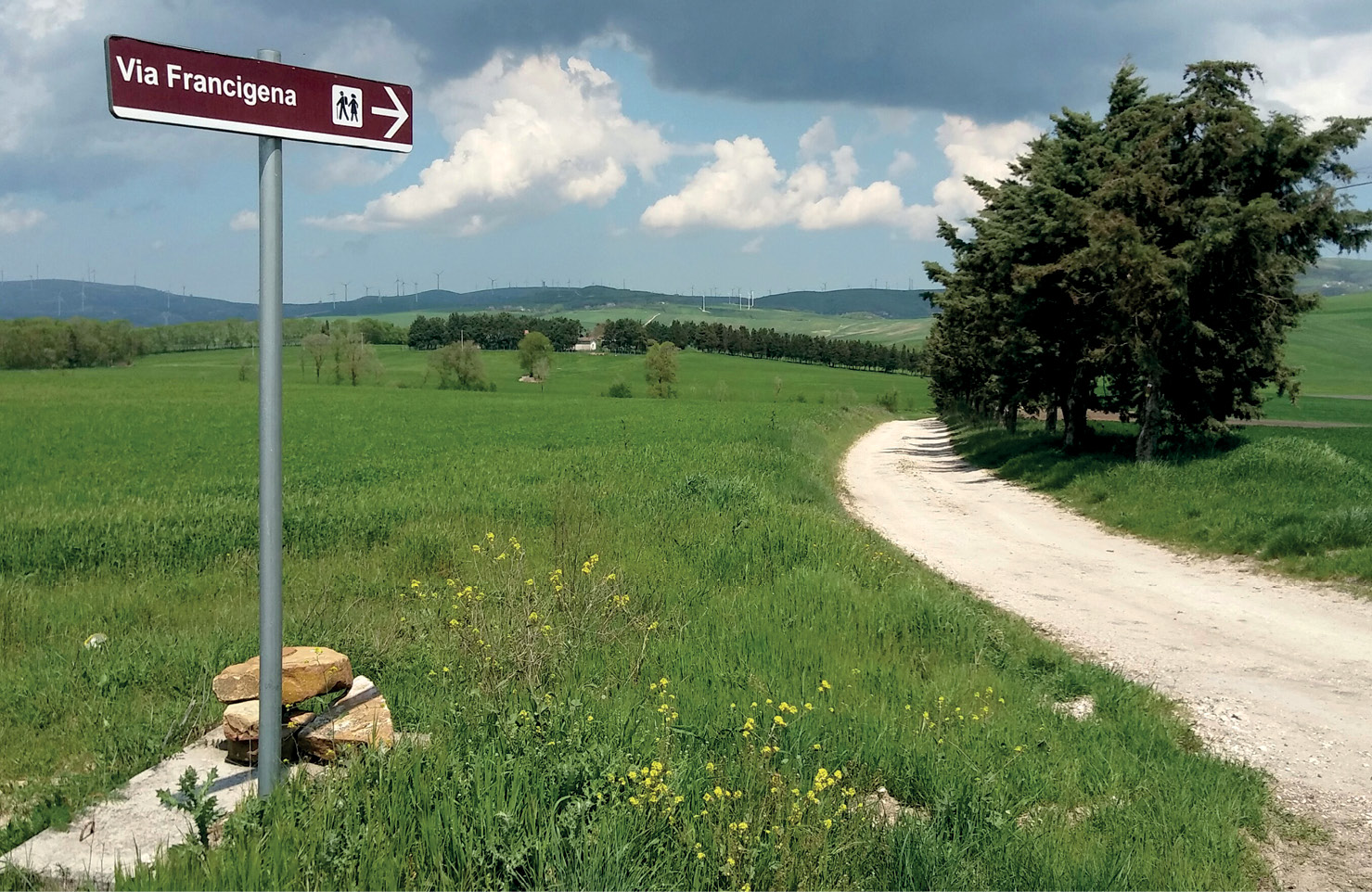
A land route is recommended during the winter months: following well-paved roads, you could cover the 2,246km in 75 days on foot or 32 days by waggon if you really pushed it. This same route is now the waymarked Via Romea Francigena, an increasingly popular long-distance path to rival the busy Camino de Santiago pilgrimage route across northern Spain. Walkers today typically take 90 days to walk the route, while cyclists reckon on 44 days, and two runners who raised money for the charity WaterAid in 2011 managed to complete the route in 58 days.
Chris Catling is an archaeologist and writer, fascinated by the off-beat and the eccentric in the heritage world.