Subscribe now for full access and no adverts
There were at least five groups of hominins 70,000 years ago, but today there is just one…
All mixed up
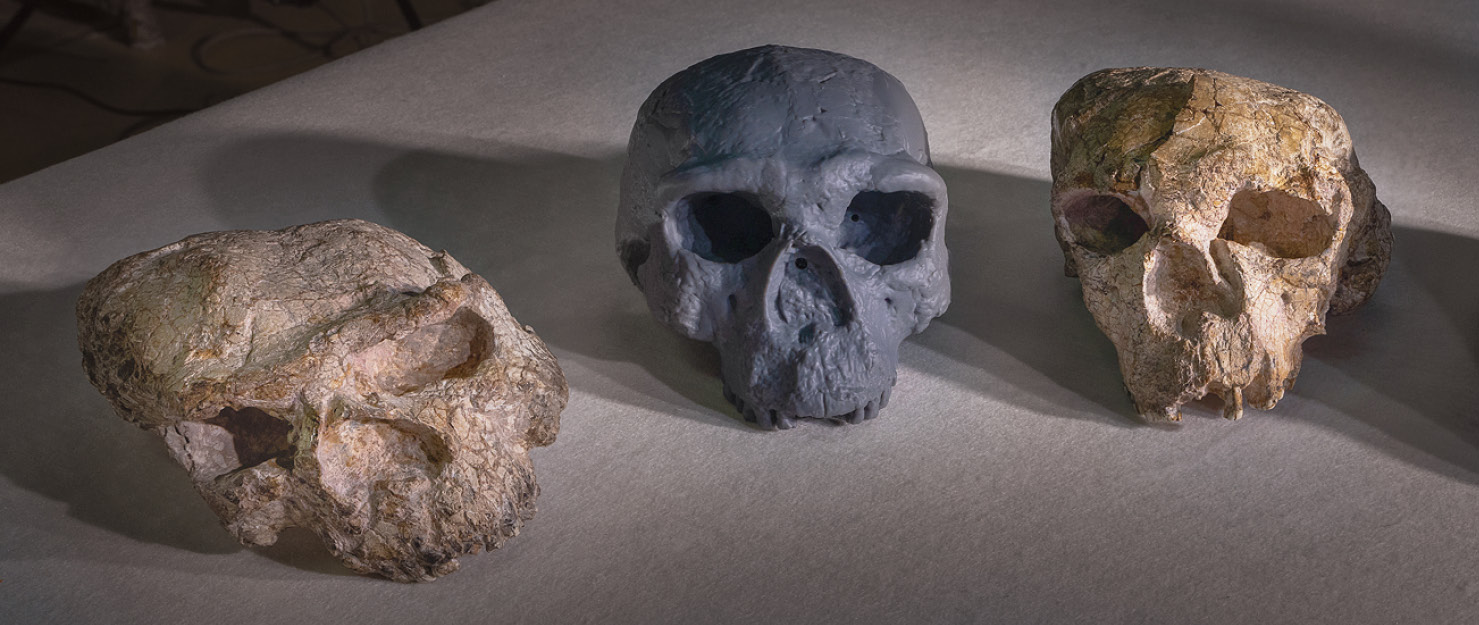
Human beings may have suddenly doubled their age thanks to some recent research on a group of fossilised skulls from China, known as Yunxian 1 and 2. Previously classified as Homo erectus, they have now been designated as belonging to the Denisovan group, based on skull shape.
In a paper published in the journal Science (https://doi.org/10.1126/science.ado9202), the researchers report that they used imaging software to study the best-preserved of the skulls – Yunxian 2 – seeking to remove the distortions caused by the compression that occurs during the fossilisation process. They also filled gaps in Yunxian 2 using material surviving in Yunxian 1. The resulting 3D model appears to have Denisovan features, not those of H erectus.
It is a mere 15 years since we first heard the term ‘Denisovan’, used to denote a new archaic hominin species identified through the analysis of ancient DNA extracted in 2010 from a single juvenile finger bone found in the Denisova Cave in the Altai Mountains of Siberia. Genetic analysis suggests that Denisovans are among the most closely related of archaic and extinct hominin lineages to H sapiens, and that their contribution to the human genome is most strongly marked in Asian populations.
Further remains were subsequently found in China, Laos, and Taiwan, including a mandible and teeth, and in 2018 a cranium was identified from Harbin, China, that was described by Chinese Academy scientists as the largest ancient skull ever found of a member of the Homo genus. This, too, has since been identified as being of Denisovan lineage (CWA 132), adding sufficient extra information to the other discoveries to enable researchers to reconstruct the individual’s facial features: dark skin, eyes, and hair, a low and long skull with massive brow ridges, wide eye sockets, a large mouth, flat face with large nose, and large molars.
At this stage, the Denisovans have been added to the taxonomic tree among our other human ancestors under Homo longi (from the Chinese for ‘dragon’, in reference to the find location of the Harbin cranium, hence its popular name ‘Dragon Man’). The H longi designation as a new species is not accepted by all, however, because offspring of interspecies breeding are usually sterile, whereas we now have abundant evidence for repeated and successful interbreeding between Neanderthals, Denisovans, and H sapiens. Some academics therefore refer to Denisovans and Neanderthals as belonging to a separate ‘group’ or ‘lineage’ rather than a different species.
Professor Chris Stringer, Research Leader in Human Evolution at the Natural History Museum in London and one of the authors of the recent Science paper, summed up the current state of knowledge by saying that human fossils show a huge amount of diversity and it is a matter of intense debate whether these various archaic humans represent entirely different species or whether they are all transitional variants that can be classed into five major groups of big-brained hominins.
Reclassifying Yunxian 2 as a member of the Denisovan lineage has significant dating implications because they were thought to have branched off from the Neanderthal lineage some 500,000 years ago, whereas these fossils are 1 million years old. Since fossil and genetic evidence shows that the split between Neanderthals and H sapiens occurred before the Neanderthals and Denisovans diverged, it follows that H sapiens must also have begun to emerge at least 1 million years ago. We have, therefore, according to the results of this study, doubled in age. In his press release about the discovery, Chris Stringer says that this conclusion requires checking against some of the other million-year-old human fossils that have yet to be studied to see whether we can identify ‘proto-Sapiens, proto-Neanderthals, and proto-Longi’.
Ancient DNA
It was the Swedish geneticist Svante Pääbo, the founding director of the Max Planck Institute for Evolutionary Anthropology in Leipzig, Germany, who led the team that produced the first Neanderthal genome in 2008 and that identified the Denisovans as a separate lineage. Since his pioneering work, there has been rapid growth in the number of ancient human genomes available for study, from 500 in 2021 to more than 10,000 today.
David Reich, Professor of Human Evolutionary Biology at Harvard University, worked as part of Pääbo’s team and in a recent speech reported in The Harvard Gazette on 18 September 2025 he reflects on the experience. Before this study, geneticists had convinced themselves that humans and Neanderthals could not interbreed, and when the genetic data showed that they had, the research team assumed that this was an error and kept trying to find ways to negate it. Eventually, they accepted the result, and it has now become apparent that modern humans mixed with Denisovans as well.
Reich noted that the overall conclusion from all this research is one of increasing homogenisation. ‘It is clear that modern and archaic humans mixed everywhere they met’, Reich said: ‘it’s not a rare thing for people to mix with people who are quite different from them. It’s in fact the rule.’ Whereas there were at least five groups of hominins some 70,000 years ago, today there is just one, and we are all very similar to each other. Human diversity is lower today than it has been at any time in the past, and everyone’s genetic background shows a mix from the different waves of migration that have occurred throughout human history.
‘The big perspective change from ancient DNA study is that people living today are almost never the descendants of the people who lived in the same place thousands of years before,’ Reich said. ‘Human movements have occurred at multiple timescales, often disruptive to the populations that experience them.’
In Africa, different tribal and language groups have moved over time, displacing others and mixing genetically. Cameroon, an area associated with Bantu languages, for example, was occupied by an entirely different people 3,000 to 8,000 years ago. Neanderthal genes have been detected in east Asians, even though Neanderthals lived in Europe and west Asia. Farmers arrived in Europe, bringing agriculture as well as their genetic imprint as they mixed with hunter-gatherers. Some 6,000 years ago, mobile pastoralists called the Yamnaya from the Asian steppe arrived, leaving a large genetic impact and possibly bringing with them the Indo-European language that diversified into European languages.
Some of these movements ‘can’t have been a happy occasion for the men involved’, Reich said, pointing out that the Y chromosomes of the Neolithic farmers of Iberia are entirely absent in subsequent populations, having been replaced by Yamnaya male chromosomes. Something similar happened when Iberians came to the Americas: people in Colombia have almost no local Y-chromosomes and no European mitochondrial DNAs (inherited through the mother): they are the offspring of European fathers and Native American mothers, a sign perhaps of male social inequality and female exploitation.
Another major revelation provided by ancient DNA is the impact of interbreeding on the evolution of human populations. In an examination of 10,000 genomes, Reich and his team have found almost 500 significant changes: a period of accelerated change began 5,000 years ago, focusing on immune and metabolic traits. Some traits show up in the DNA record as rising over time and then plummeting – for example, the genes that make one prone to coeliac disease and a severe form of tuberculosis. It is likely that these mutations conferred some unknown advantage at first, before disadvantages related to disease outweighed them.
The olive trees of Puglia
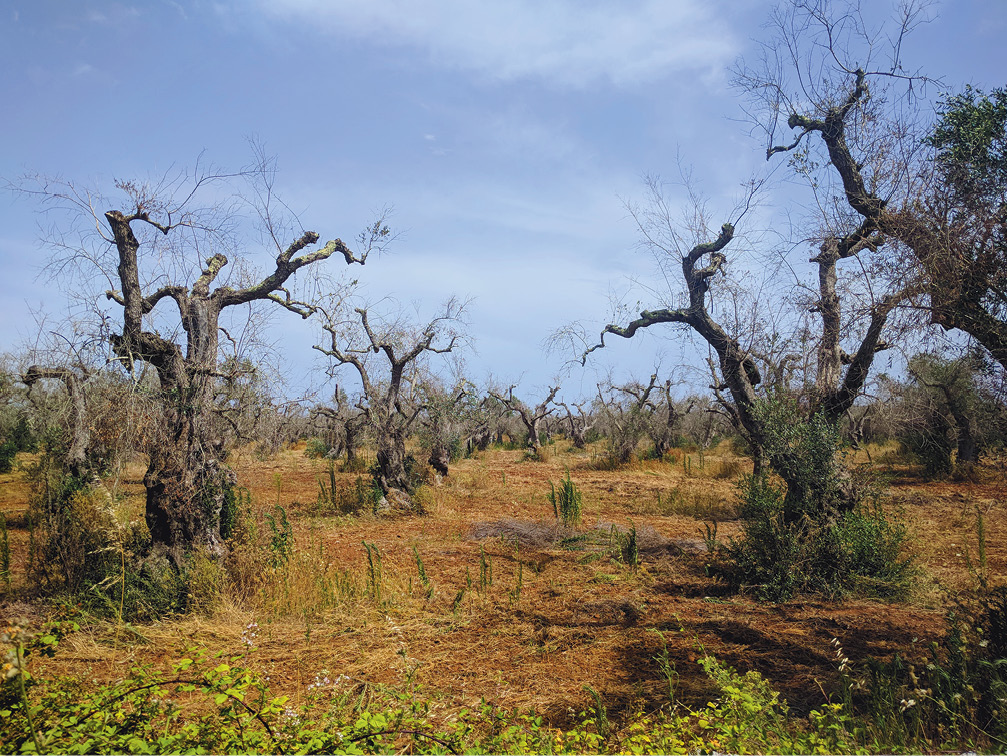
That there are risks to genetic homogeneity has been shown in the case of an epidemic that has already destroyed 21 million olive trees in southern Italy, an area that has the biggest concentration of centuries-old trees in Italy. Xylella fastidiosa, a plant pathogen that is spread by sap-feeding insects, was introduced to Italy on a plant shipped from Costa Rica in 2013 and it has already infected a third of Puglia’s 60 million trees.
Local farmers initially blamed big multinational corporations for killing the trees by spraying poison at night in an attempt to introduce new genetically modified varieties – a conspiracy theory that was fuelled by social media. Efforts are now being made to save the remaining trees by cutting down infected stock and getting rid of the grass around healthy trees where insects lay their eggs. Campaigners are urging the Italian government to speed up funding for farmers to graft new cultivars – such as the disease-resistant Olea europaea ‘Favolosa’ variety – on to the ancient trunks of centuries-old trees before they succumb.
Lending her weight to the pleas for urgent action is the actress Helen Mirren, who has a farmhouse at the centre of the epidemic. Speaking for the charity ‘Save the Olives’, she said ‘everyone needs to wake up and understand the scale of this growing tragedy. These trees are the history of Italy; we cannot lose a 1,000-year-old patrimony.’
Chris Catling is an archaeologist and writer, fascinated by the off-beat and the eccentric in the heritage world.