Subscribe now for full access and no adverts
Under the rather ponderous headline ‘Revealing Misunderstandings about Stewardship of Our Ancient Churches’, Historic England has just published the results of its survey into public awareness of the crisis facing the nation’s places of worship. The results show that people are blithely unaware that many are at risk of closure and sale. Instead, they assume that these buildings are sustained in perpetuity by ‘national church authorities, local councils, or national heritage bodies’.
Commenting on the research results, Andy Brown, Analytics Director at Historic England, says the widespread misunderstanding about who is responsible for the care of such places is holding back wider engagement by members of the community, who might otherwise be willing to get involved in their upkeep and use.
Three quarters of respondents across all age groups, regions, genders, and incomes said that having access to ancient churches was important. Four in five said it was important for other people to have access, even if they themselves did not use them. This ‘option value’, much-discussed in heritage economics, was strongest among older age groups, with nine in ten people aged 55 to 64 rating access for others as ‘very’ or ‘quite’ important.
The implication is clear: there is a deep-seated public attachment to the idea of churches remaining open and accessible to all, and any further moves towards closure and privatisation would ‘sit uneasily with most people’. Translating that finding into positive action is the challenge we face in the heritage sector. Historic England’s press release does not say how this could be achieved, though they conclude that the future for historic places of worship lies in unlocking greater local engagement.
Church recording
For that reason, one can only applaud the decision by the Arts Society (formerly NADFAS) to embrace church-recording again as a core part of its volunteer activity. As reported in ‘Odd Socs’ (CA 376), the Arts Society ceased church-recording in 2020 following a strategic policy review. This resulted in the formation of a new charity – the Church Recording Society – to continue what the Arts Society had started in 1973. The combined project has since seen the completion of more than 2,000 church surveys.
Often criticised for glacier-like progress, NADFAS recording is nevertheless greatly valued because it covers many different aspects of church heritage, whereas most of the other societies engaged in recording religious institutions specialise in a single element, such as stained glass, brasses, monuments, Romanesque carvings, or wall paintings.
Church-recording volunteers receive training to enable them to research, describe, and photograph the building and its contents in order to create an authoritative inventory. Once completed, records are deposited with the V&A Art Library, the Church Buildings Council, and the Historic England Archives, where they form an important resource for the preservation and protection of church heritage, as well as for research purposes.
The decision to reintegrate church-recording into the Arts Society’s volunteering programme has been universally welcomed, and the new board of trustees says it will be ‘encouraging more members to offer their time and energy in advancing and celebrating’ church heritage. Faster progress is essential, however, as 2,000 records in 50 years is an average of only 40 a year. At that rate, it will take 300 years to record all of England’s 12,000 listed churches, and another 105 years to mop up the remaining 4,200 unlisted buildings.
Idiosyncratic museums
Sherds frequently highlights the financial challenges faced by national and local-authority museums (of which there are some 1,600 in England alone), but that does not seem to deter new start-ups or reinventions (often with a National Heritage Lottery Fund grant). Among the new openings promised for 2026 are the Museum of Youth Culture, in Camden, ‘dedicated to the scenes, styles, and sounds forged by young people over the last 100 years’. The museum will invite members of the public to ‘bring along their own photograph, object, or spoken word history’ to showcase the heritage of those who are ‘commonly underrepresented within museums and galleries’.
Also new is the Museum of Failure, a peripatetic collection currently hosted by the Musée des Arts et Métiers in Paris, but with plans to come to the UK soon (the dates and venues have yet to be announced). This exhibits examples of failed products and ideas (including the Titanic, the Sinclair C5, and Brexit) in order to ‘reframe failure and show it is a universal and necessary part of innovation and learning’.
Sadly, two museums are themselves candidates for inclusion in the Museum of Failure. The volunteer-run Kidderminster Carpet Museum, in Worcestershire, has announced its closure apart from occasional open days, and the Ditchling Museum of Art + Craft, in East Sussex, has announced a ‘temporary shutdown’ in order to ‘allow time to reflect on the focus of our work and to plan our next phase in response to changes in the challenging economic context in which museums now operate’. This latter museum was founded in 1985 to specialise in the work of artists and craftspeople who made Ditchling a creative hub of the Arts and Crafts movement early in the 20th century.

Maybe staying small is the answer to economic challenges: the newly opened Clifftown Telephone Museum in Southend-on-Sea, Essex, is housed in a single telephone kiosk. Local resident Dame Helen Mirren provides a recorded introduction to the bijou collection of exhibits exploring the history of the Clifftown area.
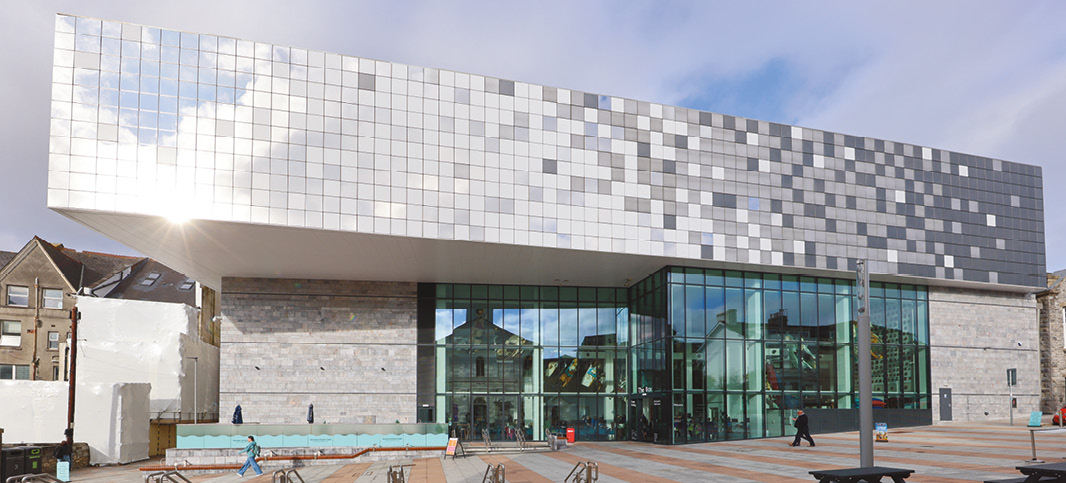
Despite the name, The Box Museum is neither located in Box, Wiltshire, nor is it a museum that displays boxes in all their variety. Instead, it is the name for the Plymouth museum and gallery with a box-shaped extension that invites visitors to ‘open the box’ and discover collections that include works by the former Plymouth resident Beryl Cook (1926-2008).
Other museums with new and distinctive collections include the Museum of British Folklore, whose touring exhibition ‘Un/Common People: Folk Culture in Wessex’ is showing at the Salisbury Museum (until 10 May 2026); the Museum of Design in Plastics, at the Arts University Bournemouth, whose mission is ‘to help [us] become more informed about plastics in design’; the Peace Museum in Saltaire, West Yorkshire, where the exhibits include CND campaign materials and banners from Greenham Common; and the Chair Discovery Centre in High Wycombe, ‘The Chair-making Capital of the World’, where the exhibits include wooden wheelback Windsor chairs and mid-century Ercol furniture – all part of the chair-making heritage that has ‘shaped both the town itself and the global story of furniture-making’.
And, if the presence of objects in British museums acquired through the nefarious practices of the past is an issue you care about, you can now build your own alternative museum using a video game called Relooted. This enables players to raid various Western museums to take back objects such as the Asante gold mask, now in the Wallace Collection in London, and the Benin bronzes, now in various European museums. The aim of the game is to highlight the scale of the culturally and spiritually significant objects looted from Africa during the 19th and 20th centuries.
Questions of consent
It has often been remarked that the mid-century generation of archaeologists interpreted the past in terms of violence and invasion as a result of their own experiences of war, as well as their Classical education based on Homeric epics and Roman military histories. By contrast, the hippy generation took a more pacifistic view – hence the early medieval period was one of migration, rather than invasion, and the Vikings were traders and artisans, not pirates, thieves, and monk-murderers.
We see that contrast again in the language of recent reports arguing, on the basis of chromosome analysis, that ‘interbreeding’ took place almost exclusively between male Neanderthals and anatomically modern human females – interactions that were described in euphemistic terms as ‘encounters’, ‘unions’, ‘pairings’, ‘mating events’, ‘interbreeding with our cousins’, and ‘making babies’ – all very ‘hippyish’.
An older generation might have called it by a different and harsher name, and younger archaeologists might wonder, in the ‘Me Too’ era, just how much of this activity was consensual. Did it really reflect what one report described as ‘what couples do naturally’ and another called ‘mating preferences’ – Neanderthals being attracted by modern human females and the latter looking for ‘a bit of rough’?