Subscribe now for full access and no adverts
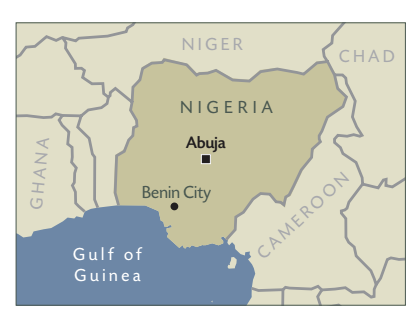
Niyi Adegoke, an archaeologist with a degree from the University of Ibadan, Nigeria, is standing in a trench with a drawing board. It’s November and officially the dry part of the year, though the monsoon-like rainy season seems to have other ideas: the excavations filled with water overnight, soon to be cleared by pumps and the burning heat. We are in the historic centre of Benin City. Adegoke is telling me about the dig.
‘My experience here has been wonderful,’ he says. ‘This is massive for Nigeria. I’m seeing a new dimension of archaeology.’

The excavation spreads over a large area. The site is of global interest. The locally based project in a country with one of the largest archaeological communities in Africa, is working with an international team. They have aspirations not just to discover, but also to train, inspire, and create new opportunities for young archaeologists. Add in a pioneering emphasis on excavation ahead of development (the latter itself a daring concept embracing archaeology, art, and public engagement), and it’s easy to see what excites Adegoke. He tells me about site-recording.
‘In my ten or 15 years’ experience in the field’, he says, ‘this is more intensive. We are making detailed connections even before excavation. This method’, he adds, ‘is called the Harris matrix technique.’
I am unexpectedly taken back 50 years to when, in a housing squat in the centre of Winchester amid large-scale excavation, an animated Ed Harris told me about a new way of seeing stratigraphy. His ideas developed into a record system, which Adegoke is now using in the heat of southern Nigeria. I feel the same thrill that I did back then: students, volunteers, and experienced archaeologists are learning, experimenting, and finding things, sharing a sense that what they are doing is revolutionary. That working with architects and contractors, they are writing a past that will become part of their nation’s future.

A powerful kingdom
Where not long ago were a police station and barracks, and now relocated hospital and state health offices, just a few blocks remain of disused one- or two-storey concrete buildings sprouting weeds (archaeologists have converted one into a site office and lab). Red earth is splashed with bright-coloured greenery. In a distant corner a miniature forest of banana and hardwood trees hides a small, overgrown graveyard known as the European Cemetery.