What is it?
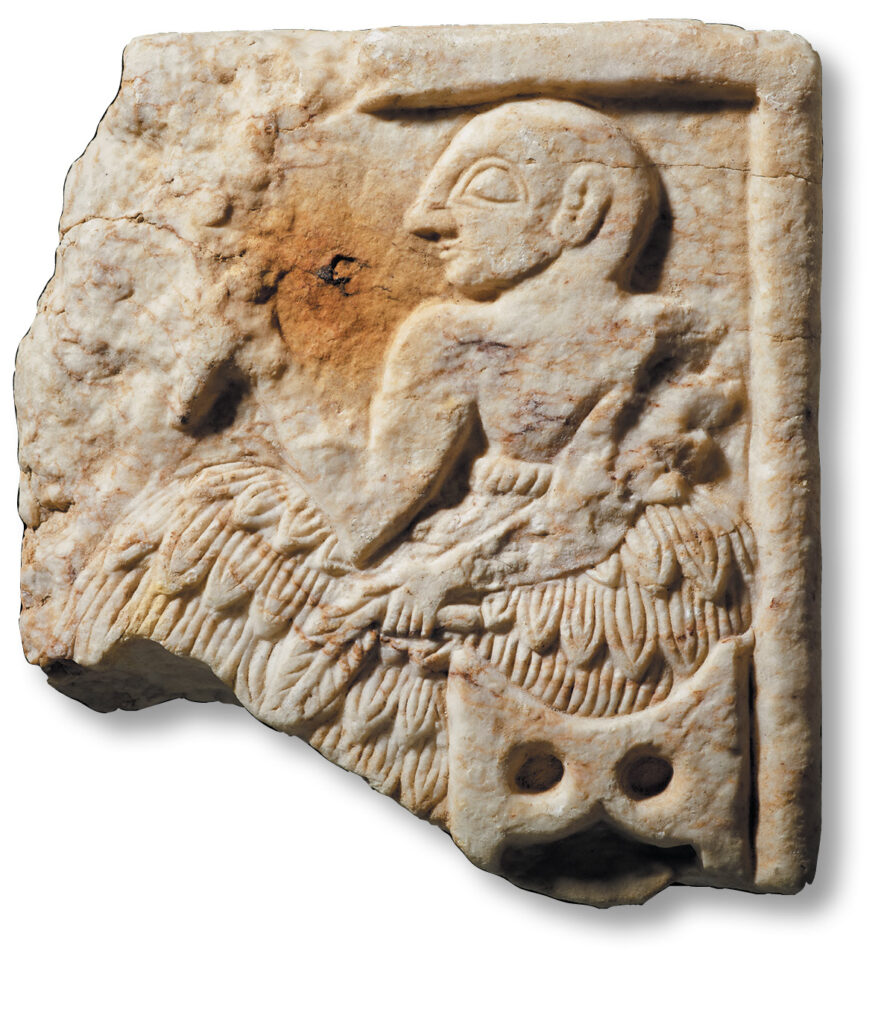
This low-relief limestone carving, dating to c.2400 BC, formed part of a larger votive wall plaque in a Sumerian temple in southern Iraq, during what is known as the Early Dynastic III period. It would have been fixed to the wall next to a door, and could have been used to securely shut it by tying a rope attached to the door around a peg in the centre of the plaque. The carving depicts a clean-shaven, elite male figure, perhaps a high-priest or ruler, sitting on a decorated stool, wearing a kaunakes (a type of Sumerian long skirt). In his upraised right hand, he holds a ceremonial goblet, while in his left, resting on his lap, is a palm frond.
Where was it found and when?
The plaque’s original find spot is unknown, as it was illegally removed from Iraq and only identified by the Art and Antiques Unit of the Metropolitan Police in 2019, when it was put up for sale on the London market. It was said to come from a private collection formed in the 1990s, but nothing else is known about its provenance. However, the style of the plaque is similar to others found at Early Dynastic III sites in southern Iraq, and analysis by the British Museum suggests that it may come from the site of Tello (ancient Girsu), where looting within the religious precinct is known to have taken place between 1994 and 2003.
Why does it matter?
Temple plaques of this type are rare, with only about 50 examples currently known to exist. They are found at important Sumerian city-sites in southern and central Iraq and eastern Syria, such as the famous sites of Ur, Nippur, Khafajah, and Mari. There is no record of this plaque in the existing literature, making it an important discovery, with potential to enhance our understanding of Mesopotamian art during this period.
Its stylistic similarities to other examples found in the Sumerian heartland in present-day southern Iraq, as opposed to plaques from other regions, makes it an especially significant discovery, as this region was a centre of rich urban civilisation in the Early Dynastic III period, with trade connections to the Indus, Iran, and present-day Syria.
Because the plaque came to light as a result of looting, we have been robbed of crucial information about the archaeological context and nature of the find. Even so, its possible connection with the site of Tello/Girsu, where excavations are still being carried out (see CWA 95), offers some hope that the missing parts of the plaque may be found in the future, allowing it to be re-examined in more detail.
SEE FOR YOURSELF
Covid-19 restrictions allowing, with the permission of the Iraqi authorities, this object will be displayed at the British Museum in Room G53 until early in December 2020, when it will be repatriated to Iraq and sent to the Iraq Museum.