Subscribe now for full access and no adverts

Especially striking due to its lack of decoration, this limestone bust is unlike most ancient Egyptian sculpture. It was made to show only the head, shoulders, and upper chest, and was not intended to be set into other elements to make a complete bodily form. The treatment of the face – particularly the sfumato eyes, which lack traditional definition, and the presence of pierced holes in the ears – strongly suggests a date at the end of the Eighteenth Dynasty. It was once painted with an elaborate broad floral collar – a sign of festivity and godliness – traces of which remain.
The function of this object was to incarnate an ancestral presence – often referred to as an akh, a being with the capacity to act for (or against) the living. Most such ‘ancestor busts’ do not carry an identifying inscription, perhaps implying that they could represent different individuals at different times. Many examples have been found in domestic settings and imply that ancestor worship seems to have played an important role in the home.
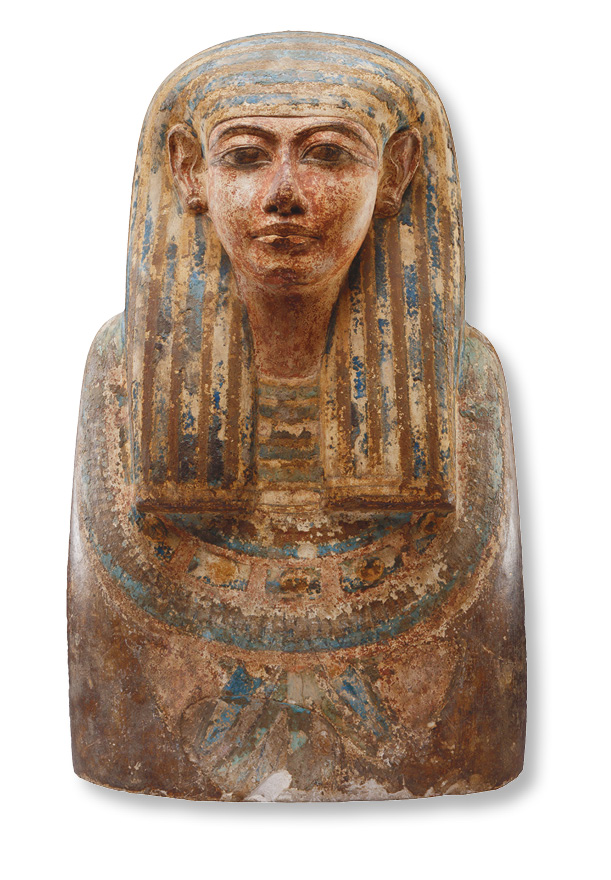
Such objects are known from sites around Egypt, but the majority derive from the Western Theban village of Deir el-Medina. (A similar bust, on which the painted decoration remains, is also thought to come from Deir el-Medina, and is now in the collection of the Metropolitan Museum of Art, New York.) Perhaps the Brooklyn example dates to just after the re-establishment of the workers’ community following the Amarna Period. Ordinarily such busts are genderless – the amorphous shrouded form and long headdress are signs of generic divinity to which the dead aspired. The feature atop this figure’s head is a modius, associated with the headgear of goddesses like Hathor. Indeed, Hathor was an obvious deity to represent the female divine dead, especially with her Western Theban associations.
Images: Public domain via Wikicommons (top); MMA, Open Access, public domain (bottom)