Subscribe now for full access and no adverts
Lost and found words
Readers of CWA will often have noted that not all of a particular site or discovery is being investigated as future scientific methodology may enable some greater insight than is possible today. Such patience is a virtue. All archaeology students (and indeed their mentors) should be encouraged to read of the extraordinary investigations into the carbonised scrolls found in the 18th century in Herculaneum: 21st-century work that has enabled (so far) small chunks of these scrolls actually to be read and which may lead to totally new insights into the world of some 2,000 years (or more) ago. Previous efforts at reading these scrolls had only led to their destruction. An in-depth article which I read in Scientific American (April 2024) can only be described as thrilling, and should be compulsory reading for all archaeologists.
Peter B Baker, Prestwood, UK

A ‘gift’ from Caesar?
I particularly enjoy ‘Object Lesson’, both for its informative value, and for the way it connects us directly with the past through a single item. The interpretation of the inscribed lead Montilla slingshot (CWA 124) as produced by the (previously unattested) town of Ipsca in support of Caesar is completely plausible – but it could also be read as ‘to Ipsca from Caes[ar]’, analogous to the messages written on Second World War bombs such as ‘a present to Adolf from Uncle Sam’. If this was the case, Ipsca would have been on the side of Pompey, like many others. Moreover, had it been on Caesar’s team contrary to the prevailing trend, it seems odd that he did not name it – he was generally good at recognising loyalty.
Rod Staples, Northampton, UK
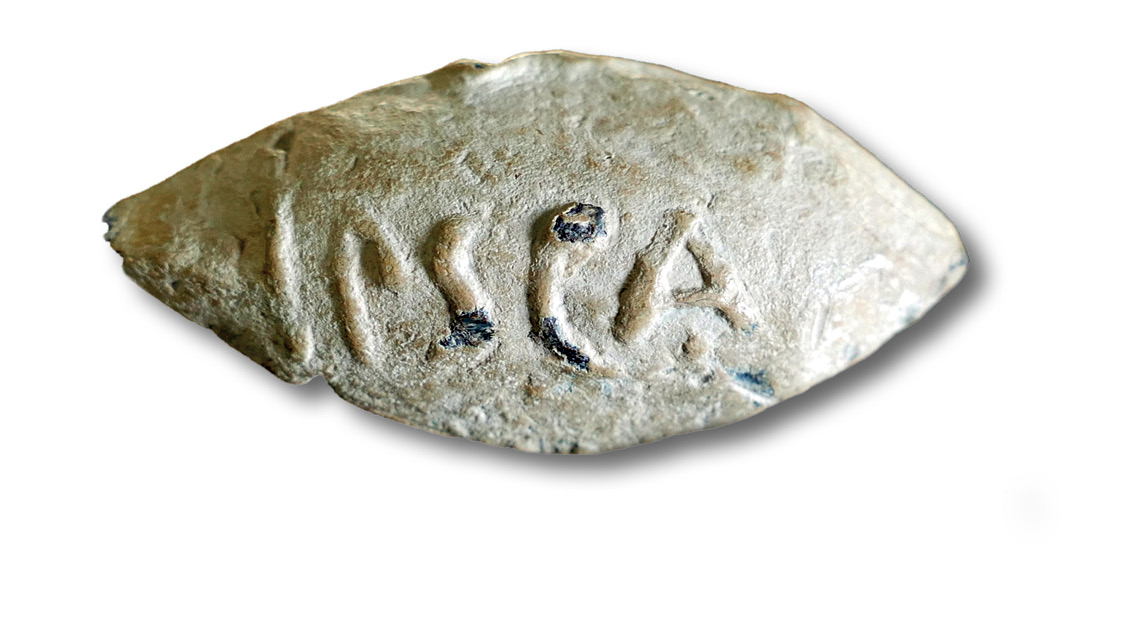
Photo: J Moralejo, J A Morena
Please note: letters may be edited; views expressed here are those of our readers, and do not necessarily reflect those of the magazine.