Subscribe now for full access and no adverts
Memories of Gallowgate
Reading your news article ‘Evidence of Glasgow’s medieval expansion uncovered at Gallowgate’ (CA 429) reminded me of previous work carried out in the area as part of the Youth Opportunities Scheme in the late 1970s and early 1980s. This scheme gave unemployed youths the opportunity to work on a series of community-based projects. A few were archaeological in nature, including excavations in 1980/1981 at the site of the 18th-century Saracen’s Head coaching inn, which was also looking for evidence of a medieval church and ‘St Mungo’s Well’.
The Saracen’s Head site was on the Gallowgate, too – only some 100 or so metres east of the recent excavations. Rather than the Molendinar, it lay on the course of the Poldrait, an-other burn lost to later culverting work. Although we were not on the scheme, a couple of us from the old Renfrewshire Archaeological Society were lucky enough to be invited to help tidy the site prior to an end-of-dig open day, so we got to get ‘hands on’ with the remains.
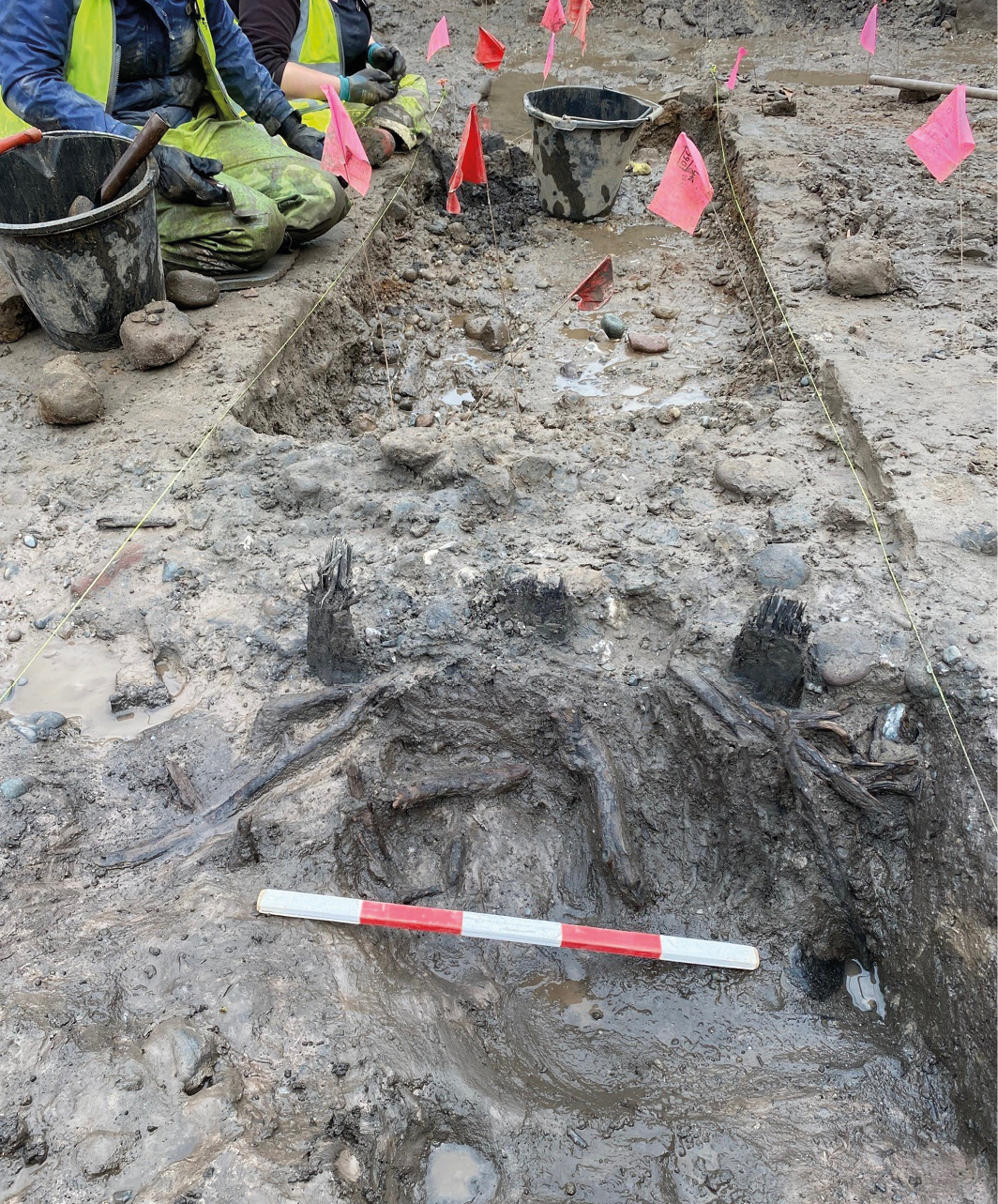
The church was not located, probably because it is lying under the Gallowgate, which had apparently moved uphill in the 17th/18th century before being paved. However, finds notably included the only known remains of a medieval water mill in Glasgow, including a wickerwork revetted mill race with several upright posts lying about 2m underneath ground level.
A short report of the excavation was published in the Glasgow Archaeological Journal 17 in 1991. It would be interesting to know if the sites are contemporaneous, although I suspect the dating of the Saracen’s Head site may be much less accurate given when it was excavated.
Iain Dickson, Bedfordshire
Dodecahedron conundrum
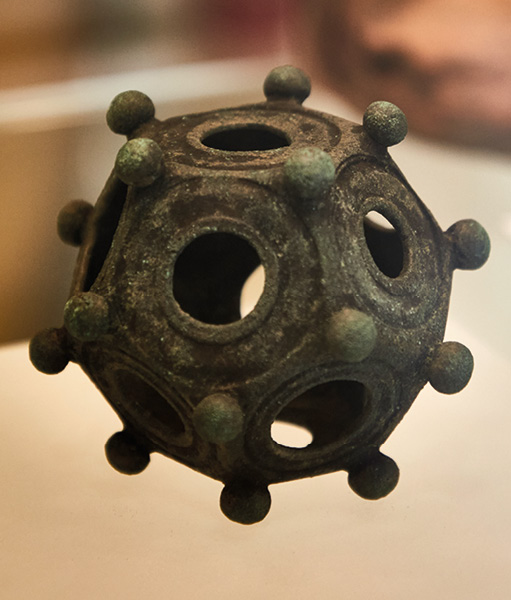
I’ve followed the reporting of the discovery of the Norton Disney dodecahedron and was intrigued by the article in CA 429 that revealed this was not an isolated object and, more importantly, that similar dodecahedra have only been found across the northern reaches of Rome’s Empire. To me that rather suggests that we should be looking for a Celtic rather than a Roman explanation. The Celts were, after all, famous metalworkers.
As to what it was for, the jury’s out; it is clearly capable of being rolled, and the holes may have some significance. It would be intriguing to speculate that maybe there was a decorated plug in each hole, or maybe each hole surround was a different colour? Either of these could make it an object of leisure for a game played like boules or pétanque, where it would be rolled or thrown, or maybe you could roll it and score points for which hole landed on top? I hesitate to say it, but could it be ritual? Add a God into all the holes and roll the ball to see if you were favoured or which course of action you should take?
A simple answer is that they may just be test pieces that an apprentice had to make to satisfy his master that he was fit to be what we would know in the Middle Ages as a ‘journeyman’.
It would be interesting to see if there are other theories out there.
Bob Britnell, Canterbury
Mathematical dodecahedra?
I think the Roman dodecahedron (as found at Norton Disney) is most likely a mathematical puzzle.
In 1857, the Irish mathematician William Hamilton described his ‘Icosian Game’, the objective of which is to find a path along the edges of the dodecahedron so that every vertex is visited only once. This can be demonstrated by winding a thread around the knobs on the vertices of the dodecahedron.
The five Platonic solids – the tetrahedron, cube, octahedron, dodecahedron, and icosahedron – were described by Plato around 350 BC, when the dodecahedron was thought to relate to the heavenly constellations, the tetrahedron to fire, the octahedron to air, the cube to earth, and the icosohedron to water.
Carved stone polyhedra have also been found in Scotland, dating to the Neolithic.
An internet search quickly returns references for Hamilton’s Icosian Game, the Platonic solids, and Neolithic carved stone polyhedra in Scotland. My reference is the very entertaining The Math Book by Clifford Pickover.
The persistence and reappearance of the polyhedra concept over a long time period is probably due to the fundamental underlying geometry, and to the way that cultural ideas and behaviours replicate and evolve within a society, which in modern parlance might be termed a meme.
Bob Burton, Wokingham
Practical dodecahedra?
I read your interesting article about the dodecahedron. The Romans were allegedly all for precision, so is it possible the dodecahedron was used as a gauge of some sort. The length of a spear or arrow could be replicated easily, but if you wanted them to be a standard weight from an aerodynamic perspective they would also need to have a standard width, measurable with the gauge, so a soldier would be performing with the same weapon each time. Pipes, too, could be produced at a standard width for a standard flow. Just some thoughts!
Brian Arnopp, Welwyn
Felting Archaeology
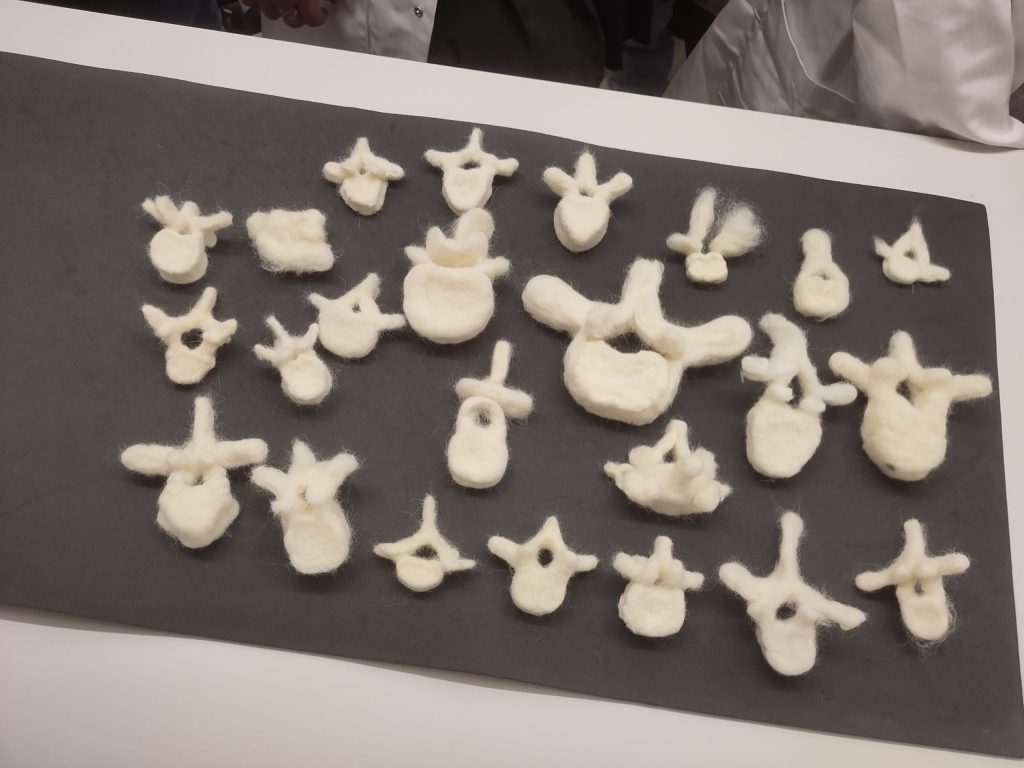
Understanding human anatomy is essential for analysing archaeological human skeletal remains. Inspired by my colleagues Janet Philp and Joan Smith, I introduced a novel and mindful way to engage with bones to our MSc Human Osteoarchaeology degree – felting them! These are different vertebrae of the spine, which our students created in only a couple of hours.
Dr Linda Fibiger, University of Edinburgh
CA ONLINE: What you shared with us this month
Adrián Maldonado @archaeonado.bsky.social
Hot off the presses! Thrilled to be a part of this important new initiative at National Museums Scotland: ‘People of the past: building a future for Scotland’s archaeological human remains’, in the latest @currentarchaeology.bsky.social magazine or with subscription at https://the-past.com/feature/people-of-the-past-building-a-future-for-scotlands-archaeological-human-remains/
Amanda Chadburn @AmandaChadburn
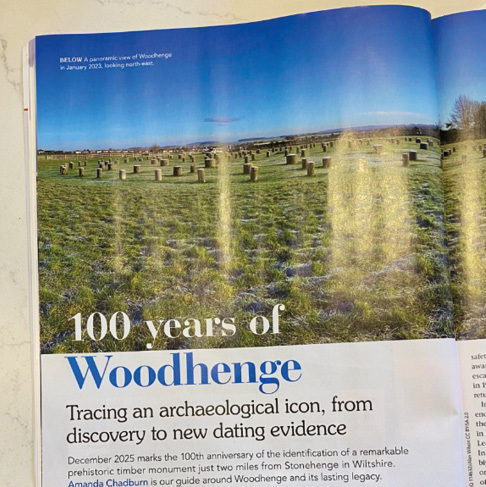
Woodhenge was discovered in Dec 1925. Delighted to see my article about this in @CurrentArchaeo’s December issue – fittingly for the 100th anniversary of this state monument. https://the-past.com/feature/100-years-of-woodhenge-tracing-an-archaeological-icon-from-discovery-to-new-dating-evidence/
Carolyn Hailstones @CarolynHailston
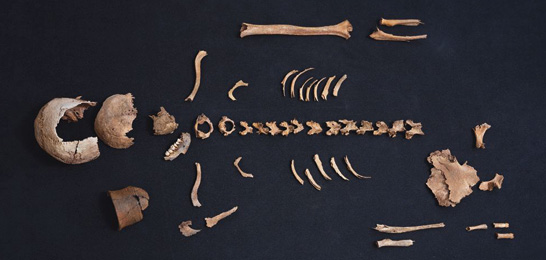
A very interesting story, thanks for the telling! There was a dog burial in the area that I took a photo of. It was the last day of excavations. Stonehenge environs?

Write to us at: CA Letters, Current Publishing, Office 120, 295 Chiswick High Road, London, W4 4HH, or by email to: letters@archaeology.co.uk
For publication: 300 words max; letters may be edited.