Subscribe now for full access and no adverts
Dear Editor,
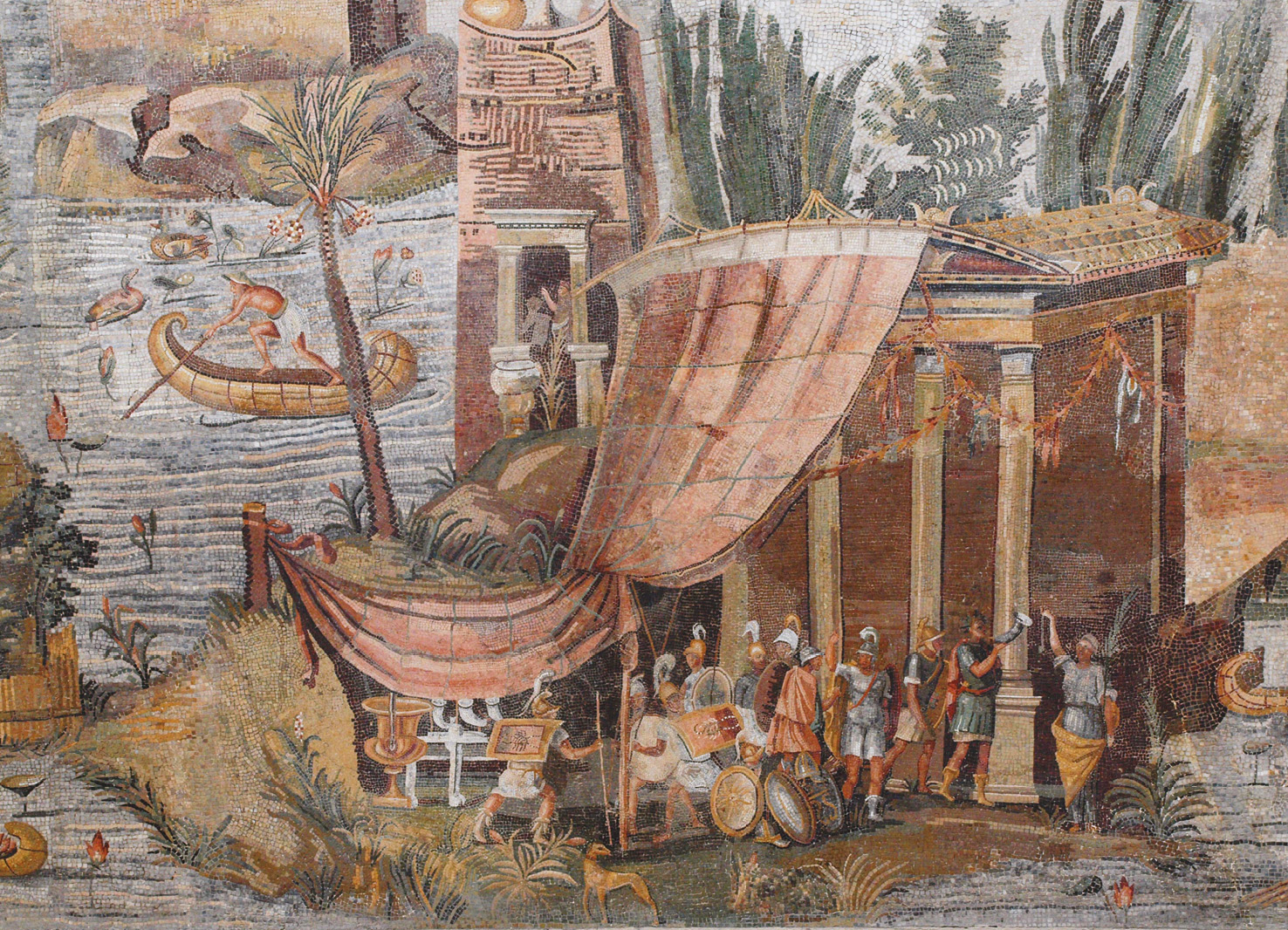
After reading Robert Frost’s excellent article ‘The Nile Mosaic at Palestrina’ in the September/October issue of Ancient Egypt (AE 150), I see the possibility of the temple shown at the bottom right being the one recently featured on PBS television as Cleopatra’s Temple – her ‘Isiseum’. Although it was actually built earlier by another Ptolemy, she is believed to have used it extensively. After her death, it was used by the Romans until the time of Claudius, when a great earthquake destroyed it. Recent archaeological recoveries along the shore at Alexandria are revealing the story. On an island, it faced forward into the Mediterranean as a distinctive feature for approaching ships. Apparently the temple was dedicated to Osiris and Isis, used as an Isiseum by Cleopatra, and then repurposed by Octavian/Augustus and succeeding Roman emperors. The four front-facing pillars, a hint of one more pillar of the second row of pillars behind it, and the length of the temple shown on the mosaic, are clues that this is that temple about which so much is being learned from the recent excavation.
Sincerely,
Jeanne Bishop, PhD, Westlake, Ohio
Dear Jeanne,
While it is possible to identify generic features of the Graeco-Roman urban landscape in the Palestrina mosaic, it is harder to do the same definitively in the case of individual buildings.
I have looked up the documentary and there are some passing similarities between the sanctuary of Isis and the mosaic, but I would disagree with your reference to the temple being long — it is little more than a porch or pronaos as Meyboom (1995) puts it. Having said that, there are multiple mistakes in the mosaic, and with the issue of its splitting and reassembly, there is the potential for pieces having been lost, so there is the possibility that the creator wanted to show this temple — and this would fit with its being where a royal party is being received.
The architectural style of this building – with its regularly spaced columns, circular entablature, and tiled roof – would certainly conform with at least the form of the pronaos (porch) of a Ptolemaic temple such as Cleopatra’s Sanctuary of Isis on the Antirhodos. It is, though, equally likely that the image represents another building in the royal quarters of Alexandria, one at Heracleion-Thonis on the Canopic branch of the Nile, or even a composite of different Ptolemaic buildings.
Robert Frost, Centre for Urban History at the University of Leicester