
Subscribe now for full access and no adverts
Football fact-checking
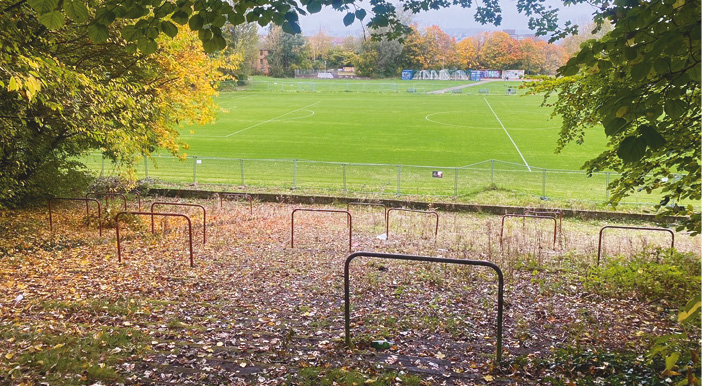
It was good to see some football archaeology being reported in CA 429 (‘Cathkin Park commemorated’). However, the article is misleading when it says that after Queen’s Park moved in 1903 ‘the stadium became disused’. Founder member of the Scottish Football League Third Lanark Athletic Club moved into the ground in 1903 and played there until being dissolved in 1967. Parts of the terracing and several crash barriers are still there – the photo (below) was taken in October 2025 – and can be explored in what is now a public park.
Martin Weiler, Exeter
Further football facts
In 1903, Queen’s Park sold the ground to Third Lanark AC (formerly the Third Lanarkshire Rifle Volunteers), founder members of the Scottish Football Association. Unfortunately, Queen’s Park could not agree a price for the buildings and took them with them to Hampden. Third Lanark then built their own stand. The team played at Cathkin until their closure in 1967. When I taught at Holyrood Secondary, adjacent to Cathkin, in the 1970s, the stand still existed along with the end terraces, but the ground was overgrown. I believe it is now used by an amateur team and the Jimmy Johnstone Football Academy.
Jim O’Neill, Irvine, North Ayrshire
Norton Disney Dodecahedron: additional references
We would like to highlight two additional references for last month’s article on the Norton Disney dodecahedron (CA 429), which were, unfortunately, sent to us after the issue had gone to press. We strongly believe in properly acknowledging sources and regret this unintended omission; we would therefore like to direct readers’ attention to Lorena Hitchens’ and Dr Gerry McDonnell’s specialist reports from 2024. The complete citations are as follows:
L Hitchens (2024) ‘Appendix 7: Roman dodecahedron’, in Archaeological Evaluation Report: Norton Disney, Lincolnshire (Allen Archaeology), pp.34-41.
G McDonnell (2024) ‘Appendix 8: Hand-held X-ray fluorescence analysis of a copper-alloy Romano-British dodecahedron’, in Archaeological Evaluation Report: Norton Disney, Lincolnshire (Allen Archaeology), pp.44-48.
Edible Archaeology
Kate Ferry, Stamford

CA ONLINE: What you shared with us this month
BAR Publishing @barpublishing.bsky.social
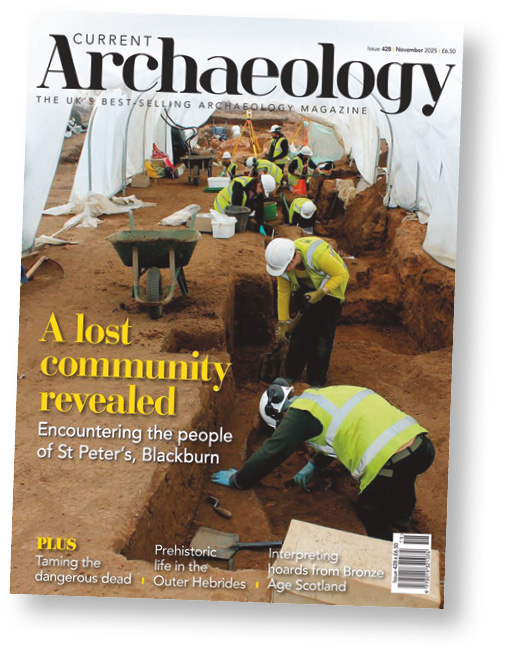
We are thrilled to see the research from Living and Dying in a Lancashire Cotton Town as the cover feature in [issue 428 of] @currentarchaeology.bsky.social
Antiquity Journal @AntiquityJ
‘100 years of Woodhenge’: learn about the discovery and research of Stonehenge’s ‘lesser-known cousin’ in @CurrentArchaeo 429.
Antiquity Journal @AntiquityJ
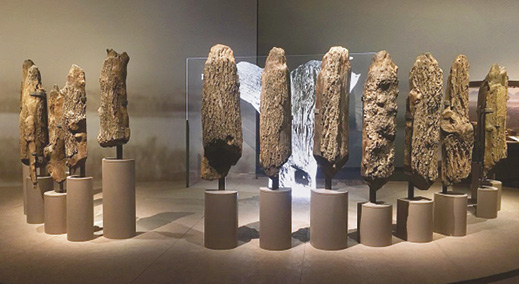
To complete the set, here is Seahenge: an Early Bronze Age timber monument from the Norfolk coast. In contrast to Stonehenge, it was likely a small-scale community gathering locale rather than a place of large-scale ‘elite’ display.
Write to us at: CA Letters, Current Publishing, Office 120, 295 Chiswick High Road, London, W4 4HH, or by email to: letters@archaeology.co.ukFor publication: 300 words max; letters may be edited.