Subscribe now for full access and no adverts

Across
7 Member of a people who lived in northern Scotland during the Roman and early medieval periods (4)
8 Fort ___, National Historic Landmark in Missouri (5)
9 Greek hero of the Iliad (4)
11 Land bridge that linked Alaska and Siberia (8)
12 Island in the Tyrrhenian Sea, where Greeks settled in the 8th century BC (6)
13 Stage of the British Pleistocene (10)
14 US state containing the Moon House archaeological site (4)
15 Yorkshire seaside town where a 6th-century Anglo-Saxon cemetery was discovered in 1913 (7)
17 Kingdom that fought the Romans at the Battle of Carrhae (7)
21 Ancient Egyptian god of artisans (4)
23 Phase in the Tehuacán Valley, Mexico, dating to 1000 BC to AD 150 (5,5)
25 One of John Franklin’s ships whose wreck was discovered in 2014 (6)
26 Confederation of Germanic tribes conquered by Clovis in AD 496 (8)
27 Mischievous god of Norse mythology (4)
28 ___ Park, phase of the British Bronze Age (5)
29 Ancient alphabet used in Britain and Ireland (4)
Down
1 Roman orator and statesman (6)
2 Kathleen ___, British archaeologist, author of Ancient Sparta (8)
3 West Sussex site yielding Palaeolithic fossils (8)
4 Greek victory over the Persians in 480 BC (7)
5 Unit of a Roman army (6)
6 The last imperial dynasty of China (6)
10 Word originating in the 1930s to describe the original inhabitants of India (7)
16 Canadian state, location of the Serpent Mounds burial site (7)
18 Huntress of Greek mythology (8)
19 God or spirit of death in Greek mythology (8)
20 Islands in the Indian Ocean, possibly settled at the end of the Last Glacial Period (7)
22 Nickname for Homo floresiensis (6)
23 East ___, English ceremonial county, location of the Mount Caburn hill fort (6)
24 Member of an ancient Hellenic people (6)
For answers to #131, see next issue.
75 years ago…
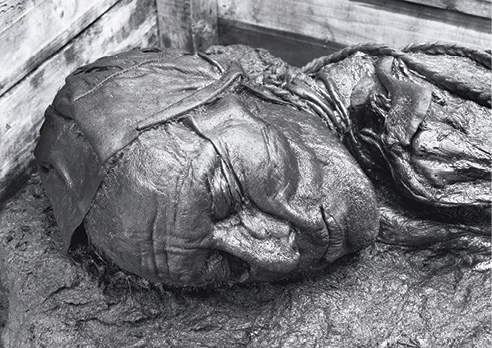
The ‘bog body’ known as Tollund Man was discovered in Bjældskovdal Mose, a peat bog c.10km west of the Danish town of Silkeborg. The humans remains, naturally mummified by conditions in the bog, were discovered on 6 May 1950 by a father and son cutting peat for fuel. The body was so well preserved that they initially believed it to be a modern murder victim, but police and representatives from Silkeborg Museum confirmed that the find was archaeological in nature. In the decades since its discovery, various investigations have been carried out, revealing that the remains belonged to a man aged 30-40 years old, who lived in the Iron Age, 405-380 BC. He was buried with a leather rope around his neck and an autopsy has confirmed that he died by hanging, but debate continues about the reason for his death. Suggestions include punishment or ritual sacrifice. Tollund Man is currently housed in Silkeborg Museum.
Technology + Archaeology
Tutankhamun: the immersive exhibition
This innovative exhibition is one of the latest heritage attractions using technology to immerse visitors in the past. Among other things, the show features 8m-tall 360° projections that take visitors on a journey through ancient Egypt; a seated virtual reality (VR) experience exploring the afterlife; a hologram room explaining the mummification process; and a digital ‘metaverse’ that can be explored using VR goggles. The exhibition is on display in London until 29 June, before continuing on its world tour. For more details, visit http://www.tutankhamunexperience.com.

Answers to Crossword #130
Across: 7 Narthex, 8 Peridot, 80 Minnesota, 11 Stoa, 12 Anchises, 13 Avalon, 15 Samnite, 17 Demetae, 20 Aureus, 22 Centaurs, 24 Tara, 26 Euripides, 27 Juvenal, 28 Oedipus.
Down: 1 Tasmania, 2 Stonehenge, 3 Aeneas, 4 Delaware, 5 Riss, 6 Rococo, 9 Fosse, 14 Alexandria, 16 Tesserae, 18 Acrisius, 19 Accra, 21 Uranus, 23 Naples, 25 Apet.