
Subscribe now for full access and no adverts
In 1859, Napoleon III’s launch of the awe-inspiring iron- clad warship La Gloire struck fear into the hearts of the British naval authorities. The 5,630-tonne vessel far surpassed anything in their arsenal, and anxieties began to spiral that Bonaparte’s nephew might have expansionist ambitions of his own.
Perceived vulnerabilities in the face of a French invasion spurred efforts to beef up Britain’s coastal defences, including the construction of a network of more than 70 ‘Palmerston Forts’. These imposing installations were named after the prime minister of the day – though they were later dubbed ‘Palmerston’s Follies’ after the feared attack never materialised.However, while the forts did not have to fend off a French fleet, many would go on to play protective and logistical roles in subsequent conflicts, particularly during both World Wars. One such site was Newhaven Fort, whose ten-acre fortifications crowning cliffs above the town’s harbour still represent the largest defensive structure built in Sussex.
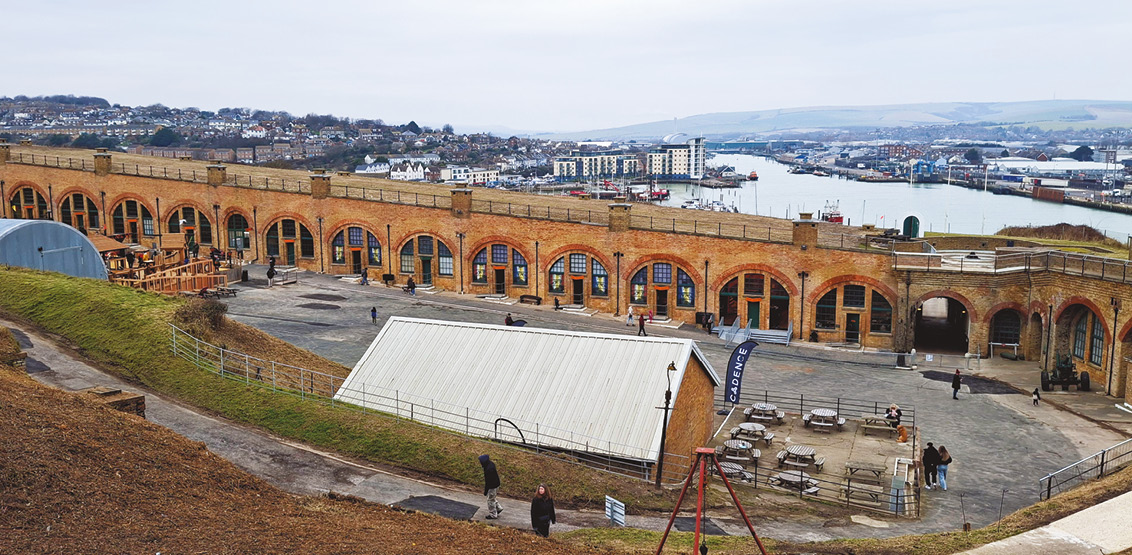
Completed in 1871 (with the fort’s guns arriving two years later), its construction involved seven years of labour, more than six million bricks, the first major use of concrete in a military installation anywhere in the world, and an investment of £80,000 – almost £8 million today, according to the Bank of England’s online inflation calculator.
Although it, too, never fired a shot in anger (though it did see enemy action once, when the site was bombed by the Luftwaffe in 1940), the fort was especially important in helping to safeguard the south coast during the first half of the 20th century. Today, the bustling port that it overlooks is best-known as one end of the Newhaven–Dieppe ferry route, but this proximity to France placed the town on the front line of wartime defences, and made it a key conduit for the transport of soldiers and supplies.
Ruin, rescue, and redesign
Standing guard over these vital voyages was Newhaven Fort, which also served as an artillery training centre. In 1962, though, the site’s military use officially came to an end. The land on which the fort stood was transferred back into civilian hands, but, with no funding to maintain the complex, it soon fell into disrepair.
For two decades, the landmark’s fate hung in the balance – but in the 1980s a major redevelopment saw it gain a new lease of life as a visitor attraction. Now a further investment of £7.5 million has transformed the site once more, preserving its historic fabric for the future and bringing its displays and facilities up to date. Following a 12-month closure while these works took place, the fort reopened to the public in February.


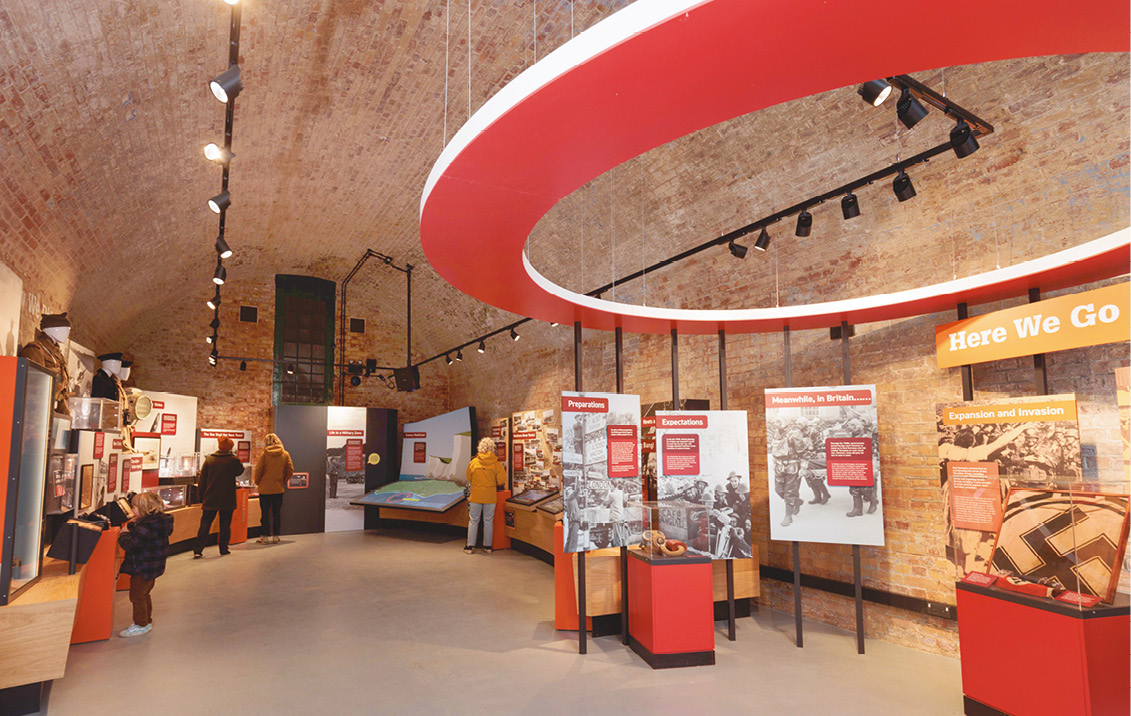
Along one side of the central parade ground, 18 casemates – vaulted barracks built into the ramparts – now serve as galleries illustrating various aspects of military history. Some trace the story of the fort itself, showcasing archaeological evidence for Iron Age and Roman activity on the site long before the ramparts rose; exploring why the Victorian defences were needed and how they were built; and examining the site’s later 20th-century decline and revival. Others allow visitors to experience garrison life for themselves, recreating the spartan spaces that soldiers once called home.
There are also displays of uniforms and objects relating to local regiments, and exhibits illuminating the role of Newhaven during both World Wars. This last theme in particular incorporates enjoyably interactive elements, including telephones through which you can hear recordings of local people sharing their wartime memories. Among them was Jim Still who, aged five, climbed into a tank destined for the port and would have ended up in Dieppe had he not been spotted in the nick of time!

Exploring the past
Even more immersive experiences are offered by a large area dedicated to civilian life on the Home Front, where visitors can walk through the rooms of a reconstructed 1940s-era house, a ‘Dig for Victory’ kitchen garden, and a grocer’s shop, to learn how Britons kept calm and carried on amid the privations of rationing and the terror of aerial bombardment.
For those of us who only know the Blitz through the memories of older relatives, an experience where you can sit inside an air-raid shelter during a simulated bombing raid offers a powerful reminder of what previous generations endured – as does a walk-through reconstruction of a First World War trench, which evokes the sights, sounds, and smells of the Western Front.
Visitors can learn, too, about the planning that went into major operations like the disastrous Dieppe Raid of 1942, and the Normandy Landings of 1944, in a high-tech ‘boardroom’ where digitally rendered generals discuss their strategies, and historical events play out on screens showing maps, photographs, and animations. Another innovative offering is a 1970s-themed escape room, which is housed inside the Grand Magazine that once contained the fort’s gunpowder stores.
For those who want to explore the fabric of the fort itself, visitors can wander the ramparts, examine gun emplacements up close, and descend into a network of tunnels linking different tactical positions (and a sally port at the base of the cliffs that, rumour has it, soldiers used to sneak out to visit the nearby Hope Inn).
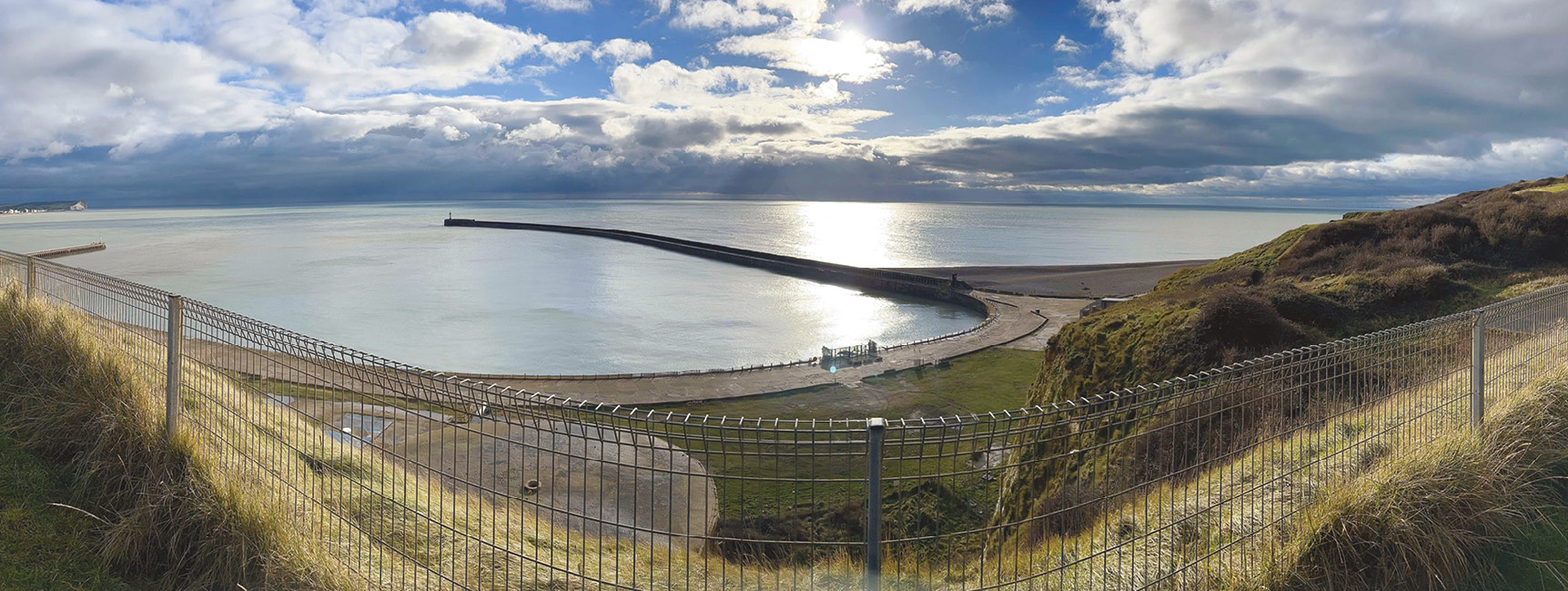
Thanks to the recent renovations, a number of previously inaccessible areas have been reopened to the public, among them the Battery Observation Point where you can now enjoy panoramic views over the Channel. With all of these experiences on offer, as well as improved facilities including a café, events space, and a large new playground, families and individuals alike can easily spend an enjoyable and enlightening day at the fort – and tickets allow unlimited return visits for 12 months, during seasonal opening hours.
Newhaven Fort
Until 2 November 2025 (£12.95)
Fort Road, Newhaven, BN9 9DS
www.newhavenfort.org.uk
+44 (0) 1273 517622
All images: Carly Jones/Wikimedia Commons/Victoria Dawe/Newhaven Fort
MHM visits…
EXHIBITIONS
Gladiators: heroes of the Colosseum
28 June-2 November 2025
Royal Armouries Museum, Armouries Drive, Leeds LS10 1LT
https://royalarmouries.org/leeds/whats-on/gladiators
Adult £6.50
Explore the world of the legendary Roman combatants through an astonishing array of artefacts – including helmets, spearheads, and body armour – found in the gladiators’ barracks in Pompeii. In collaboration with the National Archaeological Museum of Naples, Expona, and Contemporanea Progetti, this unmissable exhibition is in the UK for a limited time only.
Call to Arms: the soldier and the Revolutionary War
Opening June 2025
National Museum of the United States Army, 1775 Liberty Drive Fort Belvoir, VA 22060
http://www.thenmusa.org/exhibit/special-exhibition-gallery
Free admission
This new exhibition has been curated specifically to commemorate the 250th anniversary of not just the American Revolution, but the founding of the American army itself. Call to Arms showcases a unique collection of more than 280 artefacts from England, France, Canada, and, of course, the first colonies.
FESTIVAL
We Have Ways Fest
12-14 September 2025
Blackpit Brewery, Buckinghamshire, MK18 5LJ
https://wehavewaysfest.co.uk
£197.98 (full weekend)
Based on the popular military history podcast presented by James Holland and Al Murray, We Have Ways Fest gathers a range of top authors, veterans, and experts alongside military vehicles and hardware – plus traders, music, and food and drink. Guest speakers announced so far include Philippe Sands, Dominic Sandbrook, and Clare Mulley. Tickets available now.