Subscribe now for full access and no adverts
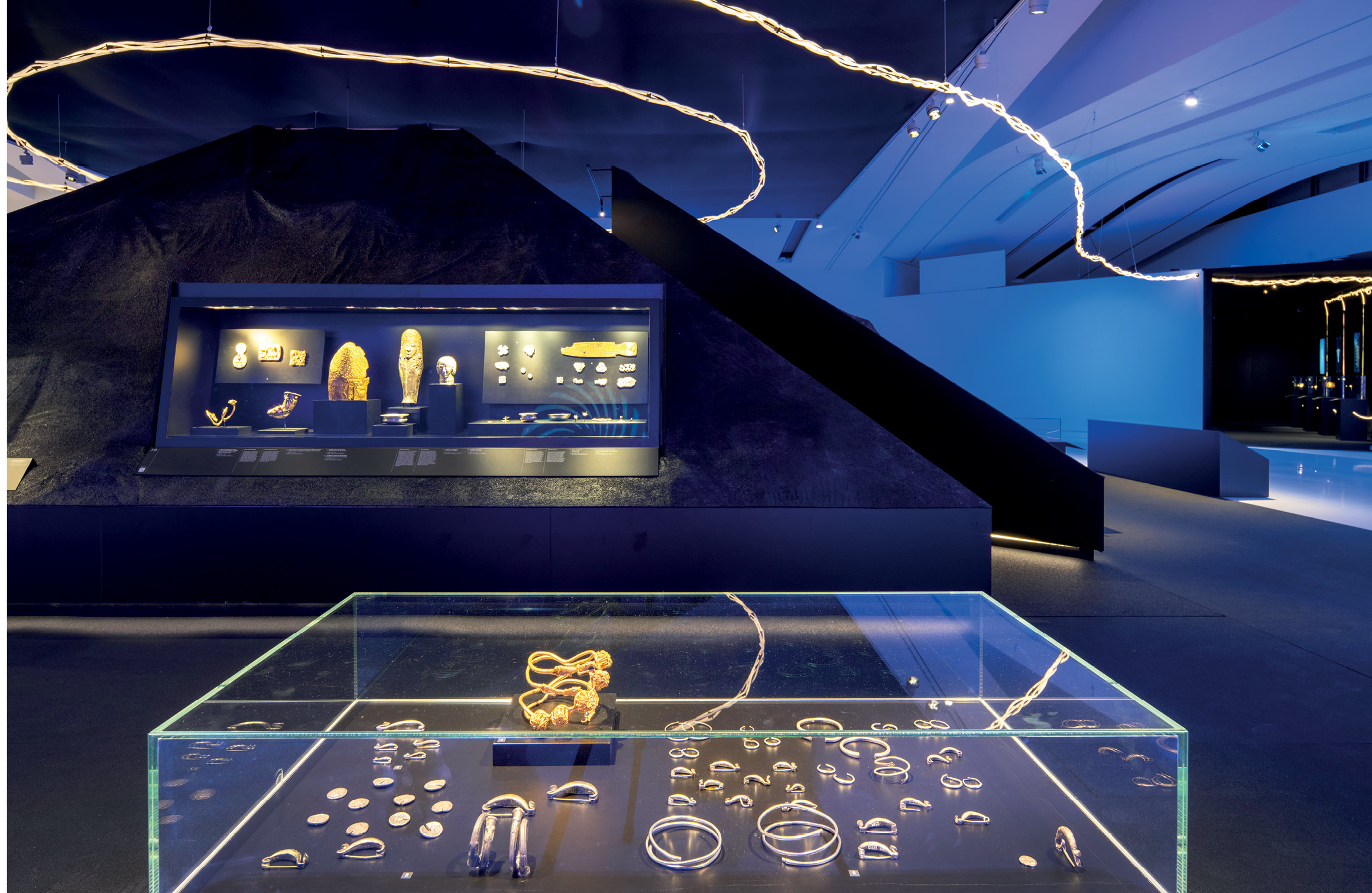
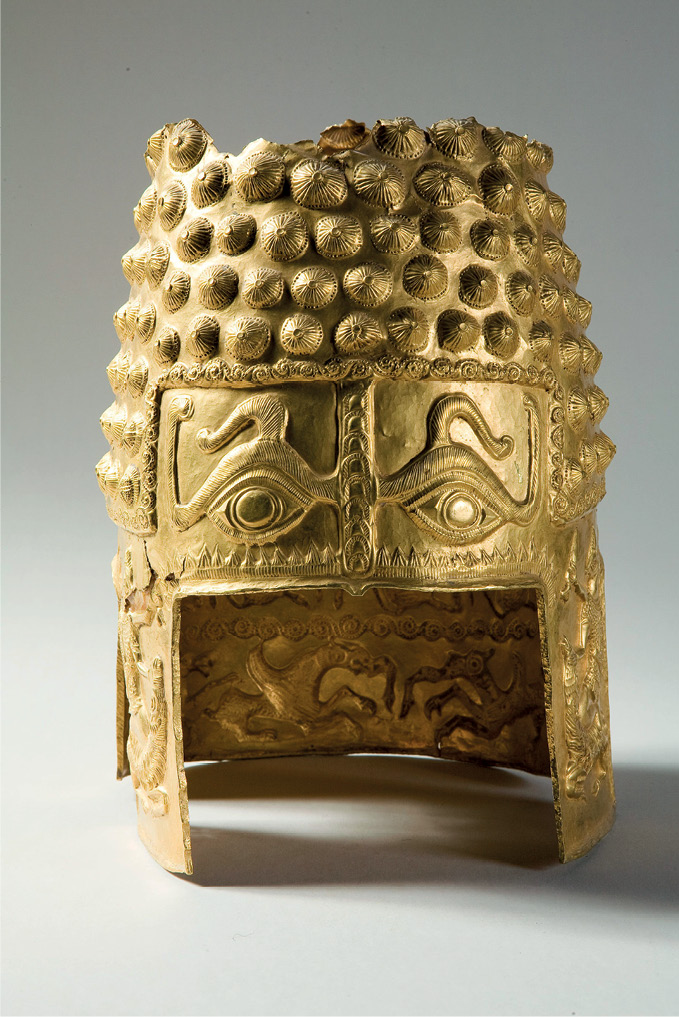
The Drents Museum in Assen continues to charm the museal world with surprising displays. The latest offering is Dacia – Empire of Gold and Silver. No title could have suited the exhibition better, for indeed ancient Dacia – a land encompassing much of modern-day Romania – was famed in antiquity for its immense wealth in gold and silver. Archaeological evidence shows that the Dacians had developed a rich culture of craftmanship by the 5th to 4th centuries BC. Gold and silver ornaments, pendants, and rings, used as trade items or as offerings to the gods, can be traced back to around 350 BC. Arguably the most impressive artefact on display is the Helmet of Coțofenești. This royal ornamental headpiece, over 2,400 years old, is made of solid gold, and has been masterfully adorned by Dacian craftsmen with decorations that reflect an array of different cultural influences.
A military to rival the Romans
Though this particular helmet was never intended to be worn in combat, the Dacians were famed for their skill in warfare, while their artistry remains a lesser-known aspect of their culture. Under the leadership of King Burebista in the 1st century BC, the Dacians displayed formidable strength, expanding their kingdom from the Carpathian Mountains in the north to the Danube River in the south. They subdued Celtic and Scythian tribes, as well as Greek city-states along the Black Sea coast. With fortified citadels and temples, the Dacian kingdom evolved into a serious challenge for the Roman Empire.
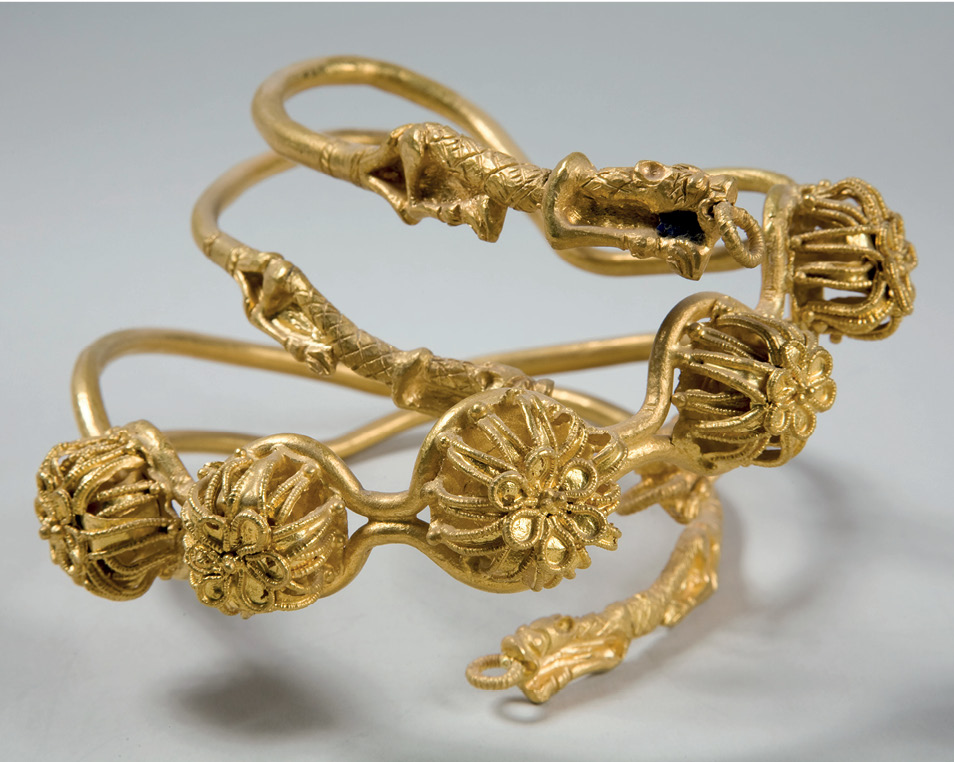
This threat was realised in the late AD 80s, when a powerful new military leader, Decebalus, launched a series of assaults on Roman positions along the Danube. The river, frozen for much of the winter, provided a tactical advantage, allowing Decebalus’ skilled soldiers to raid these settlements, gain valuable war spoils (including slaves), and transport them back to Sarmizegetusa Regia, the Dacian strong-hold. The Roman emperor, Domitian, ultimately resolved the ensuing military conflict with the Dacians by paying them off: the peace treaty of AD 89, celebrated with triumphal games in Rome, ensured cooperation between the two states for a short time. Roman engineers were sent to Dacia to assist in constructing bridges, public baths, and paved roads, and for a few years Dacians and Roman settlers lived alongside each other in the city of Sarmizegetusa Regia. These conflicts with Rome, combined with pressures from other neighbouring forces, took their toll on Dacia’s wealth, though, and gold and silver use declined in the 1st century AD. Nonetheless, the rare examples that we do find, such as the Urechești golden bracelets – which would not be out of place in today’s luxury jewellery houses – are testament to the extraordinary level of Dacian craftmanship in that period.
The late 1st-century peace was short-lived. Despite the treaty with Rome, Dacian warriors continued to carry out raids, and tensions as a result of these violations erupted when the emperor Trajan came to power in AD 98. Trajan was energetic and ambitious, and had no interest in a peace treaty that drained the treasury. Instead, he chose to invest in a massive military campaign. Following three years of preparation, Trajan is said to have sent in 13 legions to confront Decebalus in a final showdown. The first campaign, in AD 101-102, subjugated the Dacians and forced them to accept client status. When they rose up in arms again, a second campaign in 105-106 finished them off. In 106, Sarmizegetusa Regia was besieged and sacked. Decebalus was either executed or took his own life. Following Trajan’s victory, Dacia was annexed as a Roman province, with Ulpia Traiana Sarmizegetusa as its new capital.

Seizing the riches of Dacia
Trajan’s investment in the campaign paid off. The war loot from Dacia was so substantial that it is often considered the greatest of all Roman conquests. The enormity of the spoils is described by the 6th-century Byzantine historian Ioannes Laurentius Lydus. In his work De Magistratibus Reipublicae Romanae (554), he cites Criton, a physician in the 105-106 campaign, who mentions that the Romans took from the Dacian treasury over 1,650 tons of gold and 3,310 tons of silver. Criton recorded, too, that the Romans brought home a large quantity of decorated tableware and household items, which were highly valued in antiquity. Later historians questioned these figures, but recent scholarly debate has returned to the subject and re-evaluated the Roman system of measurements and weights. The Romanian historian Ernest Oberländer-Târnoveanu, director of the National History Museum of Romania in Bucharest, argues that Criton’s estimates were indeed close to accurate.
In any event, the Dacian war spoils were substantial enough not only for Trajan to organise extravagant celebrations, but also to construct the famous Forum of Trajan, between 107 and 113. Its centrepiece, Trajan’s Column, built in 113-114, commemorates the Roman victories over the Dacians with highly detailed reliefs. The final scenes depict the native people – the Dacians – being driven out of their homeland, facing the incoming Roman settlers with bold dignity.
Dacia’s influence on Romanian identity
For centuries, the long-accepted scholarly interpretation of events was that, after Trajan’s campaigns, the Romans settled into Dacia and integrated the remaining Dacians into their midst. This narrative, of fierce Dacian warriors assimilating into Roman society, became an ideal adopted by later Romanian nation-builders. In the 1850s, during an age of awakening nationalism, many Romanian poets, politicians, and writers claimed the Romanised Dacians as their direct ancestors.
However, in recent years, several Romanian historians have asserted that Roman influence may not have been strong enough to completely Latinise the region. They argue, first of all, that Trajan did not conquer all of Dacia. His campaigns resulted in the annexation of only the areas around the Carpathian Mountains and along the Danube River. The rest of the region, especially the rugged north-eastern areas, remained outside Roman control. From these mountains, located in Transylvania today, ‘Free Dacians’ continued their guerrilla campaigns. Second, although thousands of Roman colonists, mainly from southern Italy, went to work in the gold and silver mines of Dacia, their number was not sufficient to enforce a comprehensive uptake of Latin in the area. Present-day Romanian is a Latin-based language, but it is one with Dacian influences. As many as 10% to 15% of words have Dacian roots, including many toponyms. The Italian writer Primo Levi typified Romanian as a language ‘whose melody felt recognisable, yet its true meaning remained out of reach’. This exhibition of ancient Dacian gold successfully sparks our curiosity to unravel these mysteries.
Dacia – Empire of Gold and Silver
Drents Museum, Brink 1, 9401 HS, Assen, Netherlands
Open: until 26 January 2025
Website: www.drentsmuseum.nl/en/exhibitions/dacia-empire-of-gold-and-silver