
Subscribe now for full access and no adverts
REVIEW BY NICK HEWITT
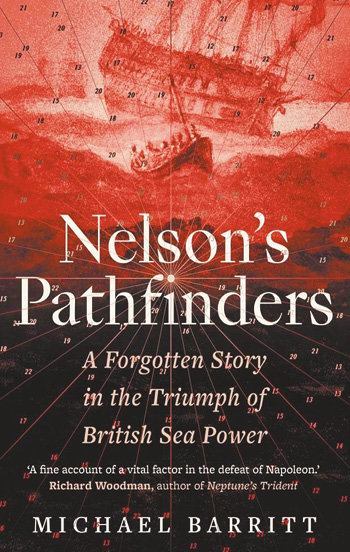
No matter how long you study a subject, there is always something new to learn, and this reviewer learned a great deal from Michael Barritt’s excellent account of ‘how Thomas Herd made hydrographic capability a crucial enabler of strategic planning and frontline operations’ in the Golden Age of Sail.
Although the evolution of nautical charts is a story that may have been told before, how the information to create them was gathered, Barritt argues, has not. The gathering of this information was primarily the work of sailors whom he calls ‘Nelson’s Pathfinders’.
Barritt himself is a retired naval captain and former hydrographer of the Navy, and his primary aim with this book is to make a strong case to the decision-makers of today for continued investment in the pathfinders of the modern era.
The breadth of his research is impressive, taking in manuscript sources from the UK National Archives, the British Library, the National Maritime Museum, the UK Hydrographic Office, and many other institutions, some of which he has clearly visited to view just a single document. Given the huge range of published and secondary sources Barritt has consulted, it is hard to believe that he can have overlooked anything of any substance relating to his subject.
After a brief introduction and prologue, Barritt divides his chapters by geography rather than chronologically. He begins by looking at the evolution of hydrographic survey in the British Empire, for example in the Caribbean, Canada, and South America. He then moves on to the meat of the narrative, which analyses hydrographic advances during the Revolutionary and Napoleonic Wars. The principal theatres of action in this period included British home waters, obviously, as well as the Mediterranean and the seas of northern Europe. Later Barritt turns his attention to the Americas during the so-called ‘War of 1812’.
A final chapter, entitled ‘The Uneasy Peace’, examines the immediate post-war period, and a postscript entitled ‘A Great Maritime Nation’ robustly makes the case for today’s hydrographers. ‘The standing and influence for good of this “great Maritime Nation”’, Barritt concludes, ‘still demands competent knowledge of coasts and seas, and the active employment of qualified and experienced pathfinders of the Royal Navy to gather it.’
Each chapter has an associated map, all of them admirably clear. The author has also supplied an extraordinary range of illustrations, in the form of plates and more than 40 sketches, drawings, and sections of chart from the archives. These are reproduced as figures embedded in the text. The latter are fascinating, although it has to be said that many are too small to see without a magnifier.
This thematic approach broadly works, but it does lead inadvertently to one of the small challenges this book presents: a huge range of naval characters are introduced, and it can be slightly bewildering to follow their careers to their ends – and occasionally even to their deaths – in one chapter, only to revisit them at an earlier stage of their lives in another.