Subscribe now for full access and no adverts
REVIEW BY GEORGE NASH
Across Europe, during the Late Bronze Age, societies witnessed a dramatic change in economy, politics, and social behaviour. This change also had an effect on the way communities expressed themselves through burial-ritual practices and the production and consumption of rock art. Gone are the great Neolithic passage graves that once dominated Iberian and south Scandinavian landscapes; the power and prestige of ancestors is shifting, and replacing it is a warrior-based society. This is reflected in the material culture – in particular, metalwork and rock art.
It has been proposed that these changes were the result of the exchange of ideas, which were spread by diffusion throughout the later prehistoric world. However, with the advent of developments in sciences such as aDNA analysis and archaeometallurgy, it is now considered that long-distance contact between diverse European communities was also ongoing. One famous example of such connections is the Amesbury Archer, who was buried near Stonehenge and who is believed to have originated from central Europe. If this type of contact was already occurring between communities earlier in the Bronze Age, then contact between southern Scandinavian and Iberian people is more than a possibility.
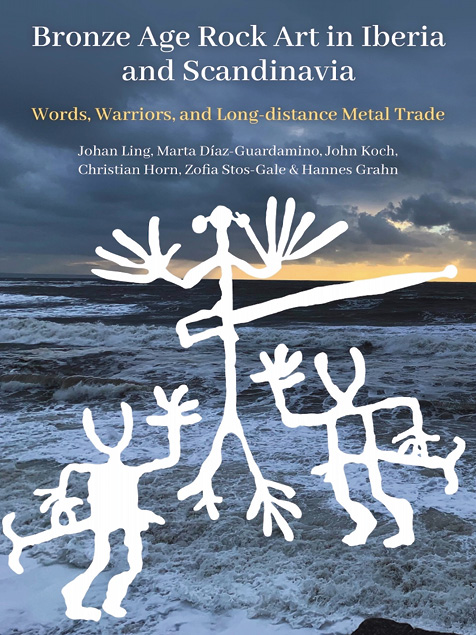
Bronze Age Rock Art in Iberia and Scandinavia provides new evidence of long-distance social and political interactions between these two busy areas of Bronze Age Europe. The book is the result of a wider research project – RAW (Rock art, Atlantic Europe, Words & Warriors) – funded by the Swedish Research Council. The book primarily discusses four themes: metalwork, rock art, warriorhood, and linguistics, all of them deeply entwined with each other. However, it can also be argued that other areas of Atlantic Europe were thinking and organising their communities in similar ways.
The rationale of the book is to cross-reference the two areas’ ideologies using a variety of themes and to marry potential commonalities. Throughout, readers are introduced to new applied methods in photogrammetry on rock art, metallurgy (sources and distribution), geological sourcing, and Indo-European linguistic semiotics, as well as sourcing human remains through aDNA.
The chapter layout provides the reader with a detailed analytical approach to understanding social interaction, communication, contact/exchange, and warriorship. Chapters 4 and 5 discuss power and prestige, and the surprising similarities associated with metalwork, rock art, and monument building. In contrast, Chapter 6 compares Iberian and Scandinavian warrior imagery, which I regard as a complex component to deal with. Equally challenging is the discussion on linguistics in Chapter 7. These sections are topped and tailed with an excellent introduction and summary.
This book can be considered an important step forward in understanding the probability and necessity of people travelling thousands of kilometres over ground or sea from what were then diverse and powerful areas of Europe to exchange commodities and ideas through a common Indo European language (with regional variations), as expressed in material culture that includes their rock art.
Bronze Age Rock Art in Iberia and Scandinavia: Words, Warriors, and Long-distance Metal Trade
Johan Ling et al.
Oxbow, £38
ISBN 979-8888571040