Subscribe now for full access and no adverts
A wooden beam decorated with a lifelike human face has been discovered in Lake Lednica, Poland.
Systematic underwater archaeological research in Lake Lednica has been taking place since the 1980s and has uncovered a wealth of material. Among the finds are numerous discoveries associated with a fortified settlement built on Ostrów Lednicki, the largest island in the middle of the lake, in the late 10th century by Mieszko I, a member of the powerful Piast dynasty and the first Christian ruler of Poland.
The realistic human image recently discovered carved into an oak beam was found among the remains of a collection of wooden structures believed to be part of a defensive rampart built by Mieszko I that collapsed shortly after its construction. Dendrochronology indicates that the tree used to make the decorated beam was felled in AD 967, supporting this interpretation. The structural element bearing the face would have faced out towards the water, suggesting that this carving had some kind of apotropaic function, perhaps representing a deity, spirit, or hero intended to protect the inhabitants of the settlement.
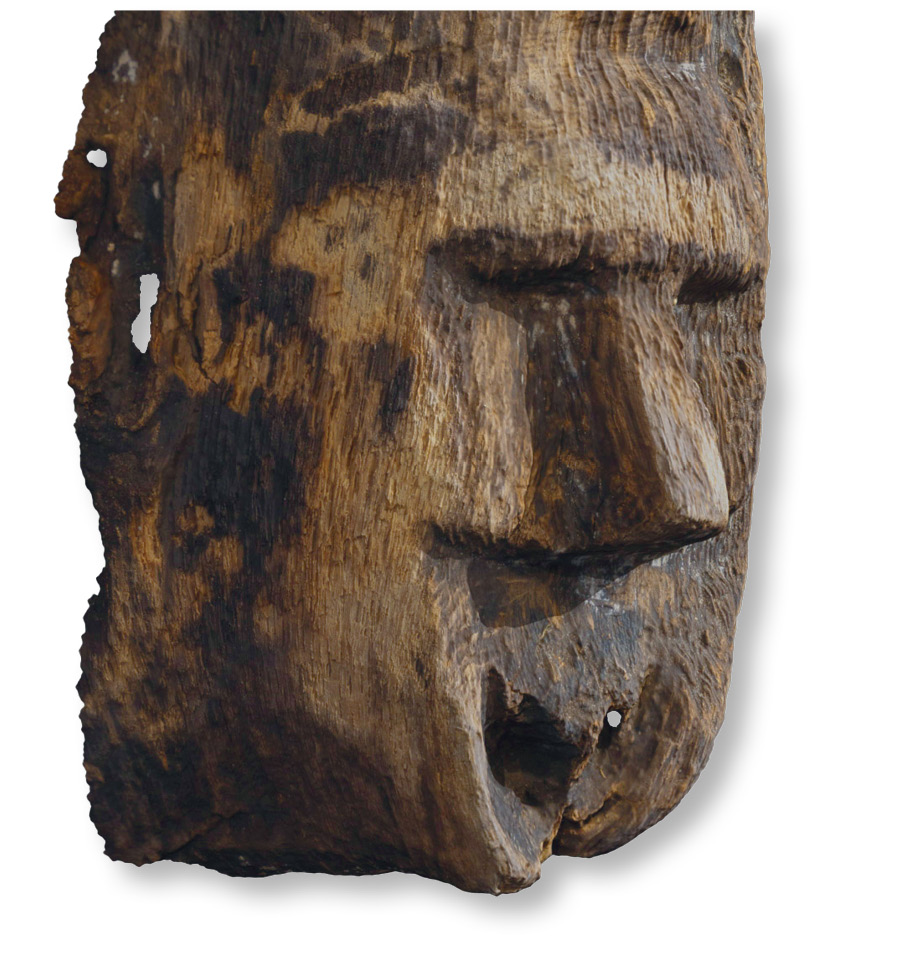
The perfectly preserved carved wooden face is an unusual discovery, although a few similar examples are known from places such as Wolin, Novgorod, and Staraya Ladoga. These objects are changing our understanding of the material manifestations of early medieval Slavic spirituality, demonstrating that it was not just monumental statues but also everyday objects, including parts of buildings and palisades, that had a spiritual dimension. The latest discovery also gives further credence to the suggestion that such anthropomorphic representations may have been more common than the surviving number in the archaeological record indicates. Additionally, this remarkable face from Ostrów Lednicki – where Mieszko I’s baptism may have taken place in AD 966 – represents a fascinating example of pagan art and apotropaic traditions during a time when Christianity was being established in the country.
Text: Amy Brunskill / Image: Mateusz Popek