
Subscribe now for full access and no adverts
The Historic Buildings Team from Cotswold Archaeology has recently carried out a detailed recording of Fort Gilkicker in Gosport.
This fort is part of the Victorian defences around the town’s harbour. It is one of a number of structures known as ‘Palmerston Forts’, which were built in the south-west during this period. They were authorised by a Royal Commission of 1859 – championed by Lord Palmerston (Prime Minister from 1855 to 1865) – to strengthen the English coastline in response to the formidable French Navy. They are sometimes less fondly referred to as ‘Palmerston Follies’, as the majority were built after the threat of the French Navy had largely dissipated, and none fired a single shot.
The main core of Fort Gilkicker was completed in c.1871 to protect the western end of the harbour from any enemy warships that might have been able to successfully penetrate the outer defences of the Solent. In particular, the fort was strategically placed to protect anchorages along the Spithead – an area of the Solent between Portsmouth and the Isle of Wight. It was originally designed to mount 27 heavy artillery pieces, 22 guns (housed within vaulted bomb-proof casemates), and five heavier guns mounted on the roof.
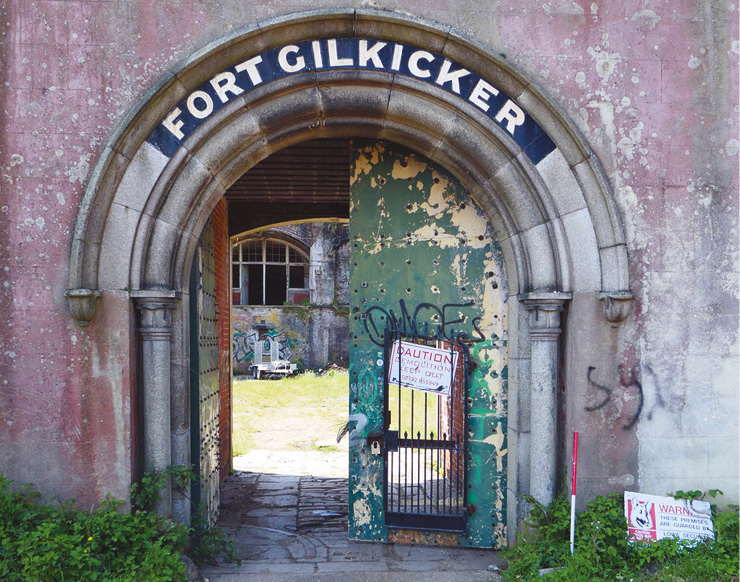
The fort was disarmed c.1907, before being fully decommissioned in 1957 when all British coastal defence batteries were deactivated. During the later period of its military use, however, the fort served as a storage location for the submarine service, and some of the graffiti found during the conservation works by Cotswold Archaeology appears to have been created at this time, including the names of individuals and units, many from the Second World War. Since its decommissioning, the empty buildings have continued to serve as an easel for local artists, particularly during the COVID-19 pandemic.
To conserve this unique heritage site, Cotswold Archaeology worked with the Palmerston Forts Society to undertake a series of drone surveys, in combination with more traditional recording methods, to create a detailed report of the buildings’ state of preservation, their evolution through time, and their cultural value. Now that the conditions of the fort have been fully assessed and it has been conserved, it is time to look to its future. As Jamie Barnes, Historic Building Consultant for Cotswold Archaeology, said: ‘Redundant structures that were built for a very specific or specialist function, such as coastal defence batteries, need a viable use to ensure a sustainable future.’
Text: Kathryn Krakowka