
Subscribe now for full access and no adverts
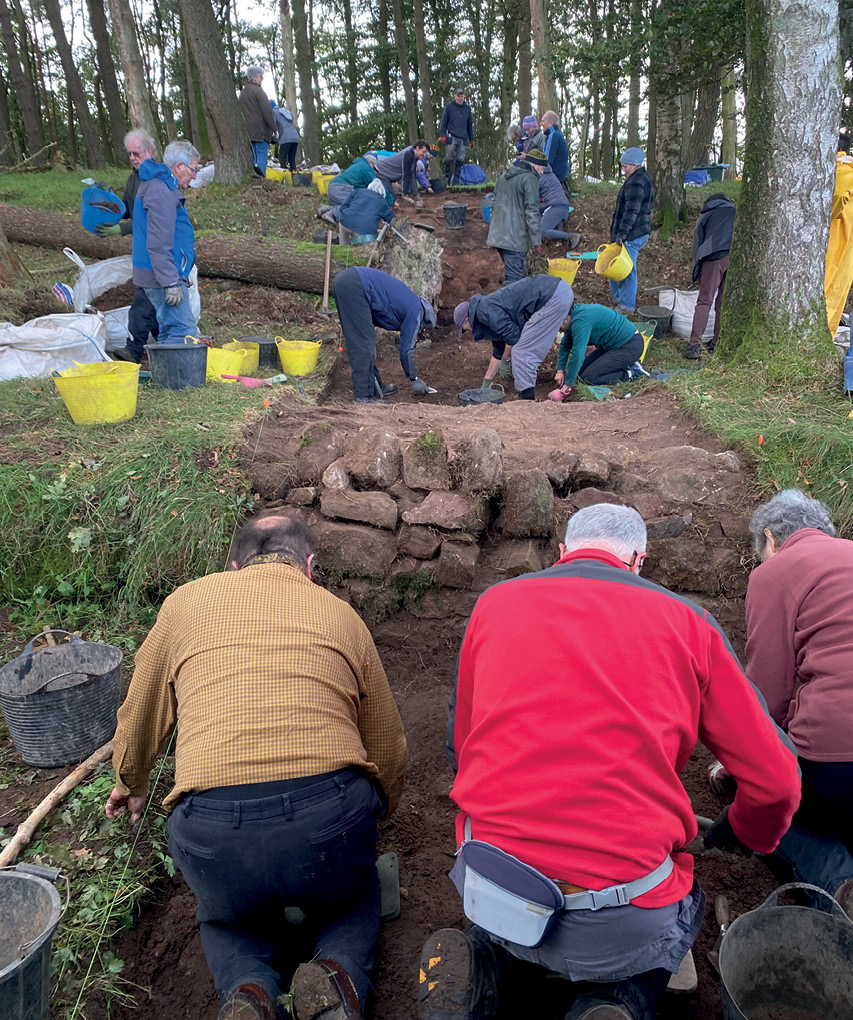
In 2021 and 2022, archaeological work along a headland near Felton in the Coquet Valley of Northumberland revealed evidence of early medieval activity, including a late 6th-/early 7th-century sunken-featured building (SFB), as well as evidence for the presence of the Viking Great Army (see CA 395). This past September, the team from the University of Oxford’s Institute of Archaeology and Department for Continuing Education, along with a group of volunteers, returned to the site to see if they could uncover more clues as to its use and chronology. The project is funded by the Leverhulme Trust.
The team opened eight new trenches in total, each targeting anomalies that had been identified through previous geophysical surveys, as well as areas of concentrated finds discovered through metal detecting and field-walking. The large SFB found in 2022 had contained a sizeable concentration of loom weights, suggesting that it may have been used specifically for weaving, and this year even more evidence was uncovered, confirming that this site saw considerable production of textiles.
In one trench, the team revealed the eastern half of a large post-built structure, with the exposed remains measuring an impressive 6m wide by 9m long. The full extent of the building is currently unknown, as the geophysical survey was unable to pick up its full footprint, but it clearly continued west of the trench. The half of the building that was excavated, though, appears to have been used largely for craft activity, including spinning and weaving, with the probable presence of at least two looms, as well as for cooking – a large stone-founded hearth, which had been closed at the end of its life with a large rotary quern, was found, and there were lots of animal bones nearby.

Another exciting discovery related to weaving was the stone base of a large external stone oven – found to the south-east of the post-built structure – which appears to have been used specifically for baking loom weights. It is believed this may be the first oven from the early Anglo-Saxon period to have been discovered that was used solely for this purpose. Three piles of baked loom weights were found next to the oven, as well as rake-out that included clay off-cuts from the process of making the weights.
In addition to the large amount of evidence suggesting this was an important site for spinning and weaving, metal-working also appears to have been prevalent. Previous seasons had uncovered a lot of slag and other by-products of smelting, but this year one of the trenches revealed the heavily burnt remains of a stone base for a smelting tower, which would have been used for extracting iron from local ore mined in the nearby hills.
As with previous seasons, all of these features appear to date from the late 6th/early 7th century, confirming that this site was a major production location during that period, and perhaps a central place for trade. Much less evidence has been found for the late 7th to late 9th century, but the site may have continued to be seen as an important location in the landscape given the evidence for the presence of the Viking Great Army in the late 9th century – based on small finds, including Viking gaming pieces and dress fittings. While field-walking and surveying has confirmed that the site does not stretch further east from where the current excavations have been centred, it is possible that more features may be found to the west, possibly at the very top of the headland. Digging has finished on the site for now, but post-excavation is just starting, and the team hope to return to the site sometime in the future to see if more clues to its use can be uncovered.
Text: Kathryn Krakowka / Photo: Jane Harrison