
Subscribe now for full access and no adverts
Archaeologists from Archaeology South-East, part of the UCL Institute of Archaeology, have uncovered remains from early medieval London during excavations in advance of the National Gallery’s redevelopment project.
The investigations were carried out along Jubilee Walk, the north of Trafalgar Square, in preparation for the construction of a new tunnel linking the National Gallery’s Sainsbury Wing with the Wilkins Building. This area was already known to have had a significant past, being part of Richard II’s Royal Mews (where he kept his hunting hawks), but the excavations revealed even earlier use of the site.
The Anglo-Saxon settlement of Lundenwic is believed to have been founded as a trading centre in the 7th century, with the main area of occupation located about 1km west of the walls of Roman Londinium, largely around what today are the Strand and Covent Garden. The Roman town was, however, resettled in the late 9th century after Alfred the Great retook London from the Vikings, and this area (now the City of London) eventually became the main focus of later medieval occupation.
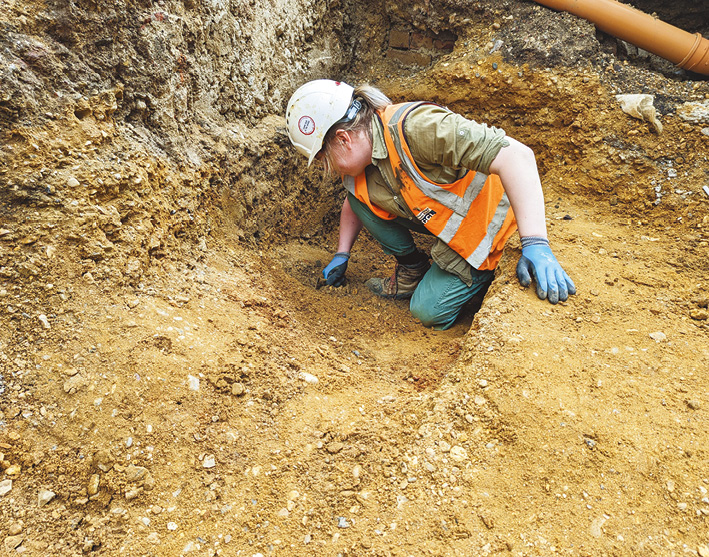
Over the last century, archaeological investigations have uncovered traces of the Anglo-Saxon settlement, and when Archaeology South-East began work on the National Gallery site last year, they hoped that they might also reveal evidence of the outskirts of Lundenwic. Previous discoveries, located just to the east, had hinted that Anglo-Saxon occupation might have extended this far west, but that suspicion remained unproven. The team were therefore excited when they uncovered evidence of a possible early medieval hearth, ditches, post-holes, stake-holes, and levelling deposits. It is thought that these might represent the reworking of fence lines and/or evolving property boundaries. Since the excavations last May, the hearth has been radiocarbon dated to AD 659-774, confirming that these features came from the earliest settling of Lundenwic and providing the first concrete evidence that the Saxon settlement extended this far.
In addition to the Anglo- Saxon finds, there was evidence of post-medieval activity, including 17th-/18th-century walls, which appear to have been rebuilt several times into the 19th century.
With the excavation now complete, plans for the National Gallery’s Bicentenary redevelopment, known as ‘NG200: Welcome’, are under way, with an initial phase to open later this year.
Text: Kathryn Krakowka