Subscribe now for full access and no adverts
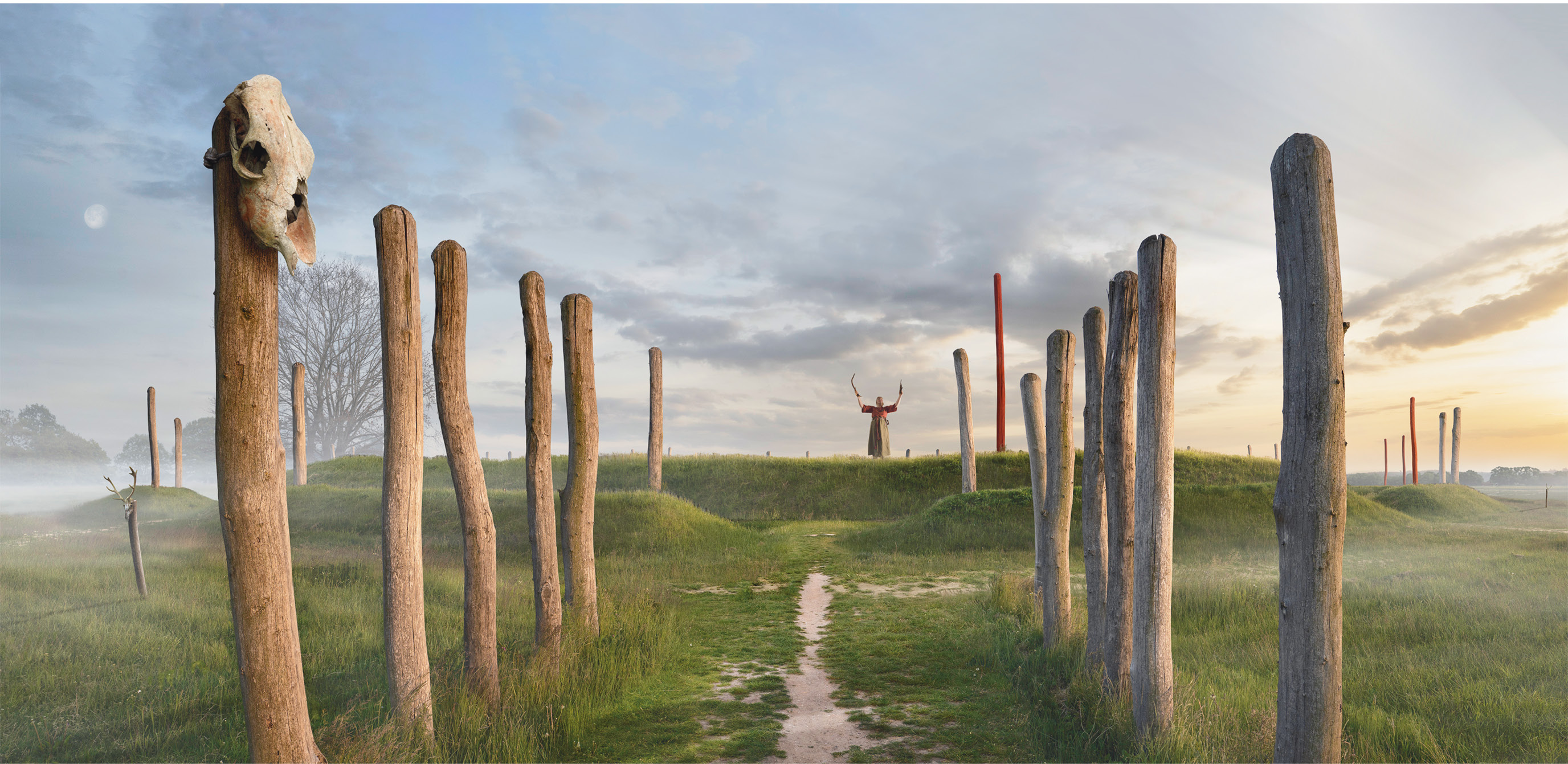
Over the past few years, large-scale excavations have been taking place in the hamlet of Medel, near Tiel in the Netherlands, in advance of the construction of a large business park. There, archaeologists uncovered a large Early Neolithic settlement and several Roman age cemeteries. The discovery of an Early Bronze Age sanctuary, burial site, and settlement, however, was unexpected. The findings from this site – which provide a snapshot of a ritualised landscape where the cycle of the sun, the living, and the ancestors were closely intertwined – were, appropriately, first presented to the public on the day of the summer solstice in 2023.
Living near the dead
The sanctuary site, which covers an area of 4ha, was inhabited as early as the Late Neolithic Bell Beaker period (c.2500-2000 BC), but settlement traces from that period have largely eroded. Better preserved are three farmsteads from the Early Bronze Age (2000-1800 BC), which were found near three burial mounds and a flat grave cemetery containing some 80 burials in total and a million, largely fragmented, finds. We suspect that a diffuse settlement pattern continued outside our view, comprising several dozen more farmsteads. Closest to the mounds, Farmstead 1 stood out as it had been rebuilt and contained a few hundred thousand finds.
The flat grave cemetery contained at least 20 individuals, most of whom were buried in a communal grave; these appear to be exclusively women. The oldest pit contained a toothless (female?) skull and a glass bead. Because of the age of the bead (c.2000 BC), we assume it originated from Mesopotamia, the only known production area at that time. This makes it the oldest glass found in a very wide region, and an exotic rarity at the time.

Burial Mounds 1 and 2 were built in the Early Bronze Age and are roughly the same size (20m). Each contains the remains of about 30 people, mostly children and juveniles. These mounds were in use for eight or nine centuries between 1950-1200/1100 BC. In the early phases, people were inhumed in crouched positions; later, they were mostly cremated. Strikingly, three human heads were also buried here. Mound 3 is a much smaller addition for a single burial containing a cremated older adult male, dating from the end of the Middle Bronze Age (c.1390-1059 BC). In this period, other cremations were buried in both of the other mounds as well.
A solar calendar
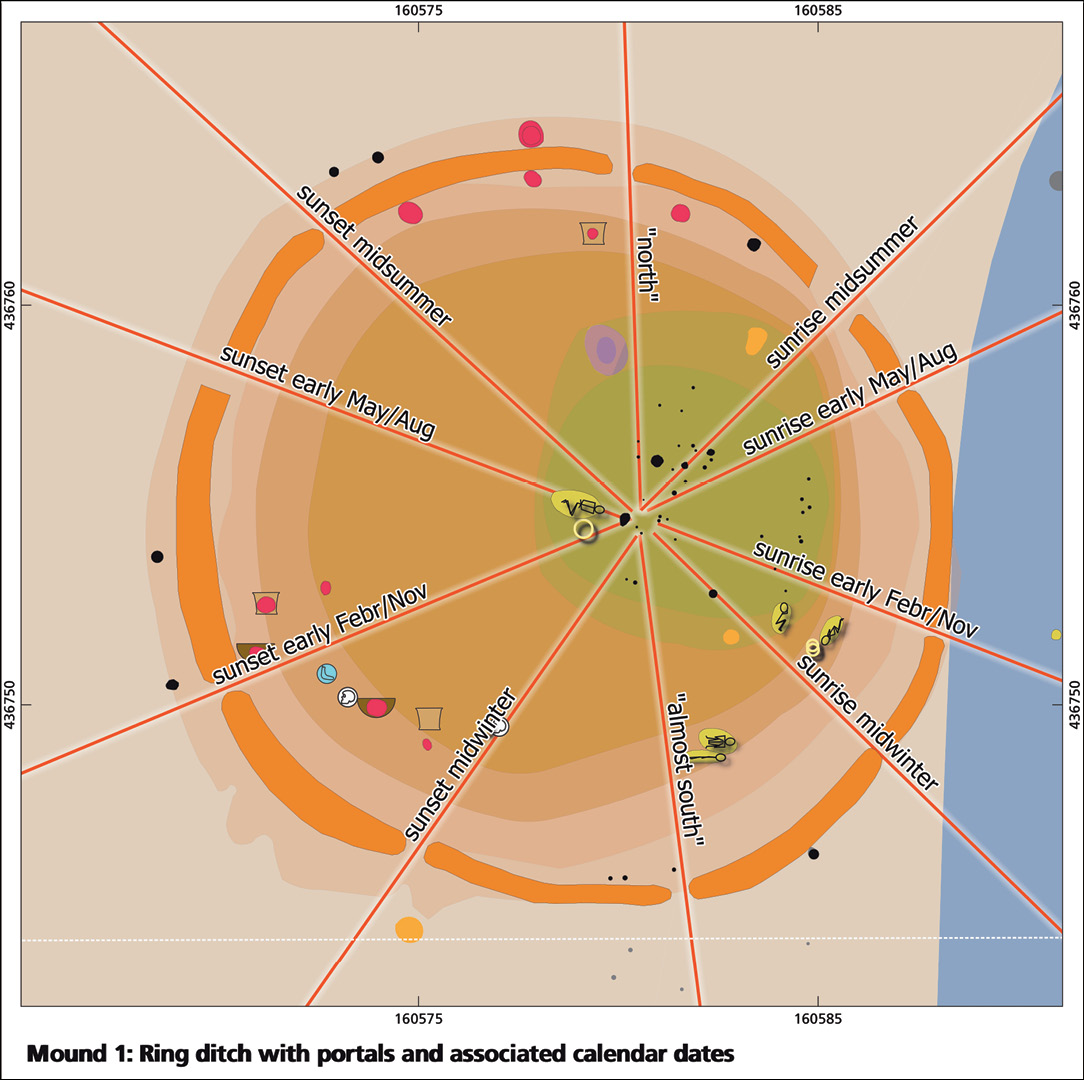
The central mound, Mound 1, displays some key differences. First, it was built in an excentric position on top of an older Bell Beaker grave or cult site. Second, it was surrounded by a segmented ring-ditch with ten small openings that was added around 1900 BC. Great excitement followed the discovery that these portals corresponded with the position of the sun rising and setting on specific days. The focal point for these positions was not the centre of the mound, but the presumed older Bell Beaker site on which it was built. The days marked are the summer and winter solstices and the cross-quarter days, which occur around early February/November and early May/August, in between solstices and equinoxes, thus dividing the year into eight parts. Besides these, two openings indicate approximately true north and south. Meanwhile, the mound group and the main building of Farmstead 1 nearby are perfectly aligned east–west, thus marking the spring and autumn equinoxes.
If we extend the lines of sight beyond the mounds, we see many more offerings, objects, and features that were related to solar events. These include bronzes, shaft-pits containing animal remains, fire-pits, and special tools related to early metalworking. Some of these pits contained primitive wooden stairs, and were possibly used as ritual pools. Remarkably, the ‘near south’ portal lines up exactly with the oldest skull-pit in the flat grave cemetery, containing the exotic glass bead. The ‘near north’ portal lines up with a shaft-pit containing bone jewellery, and another to an offering-pit containing a large sharpening stone on a former Bell Beaker site.
If we apply the principles of these solar directions to the other burial mounds, we find a similar pattern of objects, offerings, and features. For instance, in Mound 3, the line marking sunrise during the summer solstice leads to a bronze arrowhead; winter solstice to a bronze spearhead; and early February/November to a pit containing two cattle skulls.
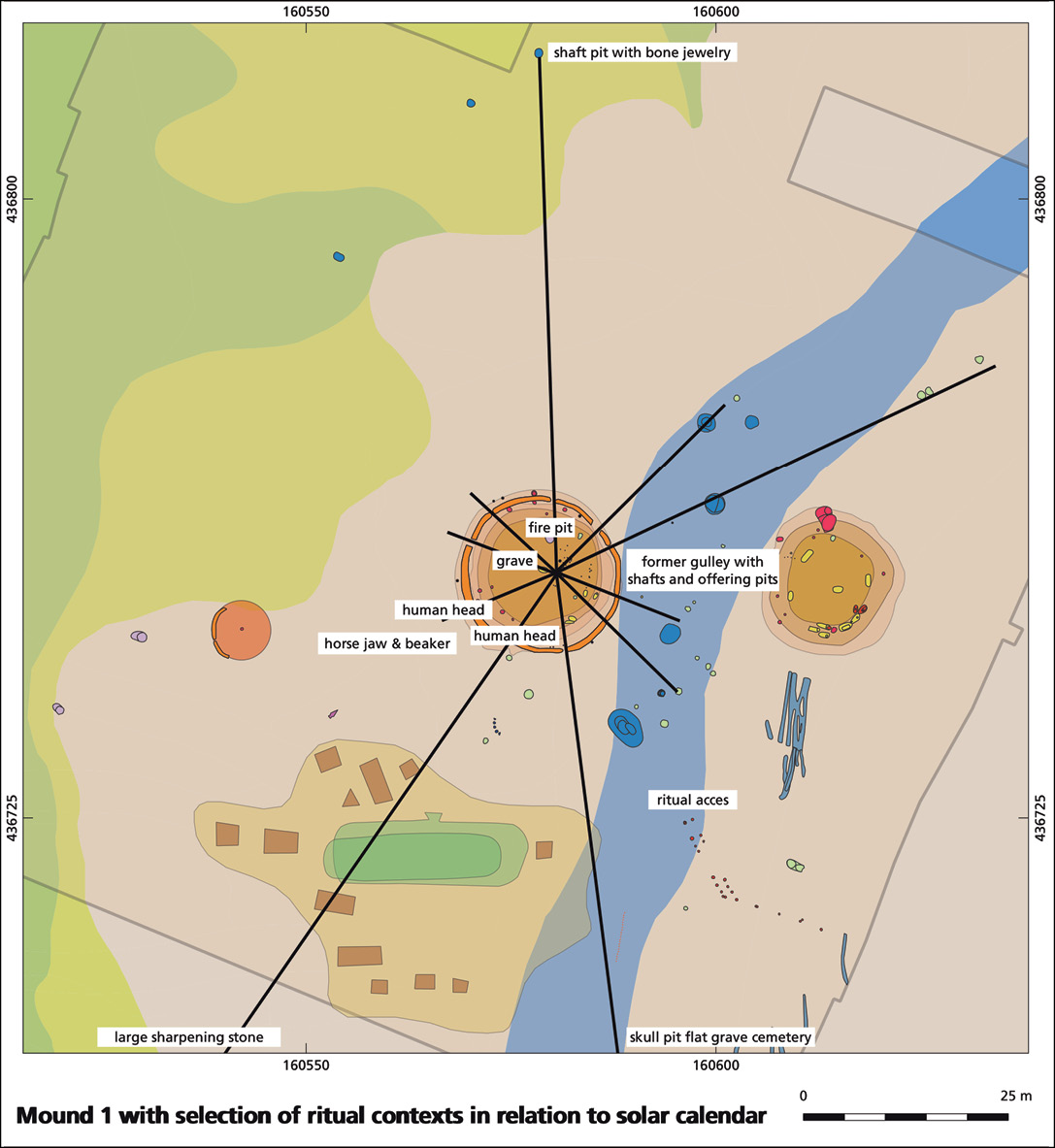
Inside the mounds, the positions of the early burials follow the funerary practices that we know from the Bell Beaker period. These are sex-determined and can also be linked to solar positions. Furthermore, the human heads and other offerings are buried on the lines of sight that correspond to the solar calendar.
What does it mean?
The sanctuary in Tiel could be seen as a simple astronomical observatory built by a farming community to help pinpoint the changing of seasons and/or as a correction to a calendar based on lunar cycles. Beyond this, the solar principles behind these patterns reflect, we think, a cosmological belief system in which the daily and annual cycles of the sun (and probably moon and star constellations as well) were synonymous with the cycle of life and death and rebirth that could be observed in nature. In this fertility cycle, an everlasting balance had to be maintained by integrating powerful ancestors in the surrounding landscape and performing proper (burial) rites and offerings. These beliefs were rooted in the Late Neolithic and maintained for almost a millennium in Tiel-Medel. As in all religions, partying and (ritual) celebrations must have been an integral part of life. We think that the dates marked in the observatory were celebrated, too. These feasts could be similar to examples we know from later Romano-Celtic and Christian traditions, which mostly centre around fertility, harvest, fires, light, and death.
Tiel-Medel fits into a group of open-air sanctuaries with henge-like characteristics that are being found more and more in continental Europe. However, this site is the first of its kind to be found in the Low Countries. Though rather small, it is unique in the completeness of its annual calendar, its enormous time-depth, and in the spatial relationship it appears to have to offerings, pits, and other burial grounds at great distances, reaching out to make the wider landscape a sanctuary of its own.
Text: Cristian van der Linde (BAAC, c.vanderlinde@baac.nl) / Images: Alexander van de Bunt; BAAC