
Subscribe now for full access and no adverts
More than a hundred letters that were sent to imprisoned French sailors during the Seven Years War have been opened for the first time.
The messages were seized by the British Royal Navy during the conflict, which took place between 1756 and 1763. They were unearthed only recently by Professor Renaud Morieux of Cambridge University.
The Seven Years War was a bitter contest between France and Britain, and their respective allies, for global dominance. One of the British tactics in the war was to impede the French navy by capturing as many of their sailors as possible.
In 1758 alone, a third of all French sailors were detained, with more than 64,000 imprisoned during the course of the conflict.
Many of these men died from disease and malnutrition, while others were later released. Their families attempted to communicate through letters – but sending correspondence to a ship, which moved regularly between ports, was immensely difficult in wartime.
Most of the letters unearthed by Professor Morieux were intended to reach the Galatée, a French ship captured by the British in 1758 while sailing to Quebec.
When the French postal service heard of the Galatée’s capture, they forwarded the letters to England, where they were handed to the Admiralty.
Morieux believes a handful of the letters were opened to establish if they had military value. But as they were mostly personal messages – reflecting the pain and torment of sailors’ wives and families – they were put in storage and never reached their intended recipients.
‘I could spend the night writing to you… I am your forever faithful wife. Good night, my dear friend.’ So wrote Marie Dubosc to her husband Louis Chambrelan, first lieutenant of the Galatée, in 1758.
Chambrelan never received the letter and would not see Marie again: according to Morieux’s research, she died the following year in Le Havre.
‘I cannot wait to possess you,’ wrote Anne Le Cerf to her husband, Jean Topsent, a non-commissioned officer on the Galatée, signing the letter with a personal nickname, ‘Nanette’. As with Louis Chambrelan, Topsent never received the message.
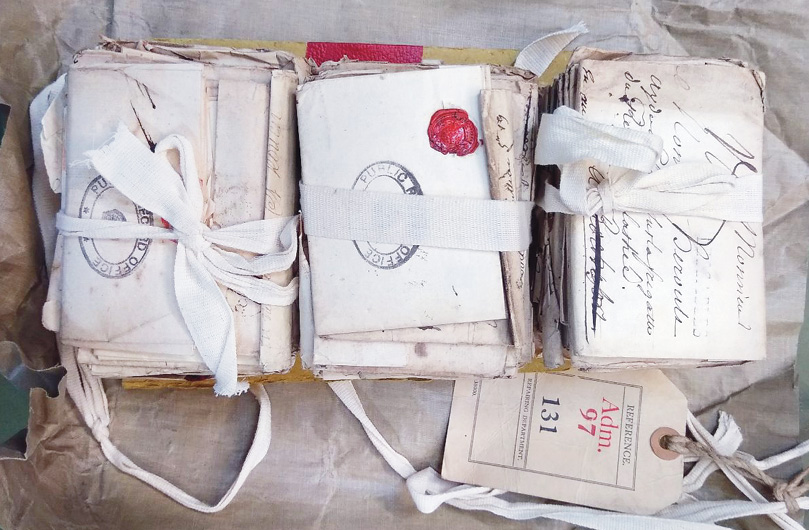
Morieux spent months decoding the letters, characterised by poor spelling and little punctuation, which he discovered largely by accident.
‘I only ordered the box out of curiosity,’ he explained. ‘There were three piles of letters held together by ribbon. The letters were very small and were sealed, so I asked the archivist if they could be opened, and he did.’
Morieux added, ‘I realised I was the first person to read these very personal messages since they were written. Their intended recipients didn’t get that chance. It was very emotional.’
He has published his findings in the journal Annales. Histoire, Sciences Sociales. The letters themselves are held by the National Archives in Kew, London.