Subscribe now for full access and no adverts
The end of the New Kingdom marked profound changes in the history of ancient Egypt, changes that affected both the political and cultural landscape. There followed some 400 years of politically divided rule and diffused power, a time-frame known as the Third Intermediate Period (c.1069-747 BC). Control was split between the kings of the Twenty-first Dynasty ruling from Tanis in the Delta, and the Amun priesthood at Thebes whose power had been increasing throughout much of the New Kingdom.
During the New Kingdom, the kings of Egypt were buried at Thebes, but until the 1930s and 1940s, little was known about the burial places of the subsequent kings of the Twenty-first and Twenty-second Dynasties, although these were assumed to be at Tanis. Excavations have been ongoing at this site since the mid-1800s, with celebrated Egyptologists such as Auguste Mariette working there from 1860 to 1864 and Flinders Petrie from 1883 to 1886. However, it was a little-known French Egyptologist, Pierre Montet, who finally discovered the burial places of these rulers and unearthed some magnificent finds that have contributed to our understanding of the Third Intermediate Period.

Pierre Montet at Tanis
In the early 20th century, Montet had excavated at a number of archaeological sites, including Abu Roash and Byblos, before being commissioned in 1928 to dig at San el-Hagar (Tanis) in the Delta. Montet then went on to excavate at Tanis every season until the 1950s, although he was forced to stop work between 1940 and 1944 due to the outbreak of the Second World War.
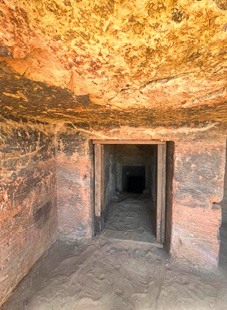
In 1939 (his 11th season at the site), while working in the south-west corner of the Temple of Amun at Tanis, Montet made the discovery of a lifetime. After clearing the remains of several mud-brick Ptolemaic workshops and artists’ studios, he uncovered a limestone structure. He removed what appeared to be paving stones, and underneath found a pit that led into a hitherto unknown tomb. This entrance had previously been used as a means of access by grave robbers, who had plundered the tomb in antiquity. The importance of the tomb soon became apparent, as the walls were decorated with painted reliefs from the Book of the Dead and the Book of the Night, and a number of quality grave goods were found scattered around.

The tomb, NRT-I (Nécropole Royale de Tanis), was found to consist of four separate chambers. Located in the largest of these was the huge granite sarcophagus of Osorkon II (c.874-850 BC), a king of the Twenty-second Dynasty. Within his sarcophagus were found canopic jars and funerary statuettes, and behind it lay a further smaller sarcophagus inscribed for one of his sons, Prince Hornakht.

In another of the chambers, Montet discovered the looted burial of Takelot I (c.889-874 BC). Takelot I was the successor of Osorkon I and father of Osorkon II. (This is an extremely confusing period, with different sources providing different successions. Some lists show Osorkon I succeeded by Sheshonq II [c.890 BC], but it is now thought Sheshonq II was appointed co-regent with Osorkon I, but died shortly after, so he did not rule as a sole king.) In the final chamber, Montet found a large uninscribed sarcophagus.
Silver coffin of Sheshonq IIa
A month later, continuing excavation work in the same area of the Temple of Amun revealed a further burial complex, NRT-III. The entrance chamber, although disturbed in antiquity, still contained a large array of burial equipment. On seeing this, Montet declared: ‘this day is a day of marvels worthy of a thousand and one nights’. To one side of the main chamber, lying on a stone base, was a falcon-headed silver coffin, inscribed for a hitherto unknown king: Sheshonq IIa (c.887-885 BC). The use of the falcon-head of Horus instead of the king’s own is extremely rare and something that only occurs on the coffins and mummy boards of pharaohs of the early Twenty-second Dynasty. Another unusual find alongside the coffin was a group of four small silver coffinettes, each one approximately 25cm in length and containing the mummified internal organs of Sheshonq IIa. The coffinettes displayed the head of the king instead of the heads of the Four Sons of Horus usually found on canopic jars.


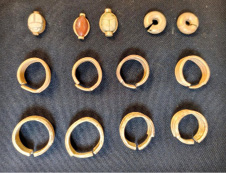
Within the coffin, Montet found the badly decomposed body of the king. Climatic conditions in the Delta (far more humid than Upper Egypt) are not conducive to the preservation of mummies or any of the funerary objects constructed from perishable materials. A solid gold funerary mask was found on the remains of the mummy, together with necklaces, pectorals, earrings, bracelets, and rings. The fingers and toes were covered with gold caps, and a pair of gold sandals were on the mummy’s feet. The coffin of Sheshonq IIa was flanked by two other poorly preserved mummies which, based on inscriptions found on nearby shabti figures, were identified as those of Siamun (c.978-959 BC) and Psusennes II (c.959-945 BC), the final two rulers of the Twenty-first Dynasty.

War in Europe
Montet went on to spend the remainder of the 1939 season clearing, cataloguing, and removing the artefacts from the tomb before returning to France. The onset of war in Europe in 1939 inevitably lessened the impact of these impressive finds on the world of Egyptology, and, although hostilities had commenced, Montet was able to return to the site in early 1940.
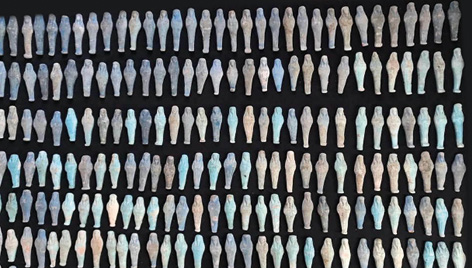
The first task he set himself was to remove further stones from Osorkon II’s vault in NRT-I in order to give better access to the damaged sarcophagus of Hornakht. He found that grave robbers had only been able to penetrate one end of the sarcophagus because a large stone block had collapsed on top of the lid. So, although the robbers had removed some of the grave goods, other objects including an attractive assortment of small figurines were left behind.

Continuing investigations revealed another tomb: NRT-IV, a free-standing structure close to NRT-I. This was found to contain an impressive, although empty, quartzite sarcophagus belonging to the Twenty-first dynasty king Amenemope (c.993-984 BC), the successor of Psusennes I. The king’s body was found elsewhere (see below), while the remainder of the tomb was found to have been plundered and was devoid of any grave goods.


Burial place of Psusennes I
Montet then turned his attention back to NRT-III and discovered, in its decorated western wall, a semi-concealed entrance obstructed by a huge piece of granite. With some difficulty, this granite block was moved using the original small bronze rollers that had been placed under it at the time of the tomb’s closure. Montet entered the tomb and saw what no Egyptologist had ever seen before: the first fully intact royal tomb of Egypt, completely undisturbed since it was sealed in the Twenty-second Dynasty some 3,000 years previously. Even the Tomb of Tutankhamun, despite the fabulous treasures it contained, had suffered at least two intrusions in antiquity.

In the main chamber of the tomb stood a pink granite sarcophagus surrounded by canopic jars, shabti figures, and gold and silver vessels. The tomb was the original burial place of Psusennes I (c.1039-991 BC), the third ruler of the Twenty-first Dynasty. The sarcophagus was found to have been usurped from the burial of the Nineteenth Dynasty pharaoh Merenptah (c.1213-1203 BC), who had been interred in the Valley of the Kings some 200 years previously. Lying within the sarcophagus was a further mummiform sarcophagus, fashioned from black granite. Inside was a silver anthropoid coffin containing the mummy of Psusennes I. Resting on the remains of the body was a magnificent gold mask, extending to the chest, together with further adornments including gold bracelets, earrings, and various rings.
Adjacent to the burial of Psusennes I, a decorated wall blocked the entrance to another room, the resting place of Amenemope (c.993-984 BC). Amenemope had been buried in a granite sarcophagus originally constructed for Queen Mutnodjmet, Great Royal Wife of her brother Psusennes I. The sarcophagus contained the remnants of a gilded wooden coffin, surrounding the mummy of Amenemope. Although the mummy was again in poor condition, there was an impressive fine gold mask and items of jewellery present on the body.

All these artefacts were transferred to the Egyptian Museum in Cairo, and, due to the continuing conflict of the Second World War, the excavation was closed and sealed. During the remainder of the war, the site was guarded, although thieves did enter the tombs looking for any remaining valuables. In 1943, there was a theft of Psusennes’ jewels from a safe in the basement of the Cairo Museum, and, although many of the stolen pieces were later recovered, a few small objects are still missing.
A faithful official
Towards the end of the war in 1945, excavations resumed in NRT-III, and initial investigations led to the discovery of an empty burial chamber belonging to a son of Psusennes, Ankhefenmut. Then one final undisturbed tomb was uncovered. The burial, which had been obscured within the stonework of NRT-III, belonged to General Wendjebauendjed, ‘the one who endures and is stable’, who was a high official at the court at Tanis. General Wendjebauendjed held administrative, military, and religious titles, and had been granted a richly appointed burial, a demonstration of his high standing with the king. He was also buried in a reused granite anthropoid sarcophagus, and on the remains of his mummy was an impressive gold sheet funerary mask, with inlaid eyes of coloured glass paste. The mask had been fashioned to a very high standard, which, similar to the other masks, demonstrated the exceptional skill of the Tanite craftsmen in their working of sheet gold.

Various precious metal vessels formed part of the grave goods as well, with the most celebrated being a broad shallow patera – a dish used for pouring libations. In the centre of the patera was a decorative motif inlaid with coloured glass paste, surrounded by a large gold disc that was attractively decorated with girls swimming in a pool.
Montet continued to work at the site and went on to discover two further tombs: NRT-V, a separate tomb, contained two empty sarcophagi inscribed for Sheshonq IV (c.798-785 BC) and Sheshonq V (c.767-730 BC), two later kings of the Twenty-second Dynasty; and NRT-II, in which was found a sarcophagus and fragments of coffins and canopic jars. NRT-II was considered to be the burial site of Pimay (c.773-767 BC), a late Twenty-second Dynasty ruler.
Although no other royal tombs were subsequently found, Montet made some further important discoveries, including the remains of temples dedicated to Horus and Khonsu, and he was able to establish the location of a sacred lake. Since that time, work has continued at Tanis through new generations of excavators under the aegis of the Société Française des Fouilles de Tanis.

Tanis and not Pi-Ramesses
As early as the 1860s, when Mariette was excavating at Tanis, he noticed that many of the inscribed monuments carried the name of Ramesses II. This led him to believe he had discovered the site of Pi-Ramesses, the Delta capital of the Ramessides. This suggestion was later accepted by Flinders Petrie, but not by Alan Gardiner, who had doubts having examined the relevant textual evidence. However, during his extensive excavations at Tanis, Montet unearthed many monuments from the Ramesside period, and he was convinced that the site was that of Pi-Ramesses.

Above & below: Golden jewellery found in the Tomb of Psusennes I included bracelets and pectorals of exquisite workmanship. Images: Aidan McRae Thomson, CC BY 2.0 (above)/ Harley Katz, CC BY 2.0 via Wikicommons (below)

It was only in 1954, when further evidence emerged, that Labib Habachi was able to assert that Qantir was the site of Pi-Ramesses and not Tanis. Manfred Bietek’s excavations at Tell el-Dab’a finally proved this to be the case, and Pi-Ramesses is now accepted as being located at Qantir, some 20 kilometres south of Tanis. The ancient Egyptians routinely reused building materials, and the Delta’s lack of natural stone meant the ancient builders transported stone from Pi-Ramesses to be used at the site of Tanis. Many of these transferred architectural elements bore the inscriptions of Ramesses II.
The importance of the Tanis treasures
Montet’s excavations at Tanis expanded our knowledge of the Third Intermediate Period. The inscriptions, particularly on the gold vessels, allowed the genealogy of the kings of the Twenty-first Dynasty to be determined. Further information about the families and relationships between the Tanite rulers and the high priests of Amun at Thebes was established, and the burials made a significant contribution to our understanding of the burial practices of the Third Intermediate Period kings.

Above & below: The gold mummy mask and head from the gilded wooden coffin of Amenemope. Images: KH (above)/ CN (below)

Unfortunately, some of the burials were emptied with haste due to the impending outbreak of the Second World War, and so some of their context was lost. Nevertheless, seven tombs of the rulers of the Twenty- first and Twenty-second Dynasties were found at Tanis, three of them completely undisturbed. Amazingly, even though this discovery was an extremely important archaeological milestone, it would go largely unnoticed for decades to come. During wartime, there were obviously far more pressing priorities, and details of the excavation and finds were only published in French some time after the war ended.


The splendour of the Tanis masterpieces inspires comparison with the magnificence of the Tutankhamun collection. Although a special section was created to display the collection in the Egyptian Museum in Tahrir Square, Cairo, it is still not well known to the general public. In terms of their technical and sculptural features, many of the finds are comparable to those of Tutankhamun. However, although the treasures from Tutankhamun’s tomb are world renowned, the tomb had been robbed at least twice in antiquity. Not a single intact royal tomb had been found in ancient Egypt until Montet’s discovery of the tombs at Tanis. He was later to describe the finds as: ‘One of the most beautiful collections that antiquity bequeathed us. It would have had the first place in ancient Egypt if the tomb of Tutankhamun did not exist’.


Roger Forshaw is an honorary lecturer in Biomedical Egyptology at the University of Manchester and a former dental surgeon. He studied Egyptology at the University of Exeter and later obtained his MSc and PhD at the University of Manchester. He has published on the Saite Period, the role of the lector in ancient Egyptian society, and medical and dental care in ancient Egypt. His latest publication, which he co-wrote with Roslie David, is Medicine and Healing Practices in Ancient Egypt.

Further reading:
• H Coutts (ed.) (1988) Gold of the Pharaohs: Catalogue of the Exhibition of Treasures from Tanis (Edinburgh: City of Edinburgh Museum and Art Galleries).
• A Dodson (2012) Afterglow of Empire (Cairo and New York: The American University in Cairo Press), pp.39-81.
• C Naunton (2018) Searching for the Lost Tombs of Egypt (London: Thames & Hudson), pp.165-176.

You must be logged in to post a comment.