The changing faces of Easter Island: Revealing the secrets of shape-shifting figurines

Start
This article is from World Archaeology issue 134


Subscribe now for full access and no adverts

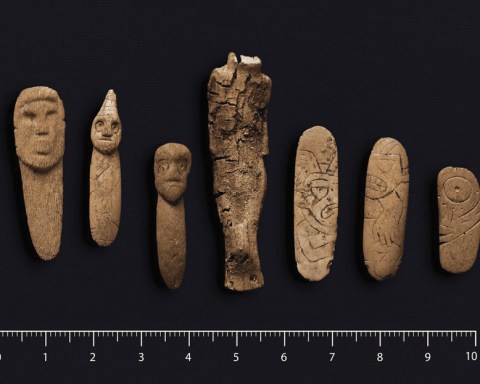
The ancient Rapanui (Easter Islanders) excelled in different forms of artistic expression, producing about a thousand monumental stone statues and numerous wooden figurines. Almost 400 of the latter, known from museums and private collections worldwide, are old: they left the island before 1880, which marks the beginning of the commercial carving era.

In the 20th century, Rapanui stone- and woodcarvings made a large impact on modern art, inspiring the Surrealists. Now the recent reassessment of woodcarving techniques has brought a well-deserved esteem and artistic appreciation to the ancient Rapanui figurines. Produced using basic tools such as obsidian blades for carving and shark skin/fine sand/cowrie shells for polishing, these figurines feature an exceptional level of detail and very fine surface finishing. Their eyes have a lively glint of obsidian pupils, embedded into white bone rings for contrast.

Ahu Tongariki: the largest ceremonial platform on Easter Island, with  15 stone statues. Today, it is these sculptures that the Rapanui are best known for, but their woodcarvings have also been highly influential. Image: Paul Horley (Ahu Tongariki)

The aesthetic canon of Rapanui carvings were unfamiliar to the European crews who collected these objects; travelogues and early publications frequently complain about the shortness of figurines’ legs and their grimacing faces. Upon eventual compilation of ampler data about the old culture, these unusual shapes became easier to interpret. Analysis of a bird-man figurine from the Peter the Great Museum of Anthropology and Ethnography (St. Petersburg), collected during the Second Expedition of Captain James Cook, revealed a human nose and mouth carved on top of a bird’s beak. This meant that, when viewed from above, the bird head transformed into a human head. The mixture of human and bird characteristics in bird-man statuettes may be interpreted as a way to depict different transformation stages of a certain entity, or different avatars of the same entity.
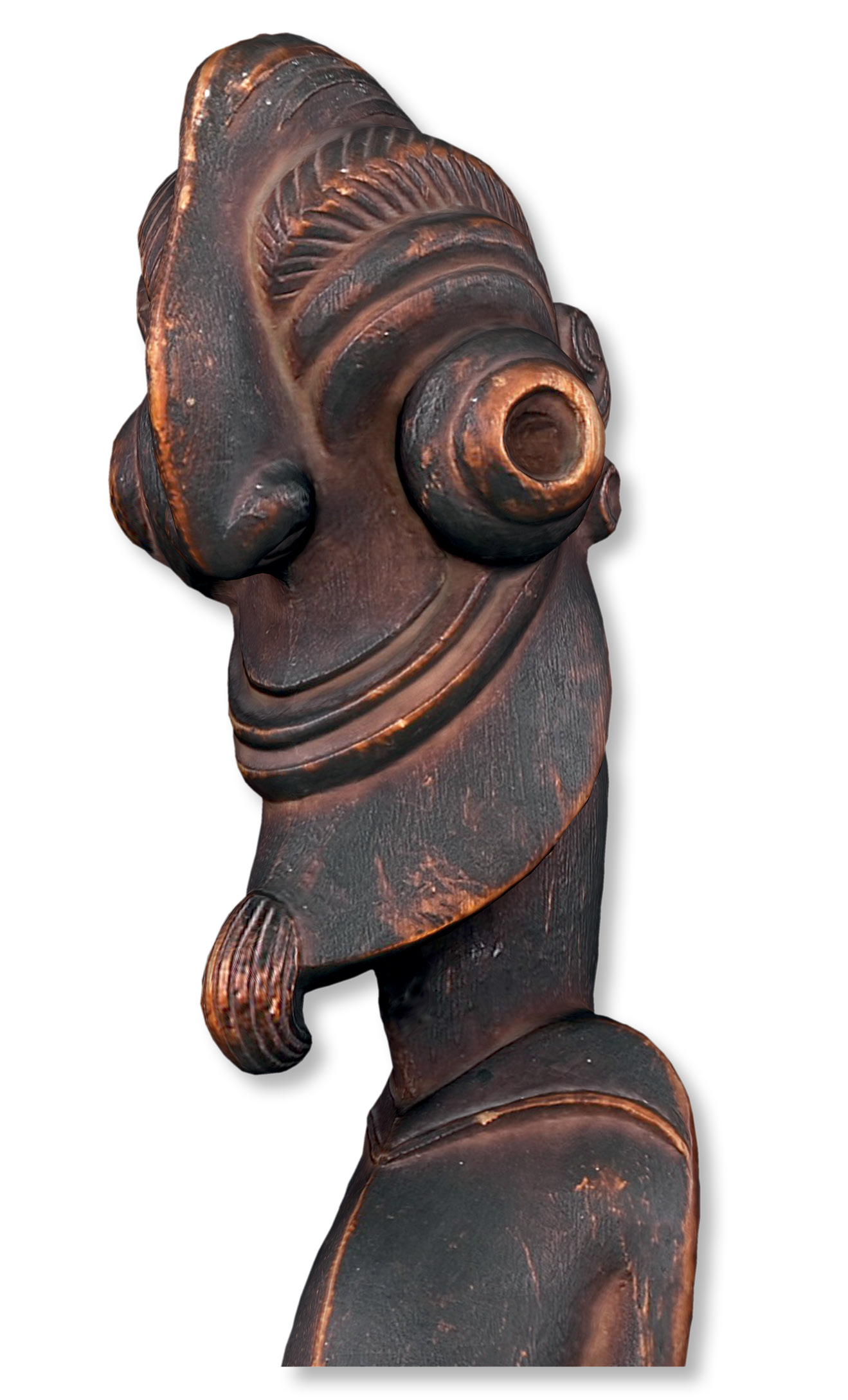
Careful study of a selection of wooden figurines from Easter Island has revealed that they can present two very different countenances to viewers, depending on the angle they are viewed from. This striking example of a figurine is from the collection of Sir David Attenborough, and was probably brought back from Easter Island by a member of the crew on Captain James Cook’s expedition of 1774. 

Our study of the St. Petersburg bird-man is based on a 3D model of the painted plaster cast from the Ethnologisches Museum der Staatlichen Museen zu Berlin. It turned out that the human face carved on the beak of this bird-man can be best viewed not by looking down from directly above the top of the figurine, but by slightly tilting it backwards. In this case, the lips flatten into a realistic smile, and the overall proportions of the human face are properly balanced. The slight sideways tilt of the figurine’s head adds an extra emotion to the image of a bearded old man, who seems to be returning an inquisitive glance straight into the eyes of the beholder.

This figurine, together with two others, was previously discussed by Thor Heyerdahl in his 1976 book The Art of Easter Island. Notably, all three depict bird-men, and, according to Heyerdahl, they allow a bird head to be turned into a human face. As the bird-man motif is a composite of human and bird elements, this transformation may seem to be almost trivial. But are there perhaps more multi-face Rapanui figurines that do not belong to the bird-man category?
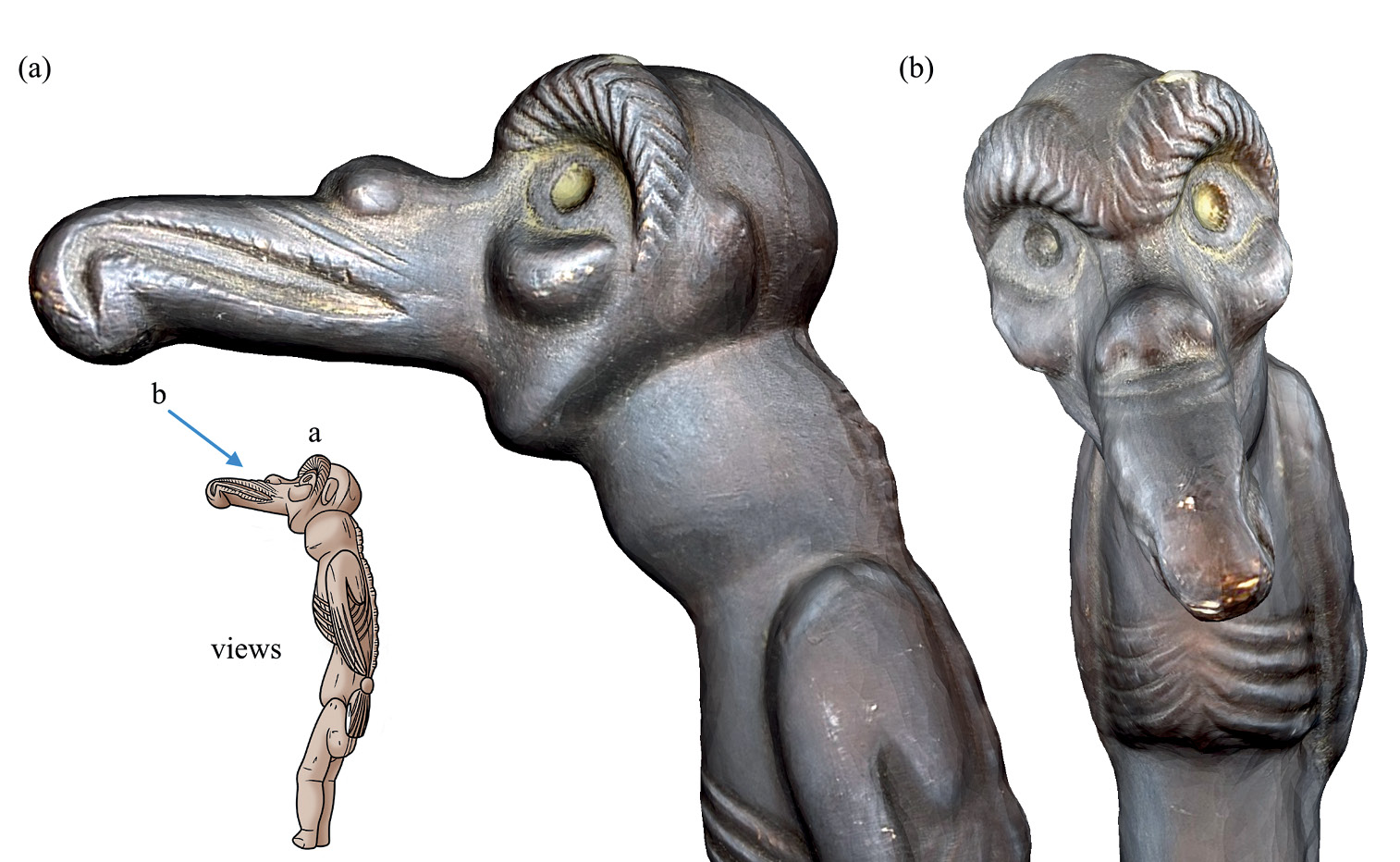
These views show the bird profile (a)  and bearded man face (b) of the St. Petersburg  bird man figurine. Image: The renderings are from the 3D model, cast VI 20209, at the Ethnologisches Museum der Staatlichen Museen zu Berlin

Two-faced figurines

The difficulty of finding such figurines is exacerbated by our limited knowledge of the ancient artistic canon: we do not know the correct way of looking at these objects, and we are quite unsure which type of views should be searched for. Technically, every figurine can be rotated, allowing it to be studied from all directions, until some interesting and unusual image pops up. This task was greatly simplified with the recent advent of computer-assisted photogrammetry, making it possible to construct a 3D model of an object from a set of digital images; the resulting model can then be studied from any angle.

Views of the Lübeck figurine, showing  a profile (a) with the unusual shape of its mouth; calm (b) and crying faces (c) are visible from different viewing directions. Image: Renderings of the 3D model produced for figurine 3778b, Sammlung Kulturen der Welt, Lübeck

We made a surprising observation during the examination of the 3D model documenting the upper torso of a slender figurine that entered the Sammlung Kulturen der Welt, a museum in Lübeck, in 1883. The face of this carving is most unusual, with a wide multi-step ridge encircling its bottom part. The purpose of the unusual ridge becomes apparent only when one looks at the face of the Lübeck figurine from the front, tilting the figurine backwards – in an instant, its face transforms into a grimace, as if the depicted man starts screaming: his thick lips bend downwards, his eyes roll up, and the eyebrows soar high!

By discovering this second face, one also finds the intended principal face: the figurine should also be viewed from the front, but slightly inclined towards the spectator. In this configuration, the thick outline around the mandible disappears from view, except for its upper part, which forms the tightly closed lips of a man’s face, who seems self-confident and partially smiling. Thus, by tilting the figurine front-and-back, its face switches between these two facial expressions. Perhaps this carving was a child’s toy; when its face changed to the crying one, it is easy to imagine that the player/operator shrieked to emphasise the visual effect.

Why did the second face of the Lübeck figurine go unnoticed for 140 years? This object is fairly well-known, a number of photographs of it have been published, and the figurine itself has been displayed at several exhibitions. Although its face design was always considered unusual, no dedicated study was undertaken to discover why this was so.

The extraordinary artistic skills of Rapanui woodcarvers are apparent in anthropomorphic (top & above) and zoomorphic (below) figurines collected from Easter Island in the 19th century. Although they are delicately carved, they do not feature any concealed faces. Images: Figurines 1880.1604 (top) and 1880.1603 (below), National Museum of Ireland, Dublin; Figurine C.149.1927 (above), © National Museums NI, Ulster Museum Collection, Belfast

Surprising as it may sound, this situation is probably because… the ancient Rapanui carvers were very familiar with human visual cognition and psychology! What is the common way of appreciating a portable sculpture? Most likely, the beholder will hold it in the hand, reasonably close to the body; it is not usual to study a hand-held object at full-arm stretch. What would such a person see? Certainly, the top view of the figurine’s head. Rapanui artists used this point to the best possible advantage, adorning figurine heads with elaborate glyphs. In Polynesia, the head was the place where the sacred power (mana) of a person is concentrated, meaning that, by carving exaggeratedly large heads, Rapanui artists provided their figurines with a larger mana-storing capacity.

The profile view of the face – and that of the body in general – was also considered important. For example, Polynesian artists will accentuate the backbone (a symbolic link with their ancestors) and the belly (a traditional seat of sacred knowledge). All these parts of the carving will certainly be studied in detail. But who will pay attention to the raking-angle bottom view of the face? If one maps this viewing direction to a person in a supine position, the beholder should sit at the person’s feet and look up towards the face: this is a very unusual viewing direction indeed! Thus, when being offered a carving with some special shape seen only from this direction, the people who commissioned the figurine – and by extension, all its later owners – may remain completely unaware of its ‘hidden’ shapes, unless they were explicitly shown to them by the artist or a person already knowing about the existence of such particular design elements.

After such a stimulating experience with the Lübeck figurine, it was natural to look for more Rapanui carvings that may possess similar shape-shifting abilities.

 Here we see the smiling face (a)  and the emphasised happy face (b) of an extraordinary ribbed figurine with large round eyes, which was probably collected in 1774. Image: Renderings of the 3D model, figurine in the collection of Sir David Attenborough, London

The unique figurine in the collection of Sir David Attenborough has a very special history: it is likely to have left the island with the crew of HMS Resolution, one of the ships participating in Captain James Cook’s second round-the-world expedition. HMS Resolution visited Easter Island in 1774, more than two and a half centuries ago. This elegant and very skilfully carved figurine, presented in the almost-a-detective documentary The Lost Gods of Easter Island, is justly famous for its unusual facial features. Its round and protruding eyes are encircled by two elegant bands, which arch below the carefully carved eyebrows, pass behind the eyes, and finally transform into the figurine’s lips, which bend in an ample smile. We are extremely grateful to Sir David Attenborough for his most kind and generous permission to document this unusual figurine. The resulting 3D model, to our great delight, revealed the second face when the viewing procedure learned from the two previously described figurines was followed. The second face of Sir David’s figurine depicts a happy man with ‘smiling’ arched eyes placed right under the dense eyebrows, and a wide grin set between protruding cheeks that are formed by the round eyes of the main face.

Views of the lizard-man figurine, showing a plain-looking human head (a), the existence of which is hinted at by the profile view (b) with ears set horizontally under the eyes; the inclined figurine produces a grimacing face (c) with a mouth full of teeth. Image: Renderings of the 3D model produced for figurine GLL 17234, collection L

Two faces can also be found on a fourth figurine, in the form of a lizard-man, which is called a moai tangata moko in Rapanui language. This object is in a private collection. In this case, the presence of the mouth full of teeth is very notable; it is the only lizard figurine with this feature among all the surviving moai tangata moko. The mouth of the lizard is surrounded with a wide multi-step ridge. Two delicately carved ears with elongated earlobes are set horizontally under the bulging eyes, suggesting that the proper eye–ear alignment is achieved when this figurine is viewed face on from above. By doing so, one discovers that the bared teeth become invisible, while the wide band encircling the mouth transforms into tightly shut lips. Remarkably, the series of grooves running in parallel above the eyebrows, when seen from this perspective, recall the hair design featured on Rapanui long clubs, the symbols of chiefly authority, strengthening the impression that the head of the figurine is that of a human, and that it is depicted in full, up to the crown of the head. Although the figurine’s eyes are round and bulging, they look rather normal in this view; the symmetry of the face, complete with lips curved in a delicate smile, produce a calm facial expression. Dramatic change occurs when the figurine is tilted backwards – its face transforms into that of a grimacing monster: the eyes roll up wildly and the wide mouth bares a full battery of teeth.

A Rapanui long club featuring a human head. Note the eye inlays and stylised hair. Image: Club VI 24940, Ethnologisches Museum der Staatlichen Museen zu Berlin

Expressions of interest

The four figurines discussed above (about 1% of the total ancient woodcarving corpus) may not be the only surviving shape-shifting carvings. A fuller study is required to discover more objects with this unusual property but, on the positive side, we have already gained some experience about how to look for these highly unusual figurines. Importantly, the present research reveals that many different types of woodcarvings – not only the rare bird-man figurines – can potentially have several images embedded in them. The illustrated figurines are of high-to-exquisite carving quality, produced before the commercial woodcarving era.

Although designed with the same shape-shifting idea in mind, these figurines were certainly not copied from one another. They are made with extraordinary carving expertise, merging several complex shapes smoothly and inconspicuously, which enabled these secondary motifs to remain unnoticed for more than a century. What can be a better illustration of Rapanui craftsmanship and creativity than the production of a sculpture with basic and hidden faces, as if containing two distinct beings?

Acknowledgements: The authors are very grateful to Dorothea Deterts and Heike Meier (Ethnologisches Museum der Staatlichen Museen zu Berlin), Lars Frühsorge (Sammlung Kulturen der Welt, Lübeck), Triona White Hamilton (National Museums NI, Ulster Museum, Belfast), Aoife O’Brien and Clare McNamara (National Museum of Ireland, Dublin), Sir David Attenborough (London), and Quentin Laurens for their kind permissions to document the corresponding Rapanui figurines and to use their pictures in this article.

Further information:
• Sir David Attenborough (2000) The Lost Gods of Easter Island (BBC/PBS Documentary, 49mins).
• Paul Bahn and John Flenley (2017) Easter Island, Earth Island (4th edn; Lanham: Rowman & Littlefield).
• Catherine Orliac and Michel Orliac (2008) Treasures of Easter Island/Trésors de l’Île de Pâques (Paris: Éditions D/Éditions Louise Leiris).
• Rafal Wieczorek and Paul Horley (2024) ‘New visualization method for cranial carvings of Rapanui wooden figurines’, Archaeometry 66(2): 425-444.

All images: courtesy of Rafal Wieczorek, unless otherwise stated.

By Country

Popular
UKItalyGreeceEgyptTurkeyFrance

Africa
BotswanaEgyptEthiopiaGhanaKenyaLibyaMadagascarMaliMoroccoNamibiaSomaliaSouth AfricaSudanTanzaniaTunisiaZimbabwe

Asia
IranIraqIsraelJapanJavaJordanKazakhstanKodiak IslandKoreaKyrgyzstan
LaosLebanonMalaysiaMongoliaOmanPakistanQatarRussiaPapua New GuineaSaudi ArabiaSingaporeSouth KoreaSumatraSyriaThailandTurkmenistanUAEUzbekistanVanuatuVietnamYemen

Australasia
AustraliaFijiMicronesiaPolynesiaTasmania

Europe
AlbaniaAndorraAustriaBulgariaCroatiaCyprusCzech RepublicDenmarkEnglandEstoniaFinlandFranceGermanyGibraltarGreeceHollandHungaryIcelandIrelandItalyMaltaNorwayPolandPortugalRomaniaScotlandSerbiaSlovakiaSloveniaSpainSwedenSwitzerlandTurkeySicilyUK

South America
ArgentinaBelizeBrazilChileColombiaEaster IslandMexicoPeru

North America
CanadaCaribbeanCarriacouDominican RepublicGreenlandGuatemalaHondurasUSA

Discover more from The Past

Subscribe now to keep reading and get access to the full archive.

Continue reading